
‘Lecz miła Polska na żyznym zagonie
Zasiadła, jako u Boga na łonie;
Może nie wiedzieć Polak co to morze,
Gdy pilnie orze.’
[But dear Poland sits on a fertile field
As in God’s bosom;
A Pole does not have to know the sea,
If he is a diligent ploughman.]
Sebastian Fabian Klonowic,
Flis: to jest spuszczanie statków Wisłą i inszymi rzekami do niej przypadającymi, 1595
This verse from the sixteenth-century poet Sebastian Fabian Klonowic is often quoted when Poland’s historical relationship to the sea is discussed. It illustrates the complexity of this relationship and the difficulty of getting over the historical heritage in the modern-day context. Sitting on the fertile fields of the European Plain, diligently ploughing them to grow grain that fed big parts of Europe, the Polish-Lithuanian Commonwealth was content to leave sailing and overseas trade to others. The interests of the dominant class of noble landowners were tied to agriculture and southeastern expansion, and Poland’s political traditions, its culture and what could be called the national character developed far from the shores of the Baltic Sea, separated from the seaside region of Pomerania by a natural barrier of marshes and dense woodlands. In this spirit, Renaissance and Baroque poets and philosophers celebrated the peaceful, pastoral life of the countryside over the perils of going to sea, valuing the grain from the Polish-Lithuanian fields more highly than treasures brought from overseas.
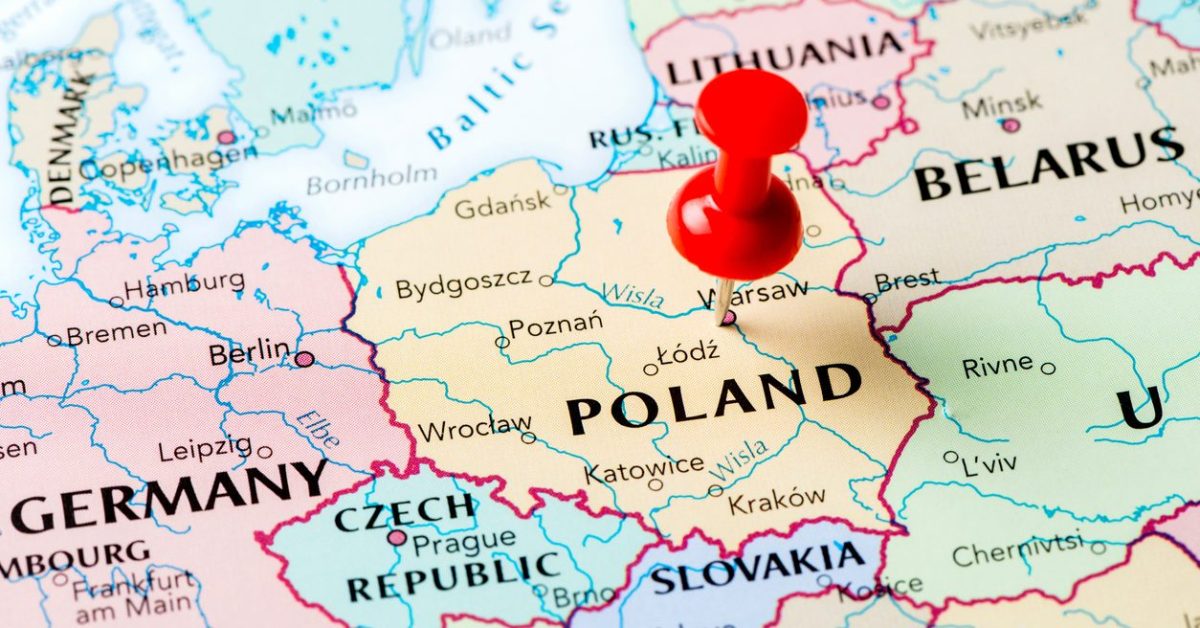
These factors were reinforced by the events and processes of more recent, nineteenth- and twentieth-century history, during which both the most vital interests and the most serious threats to the country’s fate were bound to its position in Eastern or East Central Europe, between Russia/USSR and Germany, rather than to the Baltic shores. Thus, Poles grew to define themselves in these geopolitical contexts, through the experiences of being the victim of aggression and oppression from their eastern and western neighbours, Second World War occupation, incorporation into the communist block during the Cold War, and in more positive terms – as part of the Visegrád Group, of NATO’s and EU’s eastward expansion. Poland’s identity revolves around an east-west axis, and on their mental maps Poles tend to situate themselves in this context.
This is not to say that there is no place for the Baltic Sea on these mental maps at all. The problematic German neighbourhood, for example, had in the nineteenth and especially twentieth century the dimension of competition for access to the Baltic Sea. A school of thought developed in this time identified neglecting this competition as a major factor that had contributed to the Commonwealth’s downfall. The independence gained in 1918 came with access to the Baltic Sea, though disappointingly limited, lacking major ports, and carved out of German territory. This being adamantly contested by Germany throughout the interwar period, the anti-German dimension of Poland’s stance on access to the Baltic Sea became even stronger. The main impulse for developing a maritime policy was the Polish-German customs war of 1925, which demonstrated vividly the importance of secure and free from foreign influence access to export markets through the maritime border.
However, this negative, anti-German dimension was not the only basis on which Poland’s connection to the Baltic Sea was built. Major investments on the Baltic shore, especially the construction of the port in Gdynia (started in 1923), were accompanied by intensive maritime propaganda aiming to incorporate the maritime component into thinking about the national policies, economy, culture and identity. It was also meant to integrate the seaside region, Pomerania, with the rest of the Polish state, as – due to historic reasons mentioned above – it was not generally perceived as part of its core in the public imagination. This propaganda was conducted by, for example, the Baltic Institute (a research institution established in 1926) with its numerous academic publications, the Maritime and River (since 1930 Colonial) League with its journals addressed to the general public, mass events like Holidays of the Sea, and excursions to the seaside, as well as conveyed in literature, film, visual arts, etc. Poles were supposed to think of access to the Baltic Sea, and the investments made on its shores as vital to the country. There was a psychological dimension too: maritimity was associated with modernisation, maritime culture with progress, innovation, entrepreneurship and patriotism. The maritime programme was thus a modernising programme for the country struggling with numerous economic, political and social issues.
This programme was not entirely realised, either in the interwar period or later, when Poland gained a much wider access to the sea, with three major ports in Gdańsk, Gdynia and Szczecin. Poles have remained a predominantly land nation with more interest in the eastern and western neighbourhoods than the maritime border. But, at the same time, the ways of thinking about the sea and the maritime constructed in the interwar period, for example the association with progress and openness, have taken root in the popular imagination. Poles have started to know and love the sea, while not abandoning the fertile fields. And in the current geopolitical situation, when the Baltic Sea has become both the space of new threats and increased cooperation within NATO after its recent expansion, it might move closer to the centre of Polish mental maps.
Marta Grzechnik
Assistant Professor
Institute of Scandinavian and Finnish Studies University of Gdańsk
Poland