
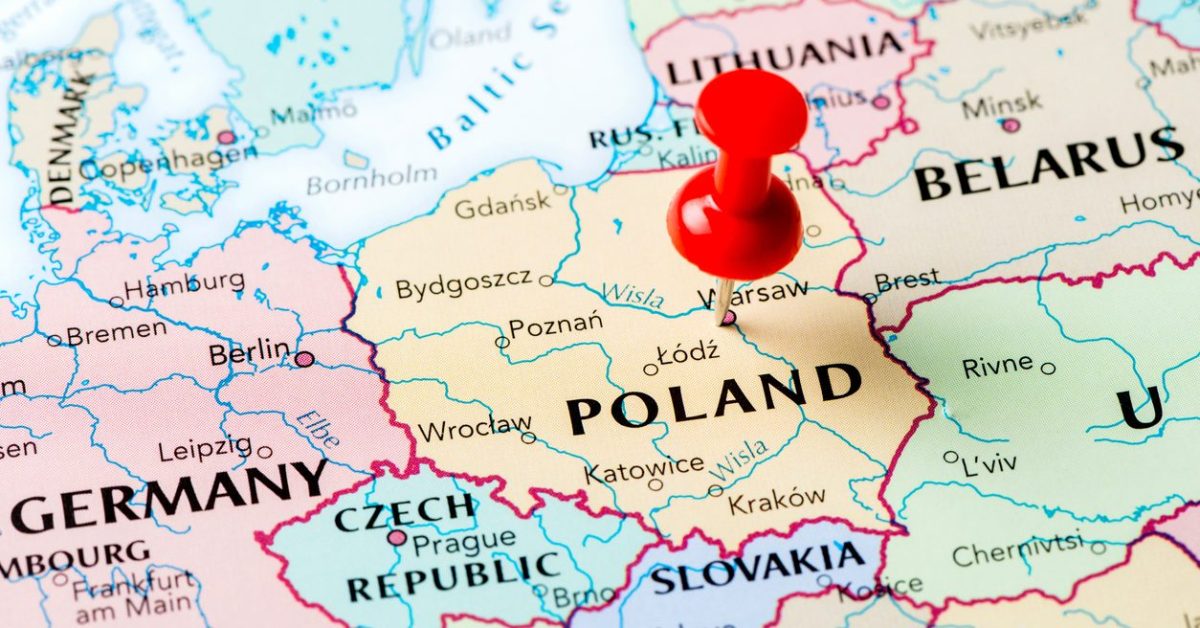
Poland enjoys around 530 kilometers of Baltic Sea coastline. The body of water is a source of economic security, in the form of commerce and trade, energy and electricity, facilitated through old and new investments in critical infrastructure, and industry, through shipyards and ports. But the Baltic Sea is also a source of security concern for Poland.
Russia’s war of aggression in Ukraine has had profound implications for Poland’s security role and its relationship to other countries in the Baltic Sea region. From worries of sabotage, like GPS jamming and vessel conflicts associated with the “dark” or “shadow” fleet, to the threats of open kinetic conflict, Poland must be ready, along with other NATO allies on the Baltic Sea, to meet Russian actions. The rise of unmanned aerial vehicles (UAVs)—drones—and underwater, drones, too, pose new threats and risks for Poland to handle in concert with European and NATO allies.
Poland understands that its security comes from partnerships as well as investment in its own defense. At the beginning of September 2025, the newly elected Polish President Karol Nawrocki was in Washington, D.C., to meet with Trump and lobby that US troop presence not be withdrawn; the trip appears to have been worthwhile. President Nawrocki also paid a visit to Finland in September 2025 to meet with President Alexander Stubb and discuss the countries’ common interests and the shared position on the eastern flank of NATO. Indeed, since 2023, Poland has been among the most visited countries by the Finnish parliamentary committees, ahead of Germany. Meanwhile, Polish Prime Minister Tusk was in Paris to meet with other leaders of the “coalition of the willing”—the group of European-NATO countries that are interested in providing security guarantees to Ukraine in lieu of the United States and stepping up Europe’s defense. While there are strong divisions between Nawrocki, of the Law and Justice Party (“Prawo i Sprawiedliwość”—PiS) and Tusk, head of the Civic Coalition (“Koalicja Obywatelska”—KO), the two personalities and political parties are united in the common cause of Poland’s security.
Indeed, Poland continues to be on track to be among NATO’s significant military powers. Since 2015, its military spending has increased dramatically. The preceding PO-led government set aside €33.6 billion for its 10-year military modernization plan. In 2022, then-President Andrzej Duda (PiS) aimed to increase Polish military spending to 3% of GDP by next year and double the number of troops in the Polish Armed Forces up to 300,000 soldiers. Poland managed to reach this goal and decided to aim even higher. In 2024, Poland had a new record, with defense spending accounting for around 4.1% of GDP. Such high spending put Poland in a good position vis-à-vis other NATO members during the recent NATO summit, when US President Trump suggested that members pay 5% of GDP.
Poland’s spending has for the most part gone towards major equipment purchases. The country has enhanced its efforts towards its military and defense modernization projects, including investments in new fighter aircraft and attack helicopters. The creation of the East Shield (“Tarcza Wschód”) has been a critical component, especially as the Baltic States have proposed their Baltic Defense Line, to form a long barrier along NATO’s eastern border with Russia and Belarus. In January, NATO announced the Baltic Sentry surveillance to prevent further sabotage, and in May, the countries agreed to an MOU for further surveillance and protection of undersea infrastructure. While these are steps in the right direction, Poland, as the other Baltic Sea NATO countries, need to continue to be one step ahead, and proactive, rather than reactive, to Russia’s ploys. Indeed, Russia could exploit gaps in Baltic Sea security cooperation if they go unaddressed.
Poland has taken on several initiatives to enhance its maritime readiness and regional cooperation in the Baltic Sea. In late 2024, Prime Minister Tusk proposed joint naval patrols with the Baltic and Nordic countries. That aim was to complement NATO’s air patrols by sharing surveillance, collaborating to monitor and secure maritime zones, responding to threats, and ensuring the security of critical infrastructure. In October 2024, a new naval headquarters, the Commander Task Force Baltic (CTF Baltic), was established in Rostock, Germany. CTF Baltic is currently headed by a German admiral, and it will have rotating staff positions, including Polish naval officers from the Maritime Operations Centre and a deputy commander position, held by Rear-Admiral Piotr Nieć. Poland is slated to take on command duties in 2028. Over the next years, Poland will work to establish POLMARFOR, in the Baltic Sea coastal city Gdynia, which will give support to the rotational command position. Though much of Poland’s military investments have been focused on land forces, its modernization initiative is working to rectify this. Through its Orka program, Poland is in the process of replacing its 1980s Kilo-class submarines with new diesel-electric submarines (SSKs) to improve security in the Baltic Sea; competing bids are from Hanwha (South Korea), Saab (Sweden), and Fincantieri (Italy). Its Ratownik vessel, a submarine rescue and support vessel, is scheduled for delivery in 2029. Finally, Poland is working to upgrade its existing naval vessels, such as Mine Countermeasures Vessels (MCMVs), through its Kormoran II-class. Still, the country comes up short on maritime forces and coastal artillery and could consider taking steps to rectify this.
Poland sees the Baltic Sea as a single operation theater, and there are many places it can cooperate with other Baltic Sea NATO countries to divide responsibilities. Yet such cooperation between allies on the Baltic Sea requires greater intentionality and practice—not just rhetoric—among partners. This is more pertinent than ever. In September 2025, Poland faced a significant escalation and probing from Russia after a significant incursion by UAVs. Poland made the decision to send up NATO aircraft and shoot the drones down. Russia’s overstepping of Polish and NATO lines is a steady way to erode deterrence. Though Russia claimed the drones had merely lost their way, one made it as far as Olesno, near Elbląg, only a short distance from the Gulf of Gdańsk. To respond to the threat, Poland relied on Polish, Dutch, German, Italian, and NATO assets. Such response through partnership underscores the importance of acting together to defend NATO territory. It is something that Poland must continue to emphasize in its approach to Baltic Sea security.
Cordelia Buchanan Ponczek
Research Fellow
Finnish Institute of International Affairs
Finland