
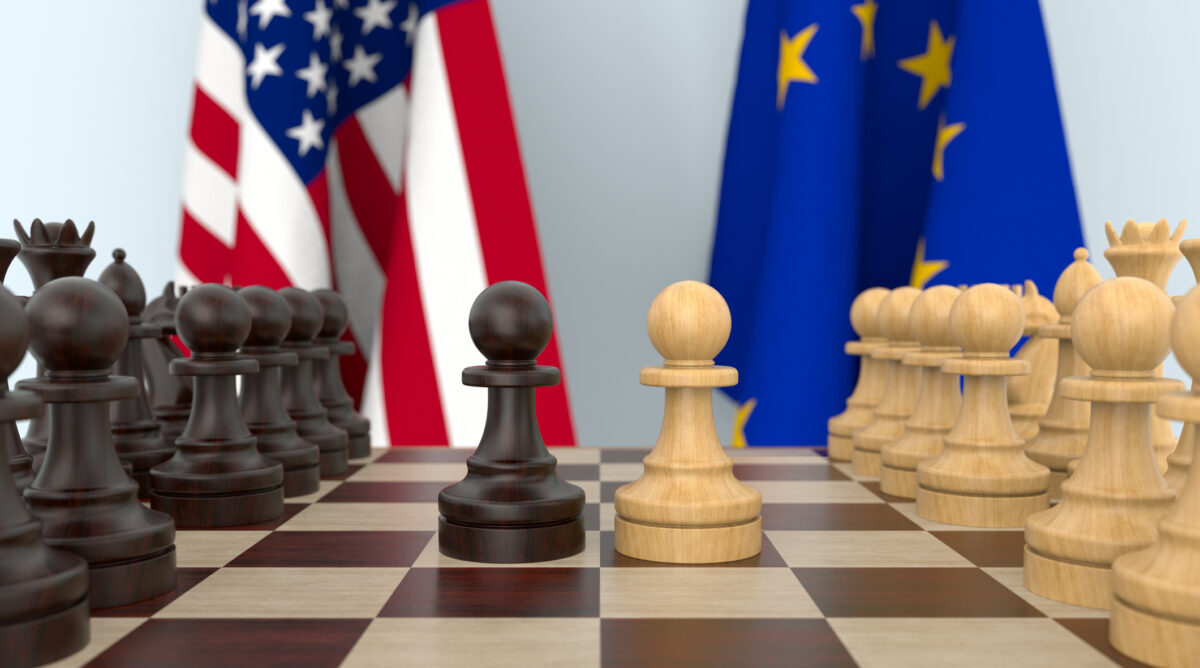
Europe faces many challenges; the most consequential is the future of its relationship with the United States. The stakes are high: the two economies are deeply intertwined, while Europe’s post-war history has been built around the transatlantic alliance and NATO.
There have been serious disagreements before. The Iraq war in 2003 divided Europeans and Americans, sometimes bitterly. Yet the disagreement did not destroy the alliance, nor did it spill over into economic relations. The post-war transatlantic relationship was a remarkable success. Successive American administrations encouraged European integration because the had an interest in a stronger Europe.
Inevitably, as the the EU developed, competition increased. Airbus and Boeing, agricultural exports, GMOs and regulatory standards generated repeated friction. But these were disputes between partners who shared a broader strategic framework.
This time is different. The second Trump administration is not simply pursuing different policies. It is challenging some of the assumptions on which the post-war Western order was built. It treats alliances more transactionally, puts unprecedented pressure on European allies, imposes tariffs on European exports and challenges values that Europeans consider fundamental.
It also no longer offers the same degree of certainty about the security relationship. Its approach to Russia’s war against Ukraine has created profound unease about the future of American engagement.
The messages coming from Washington are unsettling. Europeans are asked to pay substantially more for their own defence, while continuing to buy American. They must shoulder a larger share of support to Ukraine, while Washington seeks preferential access to Ukrainian resources. And they are expected to align with the United States on major geopolitical issues, including China, while receiving fewer security assurances in return.
This is not a fair bargain. It sounds like vassalage without a counterpart.
There are still Europeans who hope that, once Trump is gone, Washington will return to the familiar relationship. But European policy cannot be built on the assumption that the past will return.
The Turnberry agreement was a revealing example of the old reflex. The way it came about projected an image of a Europe accepting terms defined elsewhere.
The Europeans must define their own interests and defend them. This does not mean a rupture with America. It means emancipation.
”“The Europeans must define their own interests and defend them. This does not mean a rupture with America. It means emancipation.”
The world has changed. The period of overwhelming Western dominance that followed the collapse of the Soviet Union in 1991 is coming to an end. The international system is increasingly multipolar, marked by shifting alliances, power politics, weaker multilateral institutions and intense economic and technological competition.
In this world, Europe and the United States will no longer constitute a single political pole. Europe will have to act as a pole of its own, alongside partners such as Canada and other like-minded countries.
This is actually not a new concern. Charles de Gaulle repeatedly warned against European dependence on the United States. But he was not alone. In a speech on 2 October 1956, Konrad Adenauer made the same point. Europe, he argued, could not indefinitely expect to find its security through American patronage; nor could the United States reasonably be expected to carry the burden of European security forever.
Once the Soviet threat had disappeared, Europe could have progressively transformed its relationship with Washington, building a stronger EU-US partnership alongside NATO rather than continuing to rely overwhelmingly on American power. It did not. This was a wasted opportunity.
The concept Europe now needs is strategic autonomy. It means better resilience and the capacity to make decisions and act without excessive dependence on another power.
That requires a profound change of mindset.
Yes, Europeans will have to spend more on defence. But increased spending should lead to a stronger European defence industry and reduced dependencies. If there is to be a future for NATO, it requires a strong European pillar.
Yes, Europe must continue to support Ukraine. But Ukraine’s future should be anchored in the EU rather than becoming an object of external economic bargaining.
Yes, Europe must reassess its relations with China and seek a fairer economic relationship. But it must do so on its own terms, rather than being an auxiliary of the American strategy to preserve primacy.
Yes, Europe should continue to trade, invest, and cooperate with America. But if Washington uses tariffs, financial leverage or other forms of economic pressure against European interests, the EU must have the capacity and the will to respond forcefully.
This requires a hard-headed assessment of Europe’s strengths as well as its weaknesses.
Europe tends to underestimate the former and exaggerate the latter. The EU remains one of the world’s largest economic and trading powers. Its Single Market is an extraordinary achievement. Its regulatory influence is considerable. Its political model, based on free choice, mutual respect, democratic institutions and the rule of law, remains an important source of soft power.
But the weaknesses are real. The United States has outpaced Europe in economic growth and retains an exceptional capacity for innovation and value creation. The dollar’s dominance gives Washington enormous leverage. American technology companies dominate the digital economy. Europe has developed new energy dependencies, including on American LNG. In defence, its reliance on American capabilities remains substantial.
These dependencies will not be eliminated overnight. Nor should Europe try to eliminate every dependency. The objective is not independence; it is the ability to choose.
A Europe capable of defending itself, financing itself, innovating, producing critical technologies and acting politically is potentially America’s best long-term partner. There is a paradox at the heart of the current crisis: standing up to Washington may be the best way to preserve the transatlantic relationship.
Europe cannot cling to the illusion that the traditional relationship will somehow return. It should recognise that the world has changed and act accordingly. That means enhancing its autonomy and defend its own interests and values. Europe needs a relationship with America in which both sides freely choose each other.
Jim Cloos
Senior Associate Fellow
The Royal Institute of Egmont
Brussels
Belgium
