
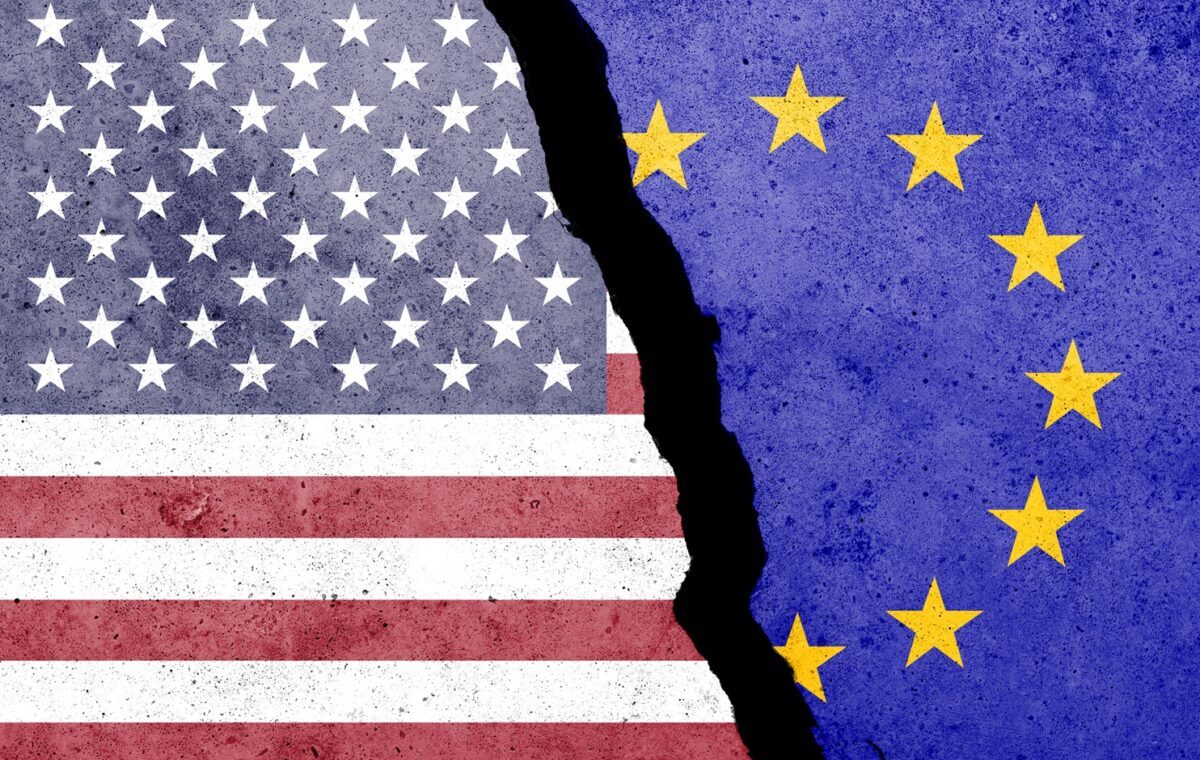
EU-US economic relations are a cornerstone of the global economy and at a time of heightened global volatility, our economic relationship with the United States is as important as ever to drive innovation and prosperity on both sides of the Atlantic. Despite recent turbulences, transatlantic trade is robust, and over the years our economic relationship with the US has been growing consistently. It supports millions of jobs in the United States and in Europe through investments, trade, and cutting edge innovation.
In fact, transatlantic trade and investment relationship is the most important and most integrated one in the world, representing almost 30% of global trade in goods and services and 43% of global GDP. EU-US trade in goods and services reached an impressive €1.7 trillion in 2025. That means €4.6 billion worth of goods and services cross the Atlantic between the EU and the US every day. At the same time, according to 2024 data, EU and US firms have €4.8 trillion worth of investment in each other’s markets. Therefore, it is very clear that any deterioration in the economic relationship between the EU and the US will have very significant negative effects on both sides, undercutting growth, jobs, productivity and joint efforts to tackle common challenges.
It is of course undeniable that US trade policy, has shifted significantly since the start of the second Trump administration. A series of tariff measures have since been announced and enacted, and continue to emerge, ranging from initial reciprocal tariffs under IIEPA, which have since been struck down by the US Supreme Court earlier this year, to Section 232 measures on grounds of national security, to Section 301, and the list goes on. What the tariff threats and enacted tariff measures all have in common is additional costs, increased administrative and compliance burdens for businesses, and uncertainty in the trading relationship with our most important economic partner.
”“Without the necessary investment, Europe cannot become more competitive, deliver sustainable growth, or the needed jobs.”
This comes at a time when rules-based trade has been eroding globally, putting internationally active businesses at risk. European chambers recent chief economist group’s report on the damaging effects of trade policy uncertainty clearly goes to show the significant negative impact on business investment in Europe, with export-oriented countries feeling the brunt of the effects. Moreover, given that the impact builds over time, the full consequences of this uncertainty are still unfolding. At the same time, without the necessary investment, Europe cannot become more competitive, deliver sustainable growth, or the needed jobs.
In this sense, the EU-US Turnberry agreement from July of last year achieved some needed degree of certainty at a time when we saw great volatility in transatlantic relations, but it didn’t restore full predictability. The capped asymmetrical tariffs are significantly higher than US average tariffs were before the Trump II administration took office, implying extra costs for consumers and businesses in already challenging economic times. But the alternative, a tariff escalation with the US, would have been considerably worse. The EU-US joint statement following Trunberry outlines a series of very useful future elements for transatlantic collaboration, including on important shared topics for European and American businesses, such as access to critical raw materials. With Turnberry implementation well on its way, it is now essential that a constructive momentum between the EU and the US is upheld in the coming months to keep stabilizing transatlantic economic relations and find solutions to some of the remaining challenges.
As business, we keep underscoring the strategic importance to both sides of EU-US economic relations, and the need for continued business to business partnerships, something which is only growing in importance in sustaining and strengthening mutually beneficial and overall balanced commercial relations between Europe and the United States, at a time when political relations are getting more challenging.
For our international economic and trade relations overall this also means that European businesses need stability, and increased resilience through diversification. Every trade agreement – of which Europe has established more than 40 with more than 80 trade partners to date – is a step towards new markets, diversified supply chains, reduced dependencies, and predictability, due to fair rules based trade. The EU-India trade agreement for instance, once ratified, has the potential to open a 1.4 billion consumer market to European businesses, with EU exports to the subcontinent expected to double by 2032 according to studies by European Commission. The highly important EU-Mercosur agreement has been provisionally applied for a few months now, and is finally bringing two of world’s growth centres closer together after more than 20 years of negotiations. The EU-Indonesia, the upgraded EU-Mexico or the EU-Australia agreements have also been concluded and are awaiting ratification. All this goes to show that Europe remains a viable global player. Delivering on trade agreements and effective and pragmatic partnerships with third country partners, must remain a fundamental pillar of EU foreign economic policy, contributing to the global competitiveness of our companies. It also signals that Europe is not sitting on the sidelines while other global players seek to extend their influence.
And after all, continuing to strengthen Europe’s own competitiveness, innovation and productive capacity remains our best answer to face global headwinds and heightened uncertainty.
Dominic Alexander Boucsein
Head of International Trade and Economic Security
Eurochambres – the Association of European Chambers of Commerce and Industry
Brussels
Belgium
