
According to international economic theory, trade is the basis for economic cooperation and integration based on mutual understanding and trust, and the certainty of compliance with international trade rules makes it possible to build stable economic and political partnerships. Twenty one years after Poland’s accession to the EU, it is worth verifying this theory in Poland’s international trade development, in particular within the European Union (EU). The process of Poland’s integration into European structures began much earlier, and dates back at least to the entry into force of the trade provisions of the Europe Agreement in the early 1990s. Thanks to the removal of traditional barriers to mutual access to both markets – the Polish market and the then-created European Single Market (ESM) – a free trade area for industrial goods was established before Poland’s formal accession to the EU, and a partial and selective liberalisation of trade in agri-food products took place. However, it was not until Poland joined the EU market that the development of trade and deeper economic integration with European structures became a key factor.
From the moment it joined the EU, Poland had strong trade relations with the other Member States – in 2004, their share in Poland’s total exports was 75.2% and in imports 72%, while for the EU it was 61.5% each. After a period of decline in 2012-2013, the concentration of Polish sales on the EU market returned to the level of 20 years before in 2023, although in the case of imports it reached a slightly lower level – around 68%. Taking into account that the average share of intra-EU trade remained at just over 60%, this means that the level of Poland’s integration into the EU through trade in goods has definitely increased (the decline in the importance of EU imports in Poland’s trade was mainly due to two reasons: exchange rate fluctuations and changes in the position of the main non-EU partners – China and the US).
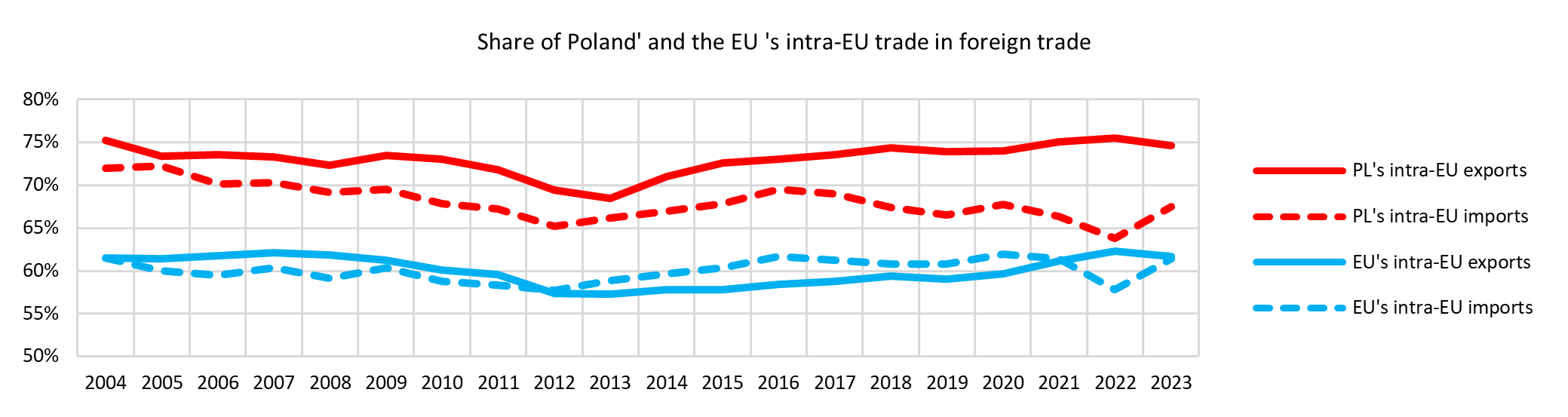 Within the EU, Germany, the Czech Republic, France, Italy and the Netherlands remained the main recipients of Polish goods, although the order changed. The same was true for imports, although in this case Belgium replaced France. This means that Poland’s intra-EU trade was concentrated not only with partners from the region, but mainly with the largest European economies.
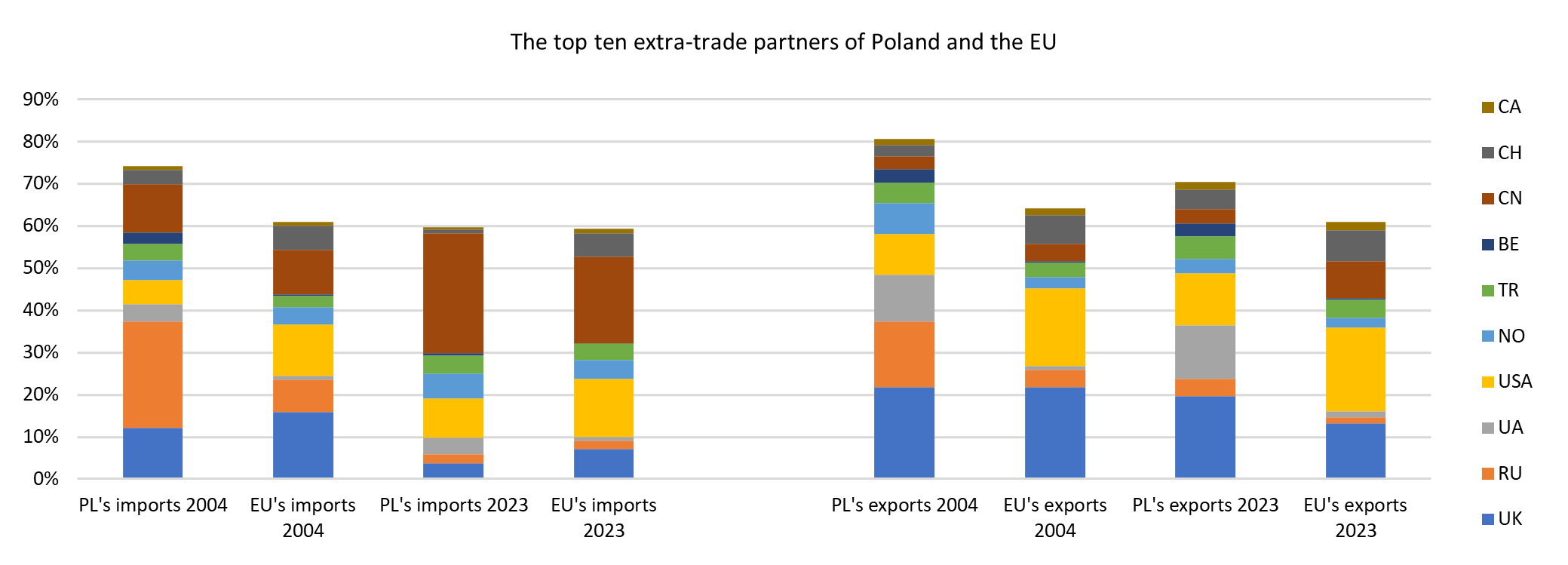
As for trade with non-EU countries, when Poland joined the EU 21 years ago, the main recipients were the United Kingdom (then still within the Union), Russia, Ukraine, the United States and Norway. However, the list changed dramatically: the importance of Russia and Norway decreased in favour of Turkey and Switzerland in 2023. The geographical structure of Poland’s extra-EU imports was slightly different: in the year of accession, Russia, the United Kingdom, China, the United States and Norway were the main suppliers. In recent years, in line with the global trend, China has clearly dominated Poland’s imports, the US has a significant position and, due to the energy embargo, Russia’s place has been taken by Norway, followed by Turkey and Ukraine. The above list, with slight differences in the positions of Switzerland and Ukraine, is consistent with the geographical structure of extra-EU trade, indicating Poland’s effective integration into the system of contractual trade agreements concluded by the EU with third countries.
 As regards the product structure of Polish exports to both the EU and non-EU markets, there was an increase in the share of food products at the expense of manufactured goods. In the case of the former, however, it is worth noting the significant increase in the share of processed food at the expense of primary agricultural products, which indicates the development of this industry in Poland. The same is true for industrial products – there was a significant increase in the share of exports (including sales to the EU market) of more advanced products, including advanced components for finished goods (automotive parts, electrical machinery and precision instruments), offered by larger EU countries (Germany, France and Italy), as well as the United Kingdom and Switzerland.
From the Polish point of view, the trade balance with the rest of the EU was positive in the first year after accession and continued to improve. This is an indication of the successful integration of the Polish economy into the European single market due to its relatively high competitiveness, not only in terms of price, which was important immediately after accession, but now also in terms of quality and technology. In addition, the surplus in intra-EU trade covered the deficit in trade with non-EU countries, which was mainly generated by imports from China and, in 2022, increased imports of energy raw materials from around the world.
The above statistics on Poland’s trade within the European Single Market and with non-EU countries allow us to formulate a number of key conclusions from the point of view of Poland’s integration into the EU:
- First, the example of Poland clearly shows that the optimal solution a successful integration process is the development of mutual trade. The gradual liberalisation of trade between Poland and the European Communities even before accession to the EU and the subsequent full integration into the mechanisms of the European Single Market ensured a significant increase in trade and, consequently, the intensification of increasingly advanced economic relations. This was evident in both the agri-food and industrial sectors.
- Secondly, the presence in such an advanced project as the European Single Market makes it possible to offset the potential negative effects of restricted access to third-country markets (embargoes in Russia, war in Ukraine, US trade wars). In the case of trade barriers, trade relocation traditionally leads to an increase in the importance of trade with partners within the integration grouping, making sales and supply of products (components and finished goods) more secure.
Adam A. Ambroziak
Associate Professor
Head of Department of European Integration and Legal Studies SGH Warsaw School of Economics
Poland
Adam.A.Ambroziak@sgh.waw.pl