
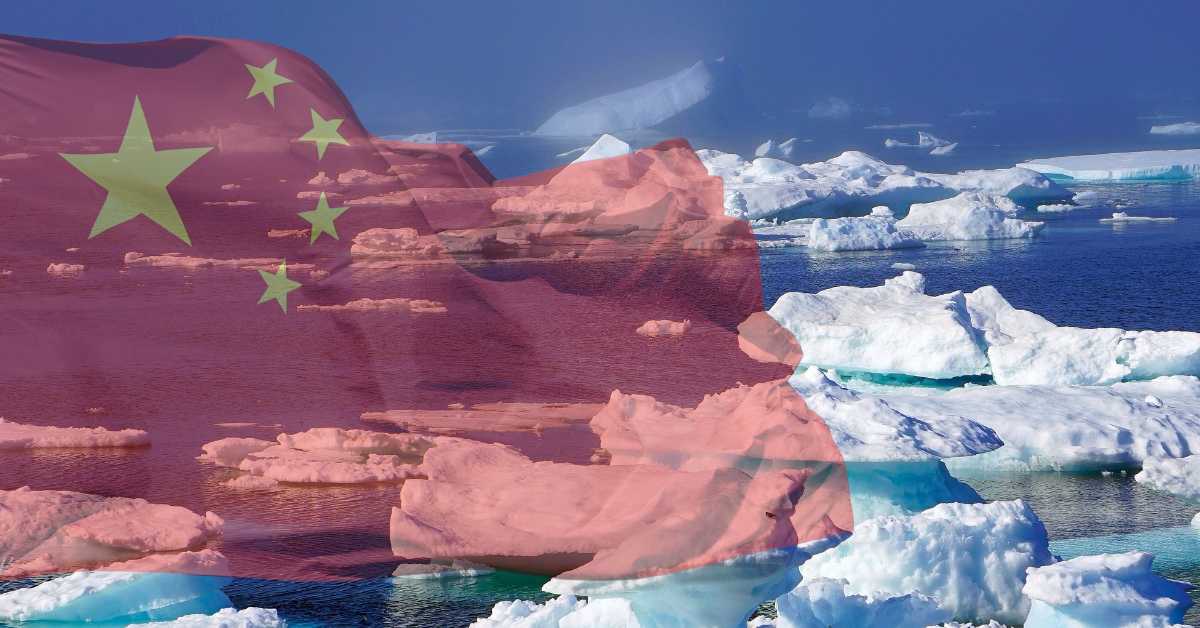
Over the past decade, the Arctic has emerged as a growing dimension of China’s international affairs. This development reflects two broader trends in global politics. First, the warming of the Arctic, defined here as the land and maritime areas located above the Arctic Circle at approximately 66°33′ north latitude, have created perceptions that the region is becoming more accessible, including for the exploitation of natural resources and the use of shorter maritime routes. Second, the international system has witnessed the rise of the People’s Republic of China (PRC) as a major global power driven by its extraordinary accumulation of wealth. The Chinese Communist Party, which governs the PRC, has used this economic strength to expand China’s influence well beyond its neighborhood, including into the Arctic, while also signaling its ambition to transform the country into a Polar Great Power. These aspirations were articulated in 2018 when the PRC released its official Arctic White Paper. In this document, China describes itself as a near Arctic state and an important stakeholder in Arctic affairs, while outlining four policy objectives: understanding the Arctic, protecting the Arctic, developing the Arctic, and participating in Arctic governance.
The PRC began its Arctic scientific engagement in the mid-1990s by joining the International Arctic Science Committee and launching its first official Arctic scientific expedition in 1999. Today, China operates two research stations in the region, one on Svalbard (Norway) and another in Iceland. Beijing also operates five research vessels with icebreaking capabilities, reflecting its long-term commitment to Arctic exploration. As of May 2026, Chinese scientists have completed 15 Arctic expeditions. These missions focus on disciplines such as climate studies, oceanography, marine biology, and sea ice formation. Recently, China has enhanced its capabilities with technologies including domestically constructed manned and unmanned underwater vehicles, low-orbit satellites, buoys and meteorological stations enabling more precise data collection. The goal is to build an integrated Arctic multi-dimensional scientific observation and monitoring network.
The PRC’s engagement with the Arctic has implications for several dimensions of its national security. For example, as a country vulnerable to the effects of global environmental change, understanding developments in the Arctic and their impact on the Chinese mainland carries important consequences for China’s ecological security. In addition, given the resource potential of the Arctic region, some in the PRC view the Arctic as a potential future resource supply base for China that could strengthen the PRC’s economic security. Chinese state-owned enterprises have already invested in LNG projects in the Russian Arctic and shown interest in the mineral potential of Greenland. Similarly, Arctic shipping routes are viewed positively as possible shortcuts between China and the markets in Western Europe, contributing to the development of the Polar Silk Road.
At the same time, through Arctic scientific and economic engagement, the PRC gains valuable knowledge in developing advanced technologies. The Arctic serves as a site for testing technologies under extreme conditions, including various types of underwater vehicles. This has important implications for China’s technological security as the country pursues greater technological self-reliance. It is also important to note that given the Arctic’s unique environmental features, the data collected during Chinese Arctic scientific expeditions have dual use applications and can potentially be utilized by the PRC government for defense purposes. This should not be surprising considering the military-civil fusion strategy currently being implemented in China.
According to the PRC’s Arctic White Paper, the Arctic region is seen as a global space in which extra-regional states have certain rights and privileges under international law such as navigation and scientific research. Chinese officials have previously stated that China will not overstep its role as a non-Arctic state in the region, yet, at the same time they have indicated that China will not be absent from regional affairs. In its bilateral relations with Arctic states, Russia emerged as China’s principal Arctic partner. The two countries regularly discuss Arctic cooperation during high level meetings. China has invested in Russian Arctic LNG projects while Russia is now more open to Chinese involvement in the development of the Northern Sea Route. In 2024, the Chinese Coast Guard conducted joint patrols with the Russian Coast Guard in waters above the Arctic Circle in the Russian Far East. By contrast, the PRC’s relations with the US are affected by the unfolding great power competition between the two nations. China sees the American return to the Arctic as a reflection of Washington’s Cold War mentality to suppress China.
For a long time, the Nordic states largely perceived the PRC as a partner in areas such as scientific research, maritime safety, data sharing, and technological cooperation. In recent years, however, perceptions of China in the Nordic region have shifted considerably due to tightening political control in China, Beijing’s assertive diplomacy, geopolitical competition with the US, and the expansion of Sino-Russian relations following Moscow’s full-scale invasion of Ukraine. As a result, China is now increasingly viewed as an intelligence threat which is negatively impacting Chinese Arctic scientific and commercial activities. Several proposed projects in the Nordic region have consequently been suspended or cancelled. For example, in 2024, reports emerged that several Chinese companies were interested in investing in the northern Norwegian port of Kirkenes. Ultimately, the Norwegian government intervened and blocked potential Chinese investment in the port. Going forward, it appears unlikely that we will see large scale Chinese investments in Arctic infrastructure or critical minerals in the Nordic region as cooperation with China will be restricted to areas related to environmental governance.
Martin Kossa
Associate Professor
Nord University
Norway
martin.kossa@nord.no
Back to Table of Contents