
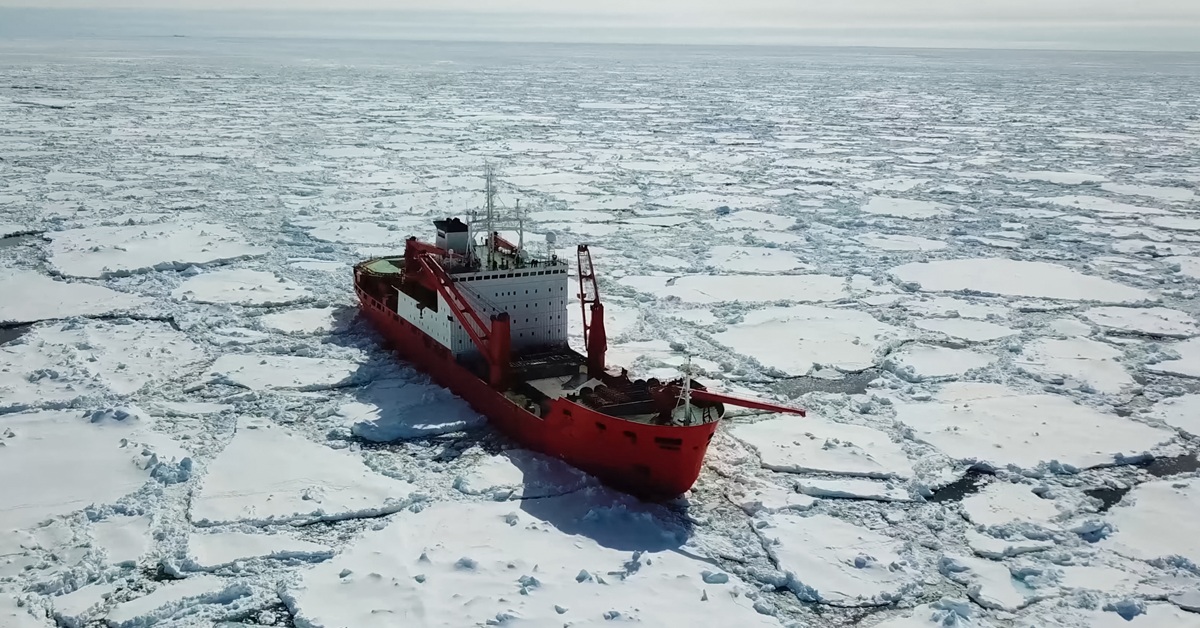
In the early 1990s, China was in urgent need of an icebreaker to facilitate its scientific research operations in the polar regions. Considering that building such a vessel on its own was both time-consuming and costly, in 1993 China decided to acquire an icebreaking cargo and supply ship from the Kherson Shipyard in Ukraine, which was originally designed for the Russian Arctic, and convert it into the country’s first icebreaking research support ship, named Xue Long (Snow Dragon). After major modifications, Xue Long was the primary vessel for China’s polar research and expedition logistics support until 2019, equipped with an icebreaking capability of up to 1.1 metres, as well as advanced systems for navigation and weather observation, a data processing centre, and seven laboratories. In the summers between 1999 and 2019, Xue Long conducted ten expeditions to the Arctic region, navigated all three major Arctic sea routes (the Northeast Passage, the Transpolar Sea Route, and the Northwest Passage), and carried out comprehensive research on the Arctic sea ice, the atmosphere, marine ecosystems, and seafloor topography. The acquisition of Xue Long not only provided China with immediate, large-scale polar operational capabilities, but also served as a technical blueprint for its subsequent domestic icebreaker construction, transforming the country from a limited presence to a significant power in the Arctic.
Following the acquisition of the Ukrainian icebreaker, China proceeded in 2016 with the construction of its first domestically built icebreaker, Xue Long 2, with design support from Aker Arctic, a world-leading icebreaker design firm based in Finland. The special features of Xue Long 2 include a moon pool in the hull designed for deploying delicate research equipment in ice-covered waters. Additionally, Aker Arctic endowed the vessel with a distinctive capability to break ice up to 1.5 metres thick at speeds of two to three knots in both ahead and astern directions. This capability enables Xue Long 2 to not only operate over a broader area for scientific research, but also overcome seasonal constraints and conduct polar expeditions outside the summer months, leading Aker Arctic to describe the ship as “the world’s most advanced polar research vessel” at the time. Since its commissioning in 2019, Xue Long 2 has sailed through the Arctic Ocean five times by 2025, accomplishing a landmark achievement in 2023 when it reached the North Pole as the first Chinese vessel to do so under its own power.
As China further enlarged its fleet of icebreakers with new vessels, such as Zhong Shan Da Xue Ji Di (acquired from Russia in 2018), Ji Di, and Tan Suo-3 (both domestically built in 2024), its Arctic research activities have increasingly evolved into a multi-vessel system with specialised divisions of labour among different ships. For example, in September 2025, China accomplished the largest Arctic scientific expedition in its history with the joint participation of four vessels. Among them, Xue Long 2 served as the icebreaking escort vessel and carried out collaborative three-dimensional observations of the Arctic atmosphere, sea ice, and ocean with Ji Di.
In addition to conducting regular marine scientific expeditions in the Arctic, China has also established a comprehensive Arctic satellite monitoring network since 2019. This system enables all-weather, multi-dimensional observation of critical Arctic parameters regardless of polar night or cloud cover. It primarily monitors sea ice dynamics, such as thickness, concentration, and sea ice deformation, and also provides real-time navigation support by tracking ice-lead systems and icebergs along the Northern Sea Route.
Moreover, China has sought to establish a digital corridor across the Arctic that would significantly reduce data latency between Asia and Europe, and has therefore provided technical support and investment for Arctic fibre-optic cable projects, including Arctic Connect with Finland and Russia. As it was suspended following Russia’s invasion of Ukraine in 2022, China pivoted its expertise in manufacturing resilient armoured cables for extreme high-latitude conditions to Russia’s Polar Express initiative, which aims to construct a high-speed fibre-optic cable system along the Northern Sea Route linking Murmansk and Vladivostok.
As a result, the past three decades of China’s Arctic engagement feature comprehensive technological and infrastructural developments spanning the Arctic Ocean, space, and subsea domains. This integrated capacity has strengthened its role in Arctic scientific research, shipping route accessibility, and emerging areas of digital and communications infrastructure. Despite not being a geographically Arctic state, China has still established itself as an influential participant in both scientific and strategic dimensions of Arctic affairs.
Weiqing Wang
Doctoral Researcher
Centre for East Asian Studies, University of Turku
Finland
weiwan@utu.fi