
Introduction
Transatlantic collaboration on climate action has reached its lowest point during Donald Trump’s second presidential term. This development is embedded within a broader populist orientation in the White House and a conciliatory approach towards the Kremlin, while simultaneously distancing the United States from the EU and other liberal democracies. Together with unilateral actions against Venezuela and Iran, as well as territorial ambitions concerning Greenland and Canada, the Trump administration is actively contributing to the dismantling of the post-Cold War international order, including efforts to combat climate change.
While the EU has also experienced a backlash against aspects of the green agenda since the European elections, it remains committed to liberal democratic order, multilateralism and the Paris Agreement. However, the new geopolitical and transatlantic realities call for a prudent approach from EU policymakers to safeguard the Union’s interests while avoiding extreme responses that could undermine climate action.
State of play
The United States has formally withdrawn from the Paris Agreement and declared its intention to leave the United Nations Framework Convention on Climate Change (UNFCCC), the Intergovernmental Panel on Climate Change (IPCC), and the Green Climate Fund (GCF). Domestically, the Trump administration has dismantled emissions standards, encouraged fossil fuel extraction, and weakened incentives under the Inflation Reduction Act for the deployment of clean technologies.
In transatlantic relations, climate policy is either absent from the agenda or viewed negatively by the Trump administration. The United States is exerting pressure on the EU to purchase American liquefied natural gas (LNG), relax its rules on AI governance and competition policy, and establish a common price floor for critical raw materials to counter China’s dominance in this area. While the EU remains open in principle to transatlantic cooperation, its cautious stance towards the White House is largely a reaction to Trump’s policies rather than a manifestation of genuine anti-American sentiment.
Nonetheless, the anti-climate stance across the Atlantic is absolute only at the federal level. Strong climate commitments continue to exist in many US states and cities, providing some grounds for optimism regarding the continuation of transatlantic climate cooperation.
The global geopolitical context
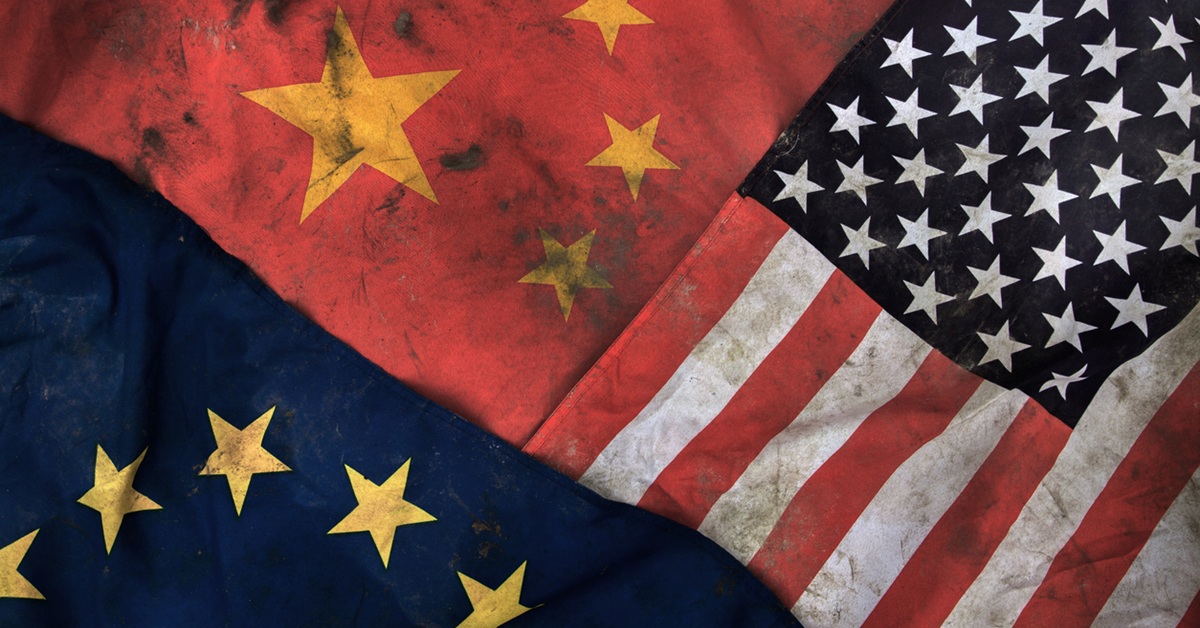
The United States and the EU find themselves operating in an increasingly geopolitical and geoeconomic world, characterised by growing security and competitiveness pressures. Russia has demonstrated its belligerence through its invasion of Ukraine. China continues actively to support its industrial expansion, including its leadership in clean technologies such as solar power, electric vehicles and battery manufacturing, while maintaining its one-party political system.
In this context, the United States has chosen to move away from multilateralism, deprioritise the clean transition, and rely on tariffs and other protectionist measures to counter China’s economic rise. In doing so, it has contributed to consolidating an emerging global order characterised by relative gains, unilateralism, transactionalism and power politics.
While the EU is also becoming more assertive in safeguarding its economic security, it remains committed to its 2030 and 2050 climate targets while introducing a new 2040 target during the current institutional cycle. The Carbon Border Adjustment Mechanism (CBAM) seeks to address the absence of a global level playing field in carbon pricing. The Industrial Accelerator Act envisages ‘Made in Europe’ provisions aimed at protecting European industry from unfair competition, particularly from China, although these provisions could also apply to third countries that maintain close partnerships with the EU.
The EU is therefore adapting to new geopolitical realities while maintaining stronger commitments to international rules and climate action than the United States.
”"The EU is therefore adapting to new geopolitical realities while maintaining stronger commitments to international rules and climate action than the United States."
The Effect of Trump’s policies on the EU’s climate commitments
The EU’s dependence on imported and expensive fossil fuels continues to provide a strong incentive for decarbonisation and electrification through renewable energy and nuclear power. In the absence of US support however, it becomes more difficult for the EU to maintain ambitious climate policies, both domestically and internationally, particularly when these policies impose additional costs on industry and households.
At the same time, current transatlantic dynamics may create opportunities for the European clean technology sector. As the US turns away from climate leadership, previous concerns about the competitive impact of subsidies for the American green economy under the Inflation Reduction Act have become less pressing. This creates an opportunity for the EU to reassert its leadership in clean technologies. Such prospects become even more important given catastrophic effects of climate change, and when considering the alternative scenario in which China capitalises on the US retreat and further strengthens its dominant position in global clean technology markets.
Stefan Šipka
Head of Sustainable Prosperity for Europe programme
European Policy Centre
Belgium
s.sipka@epc.eu
