
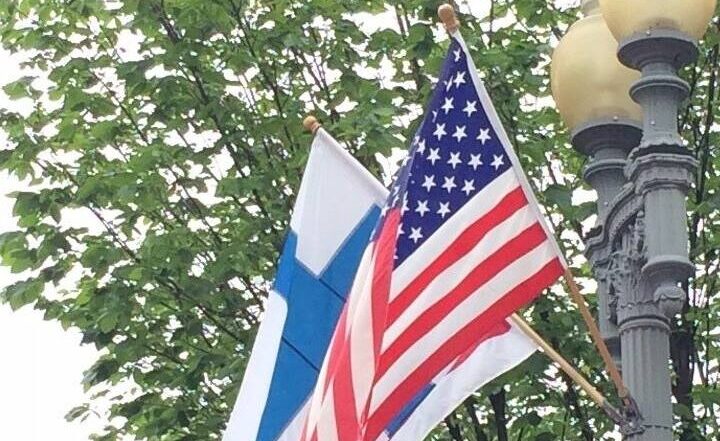
The League of Finnish American Societies (SAM) was founded in 1943 when Finland’s independence and democracy were in peril. Following the German defeat at the Battle of Stalingrad in early 1943, Finland’s leadership quietly probed for peace negotiations with the Soviet Union and Western Allied Forces.
During this time of diplomatic pressure citizens acted to preserve and strengthen ties between Finland and the United States. Prominent individuals including minister and newspaper publisher Eljas Erkko, architect Alvar Aalto and bank director Juho Hämäläinen established “Suomalais-Amerikkalainen yhdistys” which later became modern SAM.
Dr Ensi Hiitonen declared at the inaugural meeting of SAM on July 1, 1943, while war was still raging in Europe:
“The Government and Parliament have repeatedly emphasized the importance of maintaining good relations with America, which had resonated across wide circles of citizens. In order to give this idea a suitable form of expression, it had been considered necessary to establish an association whose task would be to bring the two peoples closer to each other through appropriate means.”
Henrik Ramsay was appointed as the new Foreign Minister of Finland in March 1943. Ramsay emphasized the importance of keeping strong ties with the United States, paving the way for SAM to be formally established. Over 10 000 Finns joined SAM during the first four years.
“Our understanding is that the future world must be built on the foundation of international cooperation among free nations, rather than on power politics,” wrote Juho Hämäläinen in the member magazine in 1947, as if addressing our generation as well.
Following the end of the Second World War, SAM applied for state funding to provide scholarships for Finnish students heading to Wittenberg College in Ohio. Today SAM Scholarship Foundation administers prominent third-party scholarship applications from organizations such as Saara and Björn Wahlroos Foundation, The American-Scandinavian Foundation (ASF), and Thanks to Scandinavia.
Friendship between Finland and the United States must be built on understanding, not on conformity. Finnish foreign policy is now aligned with this thought. Europe and Finland need to acknowledge that the United States is changing and that the current U.S. administration is based on ideology that “contradicts with our own values”, Finland’s president Alexander Stubb said in his speech to members of parliament at the State Opening of Parliament on February 4, 2026.
”“Friendship between Finland and the United States must be built on understanding, not on conformity.”
President Alexander Stubb continued this idea in his speech to Annual Meeting of Heads of Mission in Helsinki on August 25, 2026:
“Every US administration ever since President Truman has called for a more equitable sharing of the burden. The second Trump administration is doing this on turbo speed. The conclusion for Europe is clear: we must assume more responsibility for our own security and defense.”
Before Nato membership in 2022, the defense budget of Finland was around 4 billion euros, whereas in 2026, Nato-defined defense spending has already risen to 7.7 billion euros. Finland has taken on greater responsibility for its defense but that doesn’t mean that our bilateral relationship with the United States would be any less important. Finland is one of the key allies for the United States in Northern Europe and the Arctic.
“Finland understands territorial defense, resilience, and preparedness at a level that few countries do. As our Nato ally, Finland’s membership brings extraordinary seriousness, capability and credibility to the Alliance,” Howard W. Brodie, United States Ambassador to Finland points out in an interview by SAM Magazine on June 6, 2026.
The friendship SAM is working for is, above all, friendship between the peoples of Finland and the United States. It would be a grave mistake to underestimate the value of people-to-people relations as the bedrock of our bond with the United States. Former President Herbert Hoover led American civil society to strongly support Finland during Winter War, raising millions of dollars for civilian relief.
A contemporary example is the partnership between the Virginia National Guard and the Finnish Defense Forces. Finland took part in Nato-led peacekeeping operation in Bosnia-Herzegovina in 2001–2002, where Finns and Americans served side by side, got to know each other, and laid the foundation for a partnership formalized after Finland joined Nato.
History doesn’t simply repeat itself, but I believe we can count on the core decency of the American people. Strengthening dialogue with American civil society is in our national interest, complementing the strong ties between our governments. “Governments and political trends come and go, but meaningful encounters between people build cooperation and friendships from generation to generation,” as Ambassador Brodie has said.
Simon Elo
Chairman of the Board
The League of Finnish American Societies (SAM)
Finland
simon@simonelo.fi
