
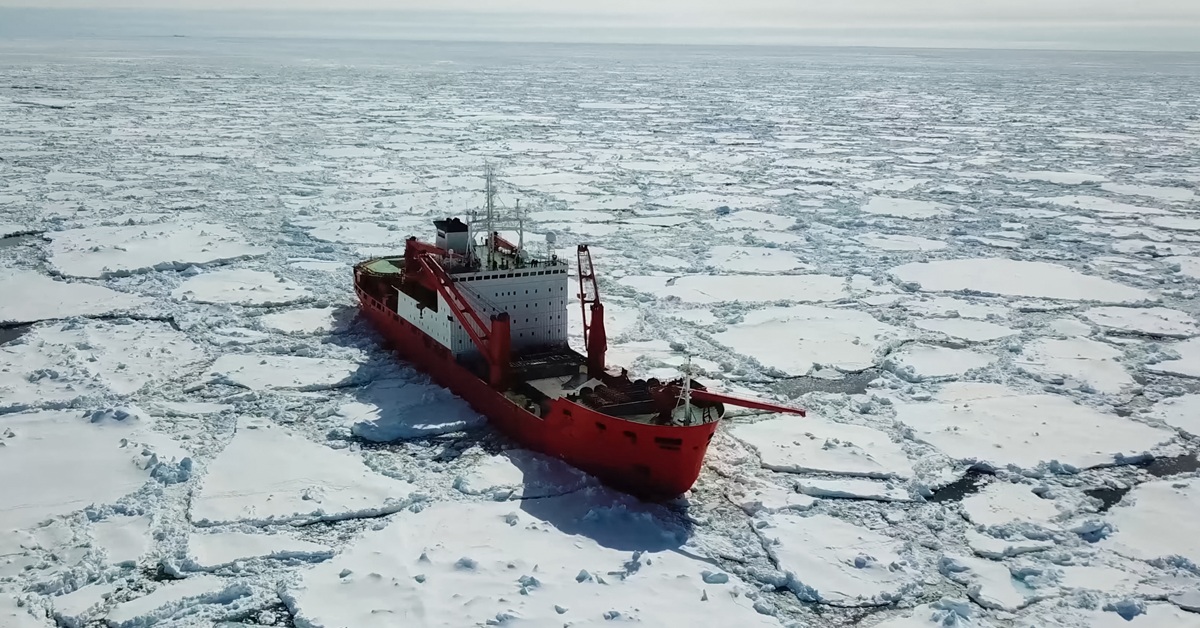
China in the Arctic is arguably one of the stories in international politics with the largest discrepancy between the narrative and the reality of a rising power’s influence in a region. For almost two decades now, international media, observers and various government reports have continuously portrayed China as a major player in Arctic affairs. While some have predicted that China’s entry into the Arctic will lead to a shipping bonanza along the Northern Sea Route through the Arctic Ocean, others have voiced their concerns about how a growing Chinese footprint creates instability, great power rivalry, and a scramble for resources in the region. The reality, however, is that China has a peripheral role in the Arctic.
China is a player in the Arctic. It is a signatory state to the 1920 Svalbard Treaty, it runs a research station at Svalbard, it is an observing member of the Arctic Council, it issued an official Arctic strategy in 2018, and its research vessels sail the Arctic Ocean on a regular basis. Nonetheless, compared to the five Arctic littorals, Russia, the United States, Canada, Denmark and Norway, China remains a minor player. China’s investments in the region are rather modest, the number of Chinese ships sailing the Northern Sea Route through the Arctic Ocean is still very small, and its military footprint in the region is almost non-existent.
The main reason for China’s limited influence in the Arctic is geopolitics. China is a superpower and a rival to the United States at the global stage, but its influence and the nature of its rivalry with the US nevertheless varies from one region to another, depending on the power structure and geography in each region. The failure to understand how geopolitics shape power dynamics in various geographic regions is probably a major reason why many tend to exaggerate China’s influence in the Arctic.
Geopolitics inform China’s role in the Arctic in a number of ways
First, the Arctic is in the geographic periphery of the US-China rivalry. It is important, however, to distinguish between the American Arctic and the European Arctic. The former, with Alaska, the Russian Far East and the Bering Strait at its core, is closer to China, and the large US military presence in Alaska makes it an important flank in the main theatre of the US-China rivalry in the Western Pacific. This is why China on numerous occasions in recent years has deployed naval vessels close to US territorial waters off Alaska, and together with Russia, China staged a joint bomber exercise near Alaska in 2024.
Second, since China is not an Arctic nation, it depends on close cooperation with one or more Arctic states to establish a presence in the European Arctic. Yet, with seven of the eight Arctic countries being members of NATO, China is largely dependent on Russia as its door-opener to the Arctic. China has made investments in all Arctic nations, but due to the US-China rivalry and NATO putting China on its agenda a few years back, there is now a deeper skepticism towards Chinese investments and technologies among the Arctic NATO members, and particularly with regard to dual-use technologies and investments in resources and critical infrastructure.
Third, the Northern Sea Route has less commercial value as China’s transportation link to Europe than often asserted. The shortest way to Europe from China’s main shipping ports in the southern part of the country is to sail the old route through the Indian Ocean and the Suez Canal to the Mediterranean ports of Pireus in Greece and Trieste in Italy, and not through the Arctic Ocean. The Northern Sea Route is also less predictable in terms of timing, and more expensive in terms of insurances, icebreaker fees, and the cost of building specialized vessels. In fact, when the growing security threat in the Red Sea area in recent years has forced major shipping companies to look for alternative routes, they have sailed around Africa and not looked at the Arctic Ocean as a preferred sea route.
Fourth, the Arctic has limited value for China in terms of its naval interests. Various sources have suggested that China has ambitions to sail its SSBNs (submarine capable of deploying submarine-launched ballistic missiles with nuclear warheads) into the Arctic Ocean, either to come closer to target the US mainland, or simply as a diversification strategy. However, it would be very difficult for any Chinese submarine to operate in the Arctic Ocean without Russian support, and in order to operate undetected, it would need to sail from Russian ports in the Arctic. It is highly questionable if Moscow is happy with such an arrangement, as it would increase US pressure against Russia’s own strategic assets in the region. In addition, Moreover, with its new third-generation intercontinental-range submarine-launched ballistic missile, the JL-3, China has no need to sail into the Arctic Ocean; it can reach the US mainland from submarines submerged in the South China Sea.
However, China has an interest in the Arctic region in terms of space and potentially also as a location for missile warning systems. Yet, Arctic NATO members are limiting Chinese access to ground satellite monitoring stations on their territories, due to concerns that Beijing might use these stations to collect dual-use data. In May this year, Norwegian authorities arrested a Chinese citizen in May this year, on espionage allegation in connection with a purported effort to set up a receiver to collect sensitive satellite data from Andøya Spaceport in northern Norway. This episode is not only a proof of Chinese interests in downloads from satellites in polar orbits, but also of local awareness of this particular topic or security risk.
In sum, China is definitely a player in the Arctic, but still a relatively minor one. China’s influence on Arctic security is limited, and without any military bases or any other form of permanent military presence in the region, China does not represent a security threat to Greenland or other parts of the European Arctic. Russia is a door-opener for China in terms of investments, access to resources, and as a facilitator for commercial use of the Arctic Ocean as a shipping route. But Russia may actually be a gatekeeper in terms of a Chinese military presence, and in particular in the European Arctic due to the location of Russia’s main strategic asset, the Northern Fleet.
Jo Inge Bekkevold
Senior Fellow
Norwegian Institute for Defence Studies
Norway
