
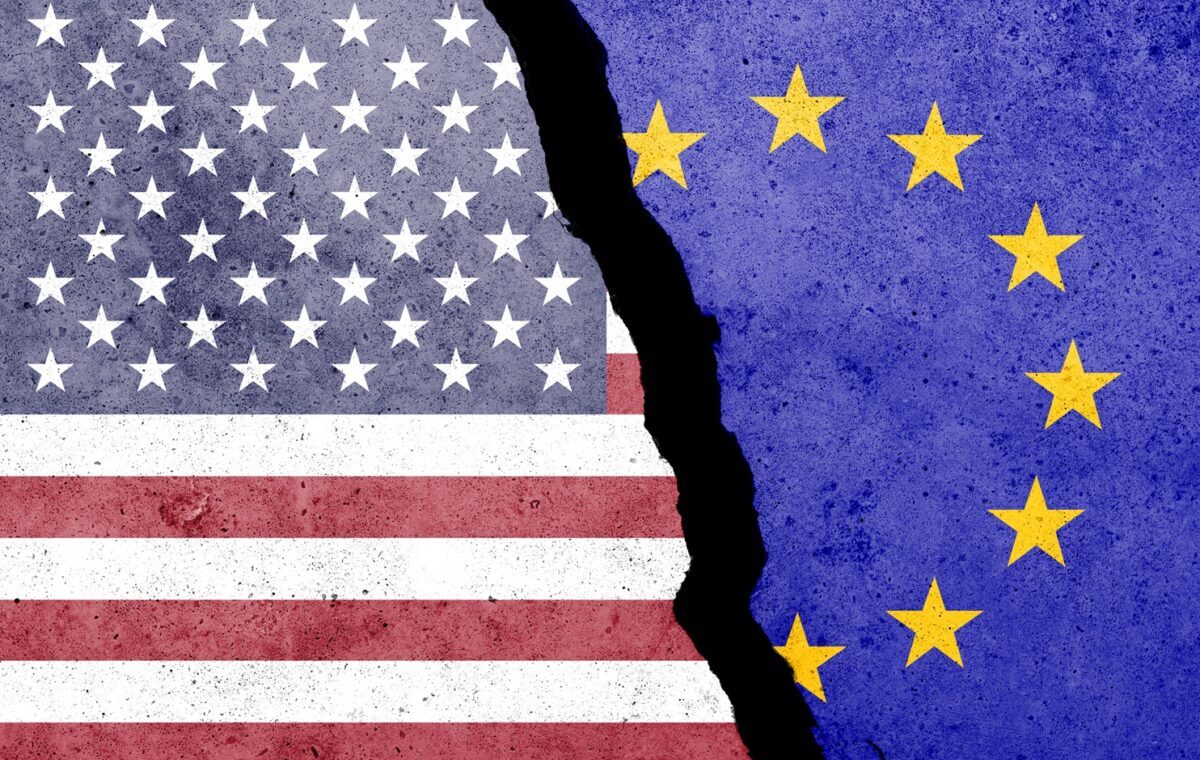
Populist politicians and parties see international institutions as dependent on the interests of competing states, and processes of global governance as generating a globalist elite whose influence should be countered in the interests of the people. This contrasts with the view that international institutions can develop a life of their own as international actors, or that they provide spaces of interaction that can enhance international communication and responsiveness among societies. Historically, American views of international institutions have emphasised an instrumentalist view, judging them by their relationship to US power, leadership and sovereignty, whereas European views have tended to emphasise a commitment to institutions as part of a rules-based liberal international order. The current period has seen an increase of populist sentiments on both sides of the Atlantic, epitomised by the two Trump Administrations in the USA and by the rise of populist movements in western Europe, often linked to US policies.
At one level, current and recent US policies seem to imply the final dismantling of the liberal international order, with its assumptions about the role of international law and organizations and the benefits of international cooperation. The challenge posed by ‘Trump 2.0’ is not simply to specific institutions but also to key practices associated with the established international order. International law is seen as an instrument of state policy, and subject to reinterpretation in line with the interests of leading states; diplomacy is redefined as a performative process, in which diplomatic events can be presented as ‘good television’ foregrounding the presence of the President; international organizations are seen as dispensable in light of the needs of the US and other major ‘powers’.
One of the first executive orders issued by the President mandated not only withdrawal from the WHO and UNESCO, but also a comprehensive review of all international organizations and their ability to serve US interests. At the same time, funding for a wide range of international bodies has been cut, partly as a result of the reduction in funding for the US Agency for International Development but also as part of a more general strategy aimed at US withdrawal from international cooperation. The United Nations system has been attacked or side-lined, and the roles of individual organizations have been attacked over a very broad front. In addition to the familiar targets of the World Health Organisation and UNESCO, challenges have been mounted to the World Trade Organisation, the Human Rights Council, the International Organization for Migration, the International Maritime Organization, the International Criminal Court (which Trump has threatened to dismantle ‘brick by brick’), and the UN Relief and Works Agency in Palestine as part of the ongoing conflict in the Middle East. Not only the UN system is at issue: attacks on bodies such as the G-7 of industrial economies, or regional organizations such as NATO and the EU itself, have proliferated.
The impact of these strategies is not simply on the activities of the specific organizations that have been targeted; it also extends to a wide range of states within the world arena. In particular, it encompasses the other ‘great powers’ and ‘middle powers’ within the international system. Where the US withdraws or distances itself from organizations, this can open up space for the injection of new forms of multilateral cooperation, for example the Chinese diplomacy surrounding the Shanghai Cooperation Organization or the BRICS (Brazil, Russia, India, China and South Africa) grouping which has now extended to include a range of regional powers as well as its core members. As a result, the nature and extent of multilateralism in the world arena is in a state of flux, and the remnants of the rules-based order are patchy at best.
”“The potential for marginalisation of the EU’s efforts, both in Europe and on the global stage, is real as the relations between a number of dominant powers come to define the new world order.”
For transatlantic relations more narrowly defined, the impact of these American policies is multi-dimensional. In relation to NATO, the key challenges have been those of attempting to maintain US commitment whilst responding to the ongoing challenges to European security. Thus, the agreements to bolster European defence spending to five per cent of GDP in the period up to 2035 have partly been a response to American pressure but also partly a recognition that new forms of European strategic autonomy should be pursued in the face of American withdrawal and the continuing threat from Russia. Despite the general commitments made, individual European members of the Alliance have pursued markedly different paths – a divergence that has been underlined by responses to US expectations of support for their war against Iran, for example in the case of Spain. For the EU, there is the well-established tension between the internal politics of the Union and the external challenges posed by US policies. Trumpian policies expose vulnerabilities and tensions within the EU, most obviously in the form of differential economic pressures arising from the erosion of international order in areas such as trade, but also in the tensions observable between member states more or less receptive to Trumpian ideas. In relation to international institutions, the EU has been challenged to maintain solidarity in its commitment to the UN system and other global governance bodies. It has been challenged more fundamentally to maintain its commitment to multilateralism and to defend its investment in the institutions of the liberal international order, from which it derives important measures of legitimacy and leverage. The potential for marginalisation of the EU’s efforts, both in Europe and on the global stage, is real as the relations between a number of dominant powers come to define the new world order.
The net result of these changes and pressures for transatlantic relations is a situation of flux and uncertainty, in which the credentials of established institutions are questioned and there is little sign of the emergence of a settled new order. Such conjunctures have occurred previously in the more than eighty years of transatlantic institution-building, but the emergence of new powers and the unpredictability of old allies, underlined by the appeal of populism on both sides of the Atlantic, has created a new set of challenges and opportunities.
Michael Smith
Honorary Professor in European Politics
University of Warwick
United Kingdom
M.H.Smith@warwick.ac.uk
