
(I) The Changing Arctic Geopolitical Dynamics
In recent years, major power competition in the Arctic has intensified. Spillover from the Russia-Ukraine conflict has paralyzed the governance architecture centered on the Arctic Council, leading to institutional stagnation and diminished governance effectiveness. Climate change and environmental protection once formed the strongest common ground for Arctic cooperation, positioning the region as a testing ground for global governance and multilateral collaboration. However, lacking a cooperative foundation, Arctic governance has become fragmented, with adverse implications for global ecological security and the shared interests of humanity.
(II) China’s Arctic Policy in Retrospect
China holds clear and comprehensive rights in the Arctic, as affirmed by international treaties. These include rights under the United Nations Convention on the Law of the Sea, as well as those conferred by the Svalbard Treaty, which grants China and other signatories equal rights to development and peaceful utilization. China has been an observer to the Arctic Council since 2013. Over the long term, China Arctic engagement remains tied to the normal functioning of the Council. Based on these rights, China’s Arctic Policy White Paper released in 2018, serves as the guiding document. It explicitly states that the principles of “respect, cooperation, win-win, and sustainability” underpin China’s engagement and will remain unchanged regardless of shifts in the international landscape.
China prioritizes multilateral rules on key Arctic issues. On shipping, China participates in refining the Polar Code through the International Maritime Organization. On fisheries, China signed the Agreement to Prevent Unregulated High Seas Fisheries in the Central Arctic Ocean, accepting the logic of the precautionary approach, thereby avoiding the irreversible consequences of a “develop first, manage later” model. China supports the BBNJ Agreement, which will also apply to the Arctic high seas, and actively seeks to host its secretariat. China has also taken the lead in establishing multilateral cooperation platforms such as the Asian Forum for Polar Sciences (AFoPS) and the China-Nordic Arctic Research Center (CNARC).
(III) An Examination of China’s Arctic Interests
The Arctic represents a relatively new dimension for the growth of China’s national interests, yet it remains limited within the broader national interest structure and is not a focal region in China’s foreign relations. China’s Arctic interests are primarily anchored in the following aspects:
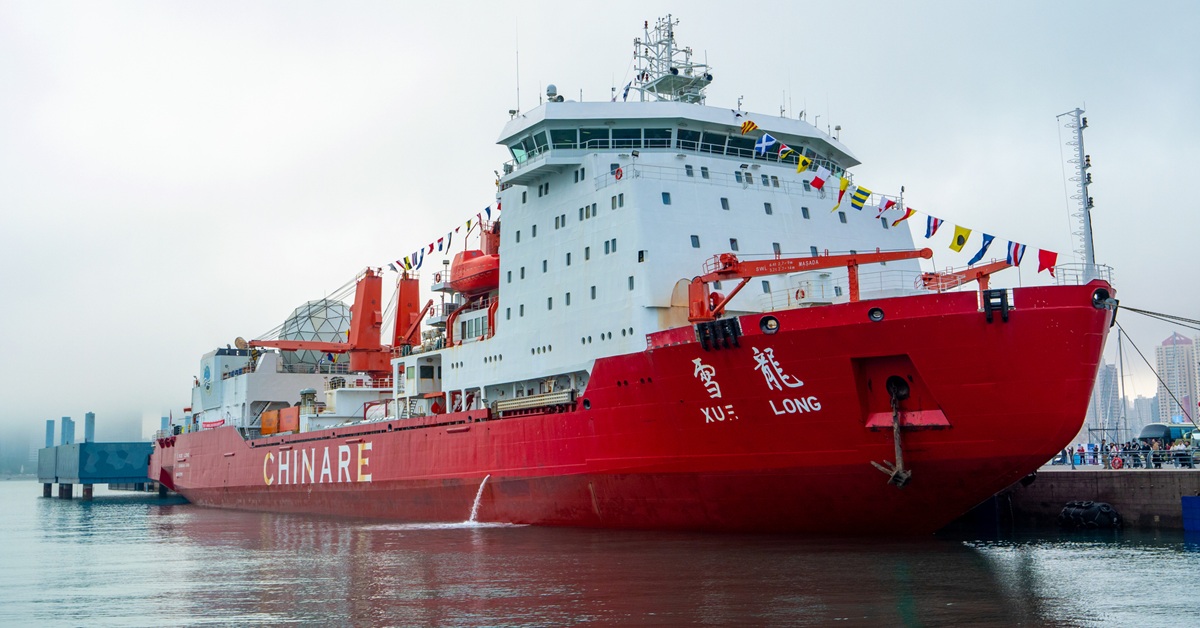
Scientific Research: Sea ice retreat, glacier melting and biodiversity degradation in the Arctic affect China’s environment and climate through atmospheric circulation and ocean currents, necessitating long-term observation and monitoring. China’s scientific activities in the Arctic are supported by land-based hubs—the Yellow River Station in Svalbard, Norway and the China-Iceland Arctic Observatory in northern Iceland—and include annual summer research cruises in Arctic high seas.
Economy: As Arctic ice recedes, new shipping routes and mineral development potential present emerging opportunities. The Arctic shipping routes are seen as an alternative shortcut for China-Europe trade, reducing sailing distances by up to 50%. In the summer of 2025, the Istanbul Bridge completed the first direct container transport between China and Europe in just 20 days, cutting the journey by 20 to 30 days compared to traditional routes via the Suez Canal or around the Cape of Good Hope. Similarly, recoverable oil and gas reserves in the Arctic, once developed, could enhance the diversification and cost-effectiveness of China’s energy imports
Nevertheless, in terms of geographic scope, duration, and scale, China’s economic activities in the Arctic remain relatively limited. Arctic states have robust legal frameworks with high thresholds, stringent standards, and intensive scrutiny. Additionally, limited profitability and environmental risks lead Chinese enterprises to adopt cautious stances.
China’s cooperation with Russia amid tightening external conditions often draws attention. Russia is one of the few Arctic states with both the capability and intent to develop Arctic economic activities, and it increasingly relies on a select group of long-term partners—China among them. In practices, however, China’s state-owned enterprises have exercised considerable restraint due to concerns over secondary sanctions, while more adventurous private enterprises have demonstrated stronger innovation capacity, particularly in pioneering container shipping via the Arctic passage.
Security Interests: The safety of Chinese personnel, assets, and the activities in the Arctic needs to be ensured. Accordingly, the implementation of the 2015 National Security Law provided, for the first time, legal safeguards in new domains such as outer space, deep seas, and polar regions, aiming to enhance “capabilities for secure access, scientific research, exploration, and development”. Furthermore, the polar regions, as a new strategic frontier, have been incorporated into China’s holistic approach to national security, becoming one of the 20 key security areas.
(IV) Conclusion
Like the vast majority of Arctic stakeholders, China’s long-term interests in the region are best served by peace and stability. China respects the existing framework of Arctic multilateral mechanisms and is committed to sustaining their functions and resilience in issue-based and demand-driven areas of cooperation, such as fisheries management, search and rescue, environmental monitoring and scientific research. China views cooperation with Arctic states as the foundation for its engagement, rather than seeking to bypass or replace them. It is also willing to foster positive interactions with other Arctic stakeholders and play a constructive role in cross-regional and global issues, adopting a stance of “neither overstepping nor being absent” in Arctic affairs. Prevailing narratives of a “China threat” in international discourse amplify zero-sum logic and politicize functional cooperation. China hopes to gradually correct such misconceptions through cooperative practice.
Deng Beixi
Dr., Director/Professor
Division of Polar Policy Studies, Polar Research Institute of China (PRIC)
China
Deputy Director
China-Nordic Arctic Research Center (CNARC)
China
