
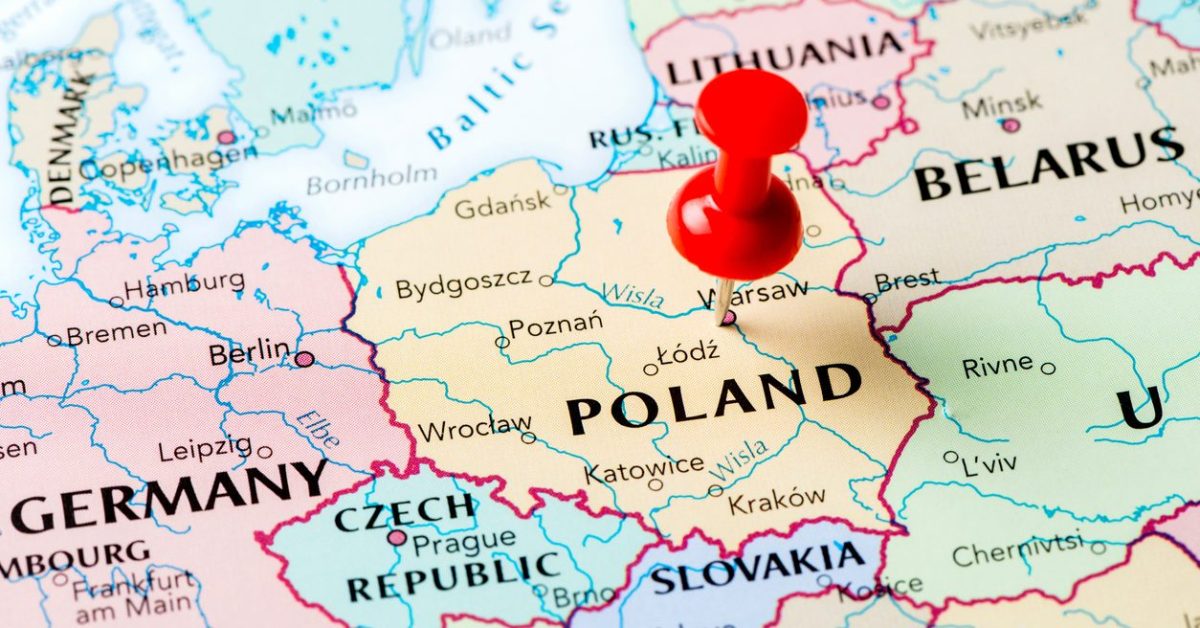
Poland has never been in a favourable geostrategic position in terms of defence. Over the centuries, wars have raged here, borders have shifted, and with them, the country’s size and population. We have bordered on various neighbours and belonged to various alliances, depending on our historical location and the political pressure we find ourselves in. Broadly speaking, true stabilization of the security situation began with Poland’s accession to NATO in 1999 and the EU in 2004. But how long will it last?
The situation has changed dramatically since the outbreak of full-scale Russian aggression against Ukraine in 2022, but more pronounced symptoms of a worsening security situation in our part of Europe appeared after the Russo-Georgian conflict in 2008 and then in 2014, when Russian little green men launched a hybrid war in Ukraine. Although Poland has always supported strengthening NATO’s defence capabilities, and changes in the functioning of the Alliance have occurred slowly and gradually, in fact, the main milestones that initiated more significant changes were those initiated at the NATO summits in Wales in 2014 and in Warsaw in 2016.
Strengthening the capabilities necessary for the collective defence of all NATO member states, in accordance with the principle of solidarity enshrined in Article 5 of the Washington Treaty, is crucial. However, developing the capabilities of national armed forces is equally important. Therefore, Article 3 of the Treaty must not be forgotten. This provision truly underpins the principle of solidarity and mutual defence within NATO. Although not as important as Article 5, it underpins the effective functioning of the Alliance, enabling member states to effectively defend themselves against threats. It concerns self-help and mutual support among NATO member states. It stipulates that member states should ensure their own defence capabilities to defend themselves effectively and commits states to continuously develop their defence capabilities to counter potential threats. This is precisely why Poland has long strived to systematically improve its combat capabilities. Although it is not the wealthiest country in the Alliance (or even in Europe), it spends relatively the most on defence among all NATO members. The burden on members was intended to be fair and based on the percentage of GDP each member state allocates to its own defence.
Defence spending in 2025 is expected to reach 4.7% of Poland’s GDP. This will be another year of consistent growth. According to NATO data, Poland’s defence spending estimates for 2024 are 4.12% of GDP and 3.26% for 2023. We’ll see what the final statistics for 2025 say, but in 2024, according to a NATO report, Estonia will be in second place (3.43%), the United States in third (3.38%), Latvia in fourth (3.15%), and Greece in fifth (3.08%). At the same time, only these five countries will spend more than 3% of their GDP on defence.
It’s no surprise that among the countries investing the most in their own defence capabilities are those closest to the potential threat, like Poland. Unfortunately, it’s common practice for wealthy Western countries, located farther from the source of potential threats, to spend far below their economic wealth and still fail to exceed the long-established 2% spending threshold, which hardly constitutes an expression of allied solidarity.
Currently, only 23 of NATO’s 32 member states will reach 2% of GDP this year. Many countries are struggling to achieve this goal. Simply put, increasing this goal to 5% of GDP on defence, as agreed at this year’s NATO summit in The Hague, will pose a significant challenge for many countries that have already announced they will not meet this commitment.
The increase in member states’ defence spending to 5% of GDP over the next decade is planned to involve 3.5% of GDP for core defence, and the remaining 1.5% for defence-related spending, such as critical infrastructure protection, network defence, civil preparedness, and innovation.
In nominal terms, Poland currently ranks fourth in Europe, after Germany, the United Kingdom, and France. Traditionally, the leader is the United States, which NATO estimates will spend nearly $1 trillion on defence. All other member states will spend less than $100 billion, although Germany is very close. Poland ranks fifth, followed by Italy, which plans to spend slightly less this year.
Poland, as the only NATO and EU member state bordering both the attacked Ukraine and the aggressor, Russia, has drawn conclusions from recent events and quickly become a leader in NATO not only in terms of defence spending, but also in the field of military procurement with a huge scale of investments.
What equipment is Poland purchasing? It’s worth mentioning some of the purposes for which these enormous sums will be allocated. In recent years, Poland has been implementing an unprecedented program of modernization and expansion of its Armed Forces. The largest arms contracts concern the purchase of modern weapons systems and equipment. These include 32 F-35 multi-role aircraft and 48 FA-50 light fighters from South Korea. Polish F-16s are also being modernized to the highest standards. Of particular note is the order for 96 AH-64E Apache attack helicopters, which will make Poland the second-largest user after the United States.
Armoured forces are also being rapidly developed. Poland has ordered 360 K2 Black Panther tanks from South Korea and 250 American M1A2 Abrams tanks. Together with its existing Leopard, T-72, and PT-91 tanks, by 2030 Poland could have more tanks than France, Italy, and the United Kingdom combined. At the same time, it is purchasing and modernizing hundreds of armoured personnel carriers and infantry fighting vehicles, such as the domestically produced Borsuk and Rosomak under the Patria license. The Navy is also seeking modernization, planning to purchase frigates under the Miecznik program and a one submarine (at this stage) under the Orka program.
Air and missile defence systems are also crucial. Under the Wisła (with Patriots) and Narew (with CAMM missiles) programs, Poland is implementing medium- and short-range systems integrated with the American Integrated Battle Command System (IBCS). The contract for its delivery and integration in Phase II of these programs is one of the most expensive, worth many billions of dollars.
At the same time, artillery is being developed—both conventional and rocket-propelled. The Polish Armed Forces are strengthening their capabilities by purchasing hundreds of domestically produced Krab and Korean K9 howitzers, as well as hundreds of American HIMARS and Korean Chunmoo missile systems. New areas, such as cyberdefence, electronic warfare, and unmanned systems, are also playing an increasingly important role. Significant funding is being allocated to individual soldier equipment.
Needless to say, modernization also requires the development of training and logistics. Training packages and simulators are being developed, and military infrastructure, warehouses, and service centres are being expanded. Ammunition purchases are also enormous. The pace of orders is rapid. Such a large number of purchases and parallel activities makes it difficult even for experts to clearly determine which orders are already being fulfilled and which are still planned. The ambitious pace of modernization raises questions about the feasibility of deliveries and the possibility of fully implementing such a large number of systems. These are, of course, only flagship examples intended to show the scale of the effort undertaken.
The destinations from which orders will be fulfilled are also worth considering. Although the Polish arms industry is playing an increasingly important role, the main foreign partners remain American and—surprisingly for many—South Korean companies. This strategy, however, means that Poland may lose access to some EU defence funding programs, which only support purchases from European manufacturers. The government argues that in the face of the Russian threat, it is better to take on debt and be well-armed than to remain defenceless.
It is important to mention the established “Eastern Shield” program, planned for 2024–2028. This project aims to strengthen Poland’s resilience to kinetic attacks and hybrid warfare. It includes the construction of fortifications, strongpoints, early warning systems, the protection of critical infrastructure, and cooperation with NATO allies to enhance deterrence. Although it draws on the experience of the war in Ukraine, it is defensive in nature – primarily intended to protect soldiers and civilians, as well as ensure readiness to defend borders.
There is no doubt, however, that Poland is currently undertaking its greatest effort in decades to build a modern armed forces numbering 300,000 determined soldiers and equipped with state-of-the-art equipment, to achieve defence capabilities that will make Poland not only a regional leader but also a strong NATO ally. The main goal of these efforts is not only to modernize the armed forces but, above all, to ensure the security of its citizens and deter potential aggressors.
Andrzej Fałkowski
Dr., Lt. General (Ret.)
Former Deputy Chief of General Staff of the Polish Armed Forces
Poland