
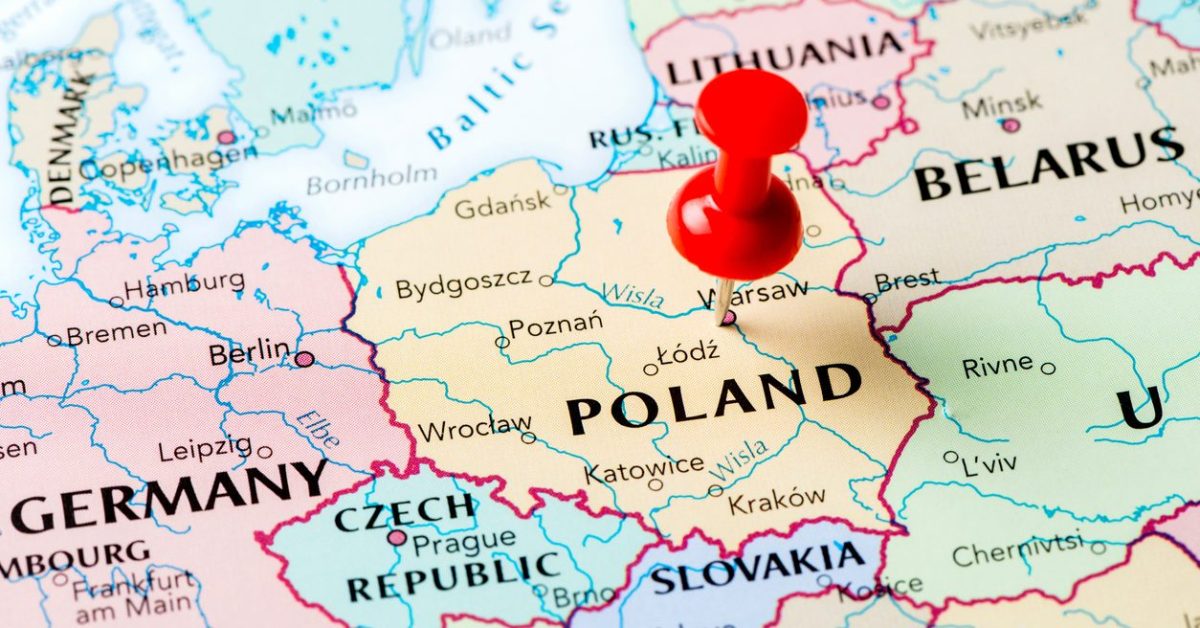
1. Germany holds a central place in Polish foreign policy: due to its potential, political and historical conditions as well as direct neighborhood. In the current conditions – Russia’s aggression against Ukraine, the war in Ukraine and Putin’s clear intentions aimed at destabilizing the European Union and the European security system – the importance of Polish-German cooperation is determined by six overlapping circles of cooperation.
1) based on the Weimar Triangle and aimed at strengthening EU cohesion, especially in the field of Common Security and Defense Policy – until the establishment of the European Defense Union;
2) in strengthening the eastern flank on the border between Poland and Belarus;
3) in strengthening the eastern flank around the Kaliningrad Oblast and on the border of the Baltic states with Russia;
4) in ensuring security in the Baltic Sea basin;
5) in the Central European region,
6) the sixth common denominator for all above mentioned is to provide comprehensive assistance to Ukraine in the fight against the Russian aggressor.
2. The foundations for solid cooperation in the above-mentioned areas are good. Political changes in Poland after 1989, German reunification in 1990 and the related overcoming of the so-called Yalta order – led to the convergence of the fundamental foreign policy goals of both countries. Many bilateral problems have been closed, and Poland’s membership in the EU and NATO has created a new framework for the future of Polish-German relations.
3. The foreign policy of the PiS (“Law and Justice” party) government (2015-2023) squandered these opportunities. At that time, the political state of Polish-German relations was frozen. PiS pursued a mindless, aggressive and offensive anti-German narrative that was intended to consolidate its electorate. It did not care about the repercussions of such a narrative in foreign policy. This was accompanied by a policy that was openly anti-EU and focused its security policy on bilateral guarantees from the US, at the expense of NATO’s position. A certain internal political consensus in Poland was achieved in the field of security policy after Russia’s aggression against Ukraine.
4. A coalition of democratic parties took over the government after PiS (following the elections on October 15, 2023) in very difficult conditions. The country was destabilized as a result of unlawful actions. In addition, the “legacy” in foreign policy was the decline of Poland’s importance in the international environment, conflict with its neighbors, marginalization in the European Union, very bad relations with Germany.
5. Nevertheless, the takeover of power in Poland by democratic parties led to Poland regaining a strong position in the international environment. First of all, the very assumption of power by these parties contributed to “renewing” Poland’s credibility. The personal arrangement is also favorable: Donald Tusk (Prime Minister) has an undisputed position as a politician with a European dimension, and Radosław Sikorski (Minister of Foreign Affairs) has begun to pursue a clear and effective foreign policy (inscribed within the framework of the EU, NATO and balanced in relation to the USA).
6. The changes on the German side (Zeitwende policy) and on the Polish side (democratic parties taking over the government at the end of 2023) led to great expectations for an end of the impasse in Polish-German relations. However, the results were (at the end of Chancellor Scholz’s term) rather modest. New perspectives appeared after Chancellor Merz took power this spring, which was reflected in clear actions to increase military spending, intensify cooperation to strengthen the eastern flank and help Ukraine.
7. Nevertheless, the perspective of Polish-German relations is not clear. In Poland, the actions of the coalition of democratic parties were inhibited by the then president of the country (Andrzej Duda), who was affiliated with PiS. Contrary to expectations, the presidential elections in the summer of 2025 were won by a representative of the radical right (Karol Nawrocki) supported by PiS, with an anti-EU attitude, restrained towards Ukraine and focused on cooperation with Trump. In addition, the result of the presidential elections weakened the position of the coalition of democratic parties, so the result of the parliamentary elections in 2027 is unclear.
8. In the current situation, the direction of foreign policy aimed at good relations with Germany, pro-EU and pro-NATO (with balanced relations with Trump) will be continued, with certain limitations resulting from the position of the President. The year 2027 may bring a change if the elections are won by right-wing parties, led by PiS. Then – with a President and a government with the same political orientation – there could be a radical return to the anti-German, anti-EU narrative, undermining the importance of NATO and focusing on cooperation with Trump.
Jan Barcz
Professor of International Law
Conference of the (former) Polish Ambassadors
Poland
j.barcz@kozminski.edu.pl
Back to Table of Contents