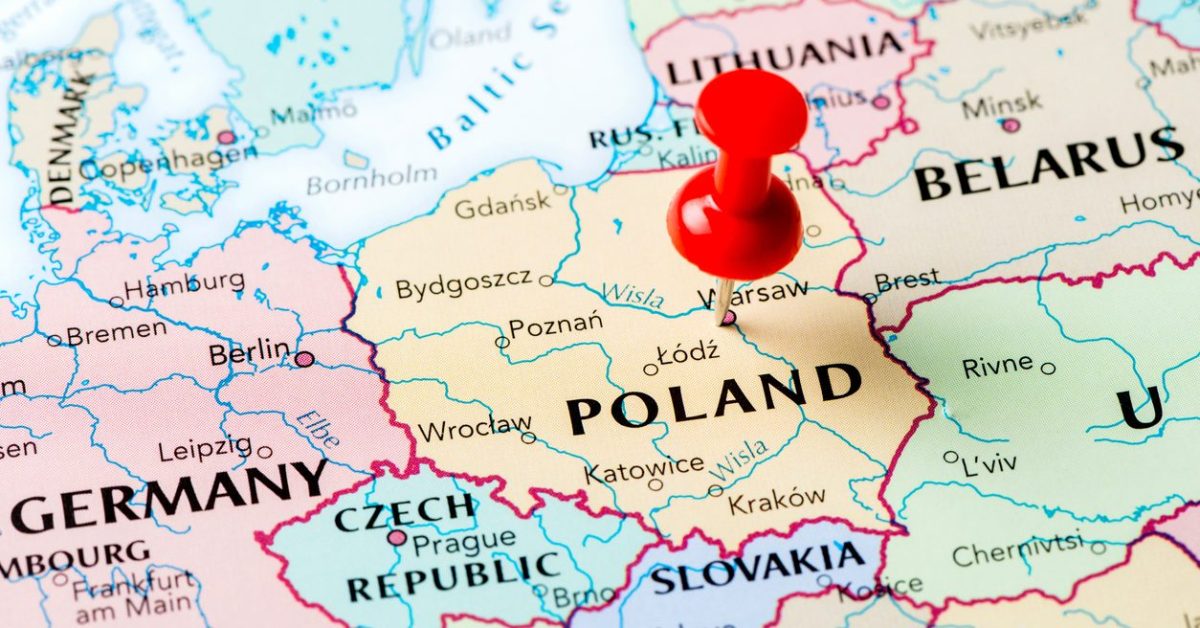
Poland in 2025 finds itself at a historic crossroads. It is simultaneously a frontline state at the eastern border of the European Union and NATO, and an emerging economic heavyweight. In 2024, the country crossed the symbolic threshold of one trillion US dollars in GDP, placing it among the world’s top 20 economies. Russia’s war of aggression against Ukraine, the weaponisation of migration on the EU’s eastern frontier, instability in the Middle East, and rising tensions between the EU, the United States and China all converge to reshape Warsaw’s role. No longer a peripheral observer, Poland is expected to be an active shaper of regional and global politics.
Frontline security and regional leadership
Poland embodies Europe’s security dilemmas. It is exposed to hybrid pressures from Belarus and Russia, including cyberattacks, disinformation, and attempted sabotage of energy and transport infrastructure. At the same time, Poland is transforming this vulnerability into a platform for leadership. Defence spending has exceeded 4% of GDP, the highest in NATO, underlining Warsaw’s determination to act not only as a consumer of security but also as a provider of stability. Cooperation with Baltic and Nordic partners is deepening, particularly in the protection of the Baltic Sea and in joint procurement. The country’s alignment with the United States remains strong, yet Poland is also reintegrating into the EU mainstream, seeking to influence debates on enlargement, resilience, and the defence of democratic values.
Economic ascent: from megaprojects to technological leadership
Crossing the trillion-dollar GDP mark reflects a decade of robust growth and integration into European value chains. Poland is no longer merely a low-cost manufacturing platform: it is becoming a logistics, production, and technology hub for central and nore thern Europe. Recent projects underline this shift. The Baltic AI Gigafactory – a €3 billion initiative linking Poland with Lithuania, Latvia, and Estonia – is set to boost Europe’s competitiveness in artificial intelligence and advanced semiconductors, cementing Poland’s role in cutting-edge industries.
Infrastructure megaprojects are equally transformative. The Centralny Port Komunikacyjny (CPK) aims to be Europe’s newest intermodal hub, connecting air travel with high-speed rail and regional transport. Rail Baltica, under construction, will finally link Warsaw with Tallinn via a modern high-speed line, binding the Baltic States more closely into the EU core. The Port of Gdańsk continues its expansion as the largest container port on the Baltic, while LNG terminals in Świnoujście and Gdańsk secure diversification away from Russian energy. Offshore wind adds a new dimension: the Baltic Power project, developed jointly by Poland’s Orlen and Canada’s Northland Power, will install over seventy turbines off the Polish coast and is set to provide clean energy to more than a million households. Nuclear power projects, launched with American and Korean partners, will anchor Poland’s low-carbon transition.
Challenges
Poland’s rise also brings heavy responsibilities. First, managing the triple transition – in energy, security, and digital technologies – in a time of geopolitical instability is no simple task. The nuclear programme, offshore wind farms like Baltic Power, and the Baltic AI Gigafactory promise transformation, but their delivery will test state capacity and political stability.
Second, catching up economically remains a central objective. Crossing the trillion-dollar GDP mark is symbolic, yet Poland still competes with higher-productivity economies. The competitiveness of Polish industry and the ability of private enterprises to scale globally will determine whether the country’s growth is sustainable – or stalls at the middle-income trap.
Third, the strategic question looms: what vision does Poland offer for the future of European security? NATO’s credibility, the EU’s capacity to act in defence, and the role of external powers like China in Europe’s economy and infrastructure will shape the continent’s architecture. Poland has the potential to be not just a frontline state, but a thought leader in defining this new order.
Piotr Maciej Kaczyński
Lecturer
University of Warsaw
Poland
Trainer
European Institute of Public Administration (EIPA)
Maastricht
Netherlands