
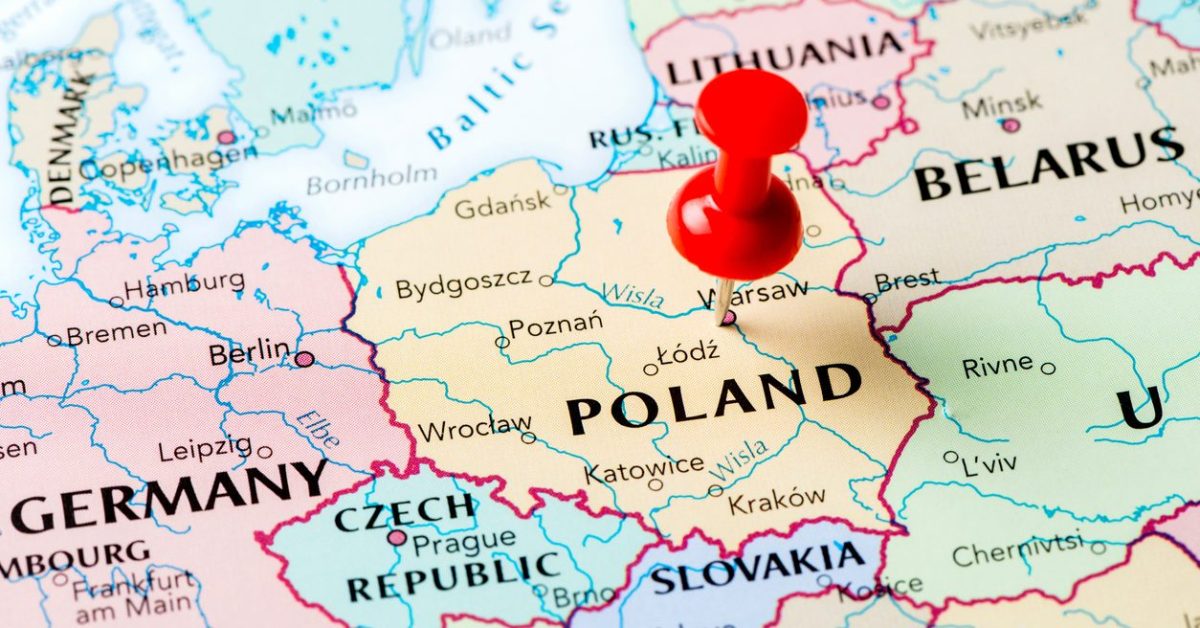
Russia’s full-scale invasion in Ukraine has had far reaching implications for Poland. Not only did Poland turn into a frontline state and a key supporter of Ukraine, it appeared to be a new powerhouse in the structures of the West. A debate about a shift to the East in Europe started, which meant that the proactive countries along the Eastern borders of EU and NATO were supposedly beginning to become more important, i. e. to attain more influence. Poland as the country with the biggest potential in the region, seemed to become a regional leader with new opportunities to co-shape European and even transatlantic agendas.
There were various sources for that perceived ascent of Poland.
The intake of hundreds of thousands of refugees from Ukraine after February 2025. Poland was called a “humanitarian superpower”.
Military investment, ambitious programs to modernize its armed forces and high defense spending amounting to more than 4% of GDP, making the country the frontrunner on defense budgeting in NATO.
Epistemic power, i. e. Poland arguing that since many years it has had the expertise and experience to form an adequate assessment of Russia, of the threats it poses and the policies that the West should have pursued. Particularly vis-à-vis Germany, which had to come to terms with the collapse of its Ostpolitik, Poland appeared as country, who has disposed of the right statecraft in Eastern affairs and security policy. Whereas Germany for a long time had continued to cling to the Nord-Stream-2 project and energy cooperation, Poland, after some delay, had implemented a policy of diversification in oil and gas supplies reducing dependency on Russian imports.
Poland tried to coordinate its efforts to support Ukraine and to contain Russia with like-minded countries on the Eastern flank of NATO or in Northern Europe, thus trying to be a coordinator of interests of Central Europe, a proactive advocate in NATO’s front-line group and of course a champion for a bold backing if Ukraine.
Particularly, Poland became a major partner for the US, for whom the country was a logistical hub to send assistance to Ukraine, a vital military ally in the region and a reliable political “teammate” in Europe. Poland, after February 2022, could deepen its anyway strong military, security and diplomatic bonds with the US. Poland’s plans to buy key defense systems for its armed forces from the US is just one element of this emerging “special relationship.”
In sum, Poland as a security provider and an emerging political big-league player seemed to box above its weight. However, soon it became obvious that this was by far no linear process. Poland’s efforts did not turn necessarily in more political significance. Here also, a number of reasons has played a role.
Russia has become more unpredictable and has sent more than just warning signals to Poland. Poland has been the target of manifold hybrid attacks and incidents from the migration crisis at the border with Belarus, over arsons in Polish cities, cyber attacks and more recently air space violations by drones. This all has shown the various vulnerabilities, despite substantial efforts to build more resilience and an effective defense.
Relations with Ukraine have become strained. Whereas Poland continues to be a firm supporter of Ukraine in its fight for independence, bilateral relations are more complicated. Squabbles over historic issues, conflicts in the context of EU market-liberalisation for Ukrainian agricultural products or for lorry-drivers from Ukraine and a growing aversion against welfare-schemes for Ukrainian refugees in the society have soured the interaction between Warsaw and Kiev.
In the military domain, debates have begun, if the ambitious plans for the modernization of the armed forces are realistic – given demographic restraints, continuing deficits in military capabilities and still-existing shortages e.g. in ammunitions. The then head of the national security office BBN declared in March 2025 that with current ammunition stocks, Poland could defend itself only for one or two weeks. Another debate was reinvigorated after the drone incidents of September 2025, when more than 20 Russian drones entered Poland’s air space and a lack of anti-drone capabilities became visible. Many experts have began asking if the expensive acquisition of what they call “legacy systems”, like heavy battle tanks, fighter jets or helicopters is the right way in times of 21st century warfare and given the lessons from the war in Ukraine.
Last but not least: New uncertainties with the US have emerged, since the Trump administration has come to power. Whilst Poland’s national-conservative camp and president Nawrocki (who was elected in June 2025) entertain close relations with the Trump administration and continue to trust in US security guarantees for the Eastern flank, the government camp has a more balanced approach, trying to consolidate relations with the US, at the same time building new bridges to partners in Europe. Irrespective of the US president’s commitment (in a meeting with Nawrocki) to maintain US troop presence in Poland or to even increase it, there are doubts about the prospects of American engagement in Europe and on the Eastern flank. Particularly, the Trump administration’s (for the time rather inconclusive) efforts to engage Russia or to strike a deal with Moscow on Ukraine, Washington’s diplomatic contacts with Belarus, but also a more fundamental US strategic reorientation toward the Indo-Pacific has brought about doubts, about the viability of US-Polish relations in the long-term. In any case, relations between Poland and the US cannot be taken for granted as a power-amplifier for Warsaw’s standing in Europe.
Hence, it appears as a key challenge for Poland to find an appropriate Euro-Atlantic path. That means to reconcile the necessity to maintain strong ties with the US and to pursue the efforts of making NATO more effective on the one hand, with new partnerships in Europe and the use of the EU as an additional source for improving Poland’s security on the other hand. The latter direction has developed remarkably. Poland has signed new bilateral accords with a strong defense or security dimension: with France, with the United Kingdom, with the Netherlands or with Sweden. Also, minilateral formats, among others meetings with the Baltic States or the Nordic Baltic Eight group, gathering with Germany and France in the Weimar Triangle or in the Weimar Triangle Plus format (including also the United Kingdom or Italy) have been one of the visible effects of this new networking. Poland has also discovered the EU as a valuable framework for enhancing security, which can contribute funds for armaments industries (Poland is the biggest beneficiary from the EU’s new Security Action for Europe initiative) or help improving military mobility. Consistently, Poland has tried to bring more security to the EU, during its council presidency in the first half of 2025.
Against this background, security and defense cooperation with Germany has still considerable potential, even though important cooperation does exist, e. g. in the Baltic Sea or with German patriot systems deployed in South-Eastern Poland and German jets participating in the air policing missions in the Polish air. All in all, in order to become a stronghold on the Eastern flank with political clout in Europe, Poland will have to find ways to combine its US and its European dimensions of foreign and security policy.
Kai-Olaf Lang
Dr., Senior Fellow
German Institute for International and Security Affairs
Germany
