
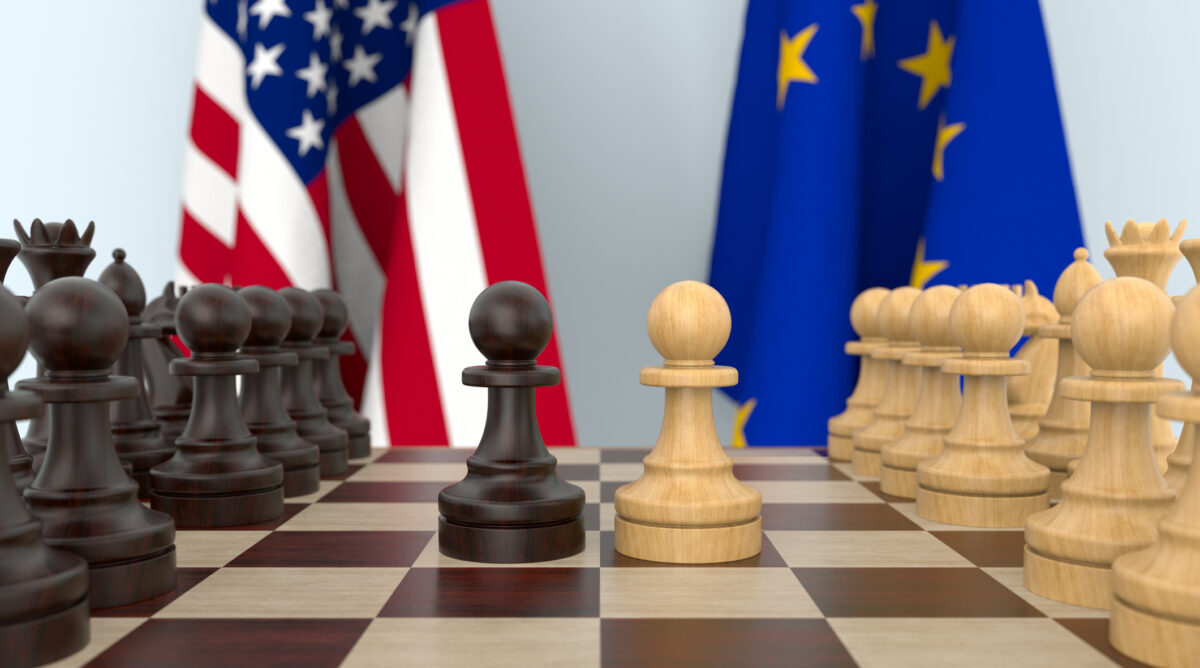
The United States has traditionally been Europe’s most important military ally and one of its largest economic partners. But Donald Trump’s second presidency has put the reliance of the transatlantic relationship under unprecedented strain. The question is no longer simply whether the transatlantic marriage is broken – it is. The question is what this rupture means for US influence.
Russia’s full-scale invasion of Ukraine exposed just how dependent European security had become on American military power. For decades, Europe could rely on NATO, and ultimately the United States, for critical defence capabilities. Successive US administrations have spent years demanding greater European burden-sharing. Trump’s return to the White House has made this demand much harder to ignore. And Europe is now beginning to deliver it. European governments are raising defence spending, expanding domestic production and investing in collective European capabilities.
In that sense, Washington may get exactly what it has long demanded: a Europe that spends more, produces more weapons and assumes a larger share of the security burden. But Europe’s security dependence was never only a burden for Washington; it was also a major source of American influence. European states bought American weapons, relied on US military capabilities and often calibrated their policies around the need to preserve Washington’s security commitment. As these dependencies diminish, so too will American influence.
”"Europe’s security dependence was never only a burden for Washington; it was also a major source of American influence.”
The same dynamic is visible in the Arctic. Trump’s repeated push to acquire Greenland challenged the assumption that territorial sovereignty among NATO allies was beyond question, producing one of the most serious disputes within the alliance in decades. In response, the EU has stepped up its Arctic policy, while what might previously has been treated as a peripheral relationship has acquired much greater geopolitical significance.
Iceland offers another indication of this shift. Although Icelanders rejected reopening EU accession negotiations in the referendum, the fact that EU membership returned to the political agenda reflected growing concerns about Arctic security and Iceland’s search for a more reliable political and security anchor through the EU.
Perhaps the most striking example, however, comes from America’s immediate neighbourhood. As Canada’s relationship with Washington deteriorates, Ottawa is actively seeking a deeper strategic relationship with Europe. This has already culminated in putting the idea of Canada’s ‘Associate Membership’ on the table. While this remains a concept in search of a legal and institutional framework, its significance goes beyond Canada. It illustrates how a shifting US foreign policy is pushing traditional allies to look towards the EU as an alternative strategic anchor, paving the way to new forms of multilateral cooperation among like-minded partners.
American power has never rested on military and economic strength alone. One of its greatest sources of influence has been its alliances: countries that trusted American leadership enough to organise much of their security, prosperity and foreign policy around it.
As that trust continues to erode, America’s allies do not simply become more self-reliant, they also diversify their partnerships, and deepen their ties with Europe and like-minded countries.
And that could prove to be Trump’s MAGA paradox: by forcing the EU to take greater responsibility for its own defence, Washington is finally equipping Europe with strategic autonomy. And by pushing its traditional allies to diversify their partnerships, the US is drawing them closer to Europe, ultimately expanding the EU’s strategic reach and global influence.
Dr. Tinatin Akhvlediani
Head of EU Enlargement Programme
Centre for European Policy Studies (CEPS)
Brussels
Belgium
Tinatin.akhvlediani@ceps.eu
