
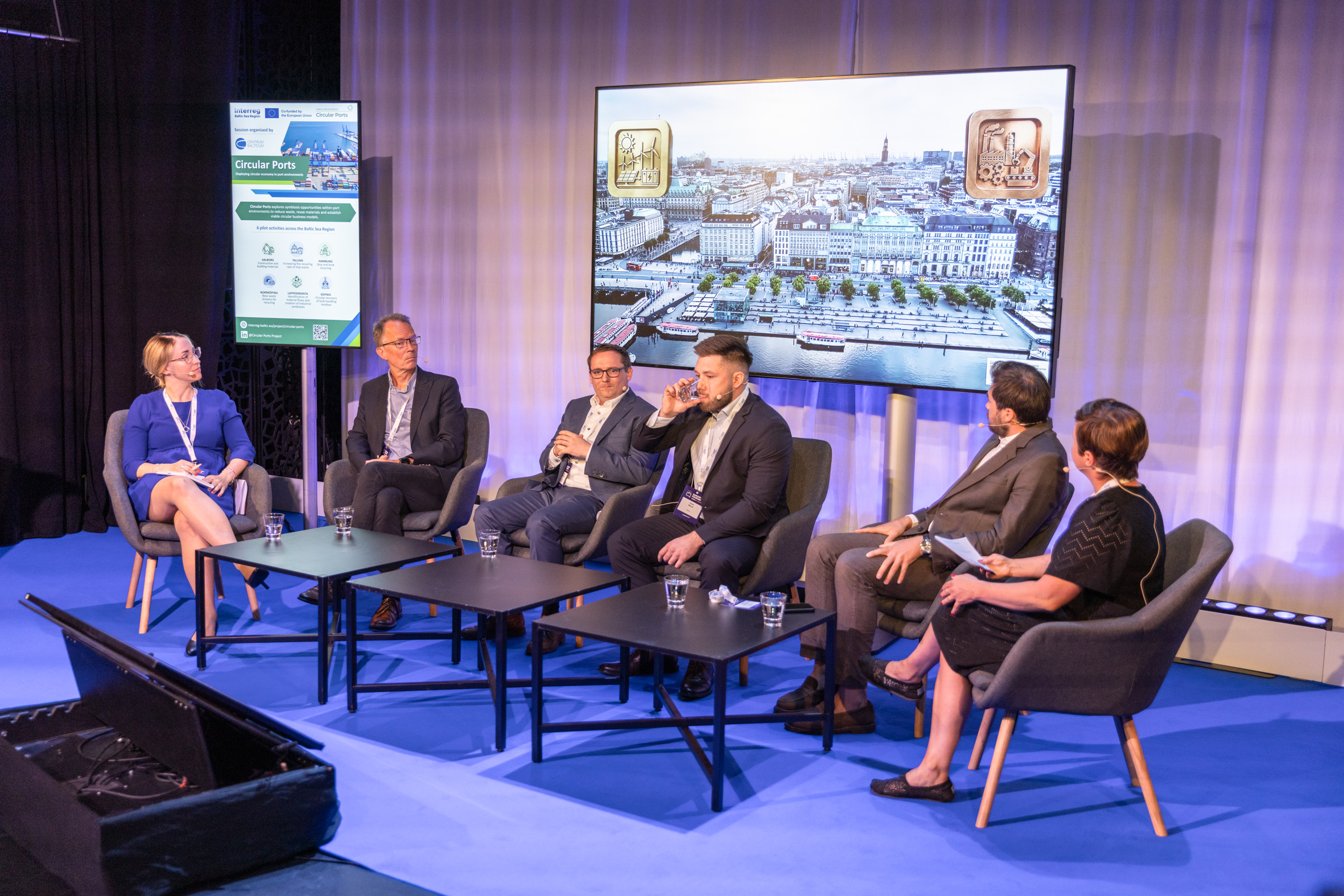
Baltic Sea ports have the potential to become a hub for circular economy. There was a clear consensus on this issue at the event “Harbours of Change: Circular Economy in Baltic Sea Ports”, organized by Centrum Balticum and the Circular Ports project as part of the Europe Forum in Turku. The session explored both the strategic framework for circularity and concrete solutions already being tested and implemented around the Baltic Sea Region. The discussion was moderated by Kirsi Ahlman from Centrum Balticum.
Projects test solutions in real life
Milla Harju, Coordinator of Policy Area Ship of the EU Strategy for the Baltic Sea Region, opened the session by placing circular economy in ports within the wider Baltic Sea Region context. Projects such as Circular Ports can help bridge the gap between strategy and practice by testing solutions in real port environments and sharing successful approaches across the region. From the authorities’ perspective, it’s also important to recognize the factors that keep ports from adapting circular solutions.
Circularity at the Port of Turku
Technical Director at the Port of Turku Markku Alahäme brought the discussion from the strategic level to concrete solutions already in use in Turku. Examples from Turku range from turning food waste from vessels into biogas and recycling construction materials to finding more sustainable uses for dredged material. Together, they demonstrate how circularity can advance step by step by finding new uses for materials that might otherwise be treated as waste.
Regulation in focus
Port of Hamburg Marketing is a partner in Circular Ports project. Head of Project Department Stefan Breitenbach explained that in ports the industries, logistics, infrastructure and large material flows are concentrated in the same area. That is why ports offer particularly promising environments for circular economy.
Regulation is another major focus of the project. Each of the project’s six pilots work with a local regulatory sandbox meaning that certain rules are temporarily relieved. The project also develops tools such as Circular Economy Handbook and procurement guidance that ports can freely utilize.
From waste to resource
Tomasz Laskowicz from the University of Gdańsk and Oskar Wanat from Metkom presented the Polish pilot, which explores how residues from bulk cargo handling can be recovered and returned to circulation. Materials that were previously mixed together and sent to landfill are now separated according to their potential use. Agricultural residues are recovered into biogas and other fractions are used as raw material in ceramic products. Beyond the environmental benefits, finding new uses for waste streams can also reduce disposal costs and create economic value.
Old vessels contain valuable materials
A video presentation from Murat Bayram of EMR Group introduced the Hamburg pilot, which explores the circular potential of end-of-life ships and boats. The pilot considers vessels as a source of valuable materials such as steel, copper, cables and machinery that could be recovered and returned to industrial use. As Bayram summed it up: “A ship ends, its value doesn’t.”
Ports contributing to a healthier Baltic Sea
As the event was organized on Baltic Sea Day, the speakers reflected on how circular ports can contribute to a healthier Baltic Sea. More efficient operations are often also more sustainable. Stefan Breitenbach pointed to electrification and more efficient use of resources as ways to reduce the environmental impact of port operations. Oskar Wanat emphasised that treating waste as a resource can reduce the risk of materials ending up in the environment.
Asked what policymakers and businesses should take away from the session, Milla Harju encouraged policymakers to make use of practical knowledge from projects when developing regulation, so that existing rules do not unnecessarily hinder circular solutions. Tomasz Laskowicz, in turn, highlighted the importance of cooperation between businesses and researchers – and reminded that circular solutions can bring not only environmental benefits but also tangible cost savings.
Circular Ports project advances the transition from linear to circular economic systems in port environments by piloting practical circular solutions and creating frameworks for their replication across the Baltic Sea Region. The project fosters collaboration between port authorities, enterprises, waste management actors and local public authorities to identify synergies, develop circular business practices and encourage systemic change in port communities.
Centrum Balticum takes care of project communications.
