
Western States and public opinions increasingly fear China’s growing Arctic influence, viewing its “near-Arctic state” discourse as a pretext for securing strategic, military, and resource advantages. Concerns center on China’s alleged collection of military intelligence, critical mineral investments, development of a dominant position in Arctic shipping and deepening alignment with Russia, which reportedly would threaten NATO security and regional sovereignty.
Development of interest from China
China has expressed a sustained interest in Arctic affairs since 2007, when it applied for observer status at the Arctic Council and Chinese analysts began publishing dozens of reports and papers on Arctic governance, resources and navigation. China was admitted as an observer in 2013 after it agreed to subscribe to the Nuuk Criteria, ie recognizing Arctic state sovereignty and the prevalence of UNCLOS rules. China published its Arctic Policy in 2018 with a view to responding to the criticism China’s goals in the region were not clearly expressed, but this document displays several ambiguities that fueled fear of ultimate goals China was nurturing in the Arctic, notably the concept of “near-Arctic State” and associated rights in Beijing’s views ; the mention that China would respect UNCLOS and national regulations but had navigation rights ;the document insisting on the necessary respect China would provide for Arctic States but that these should also provide to Chinese interests in the area.
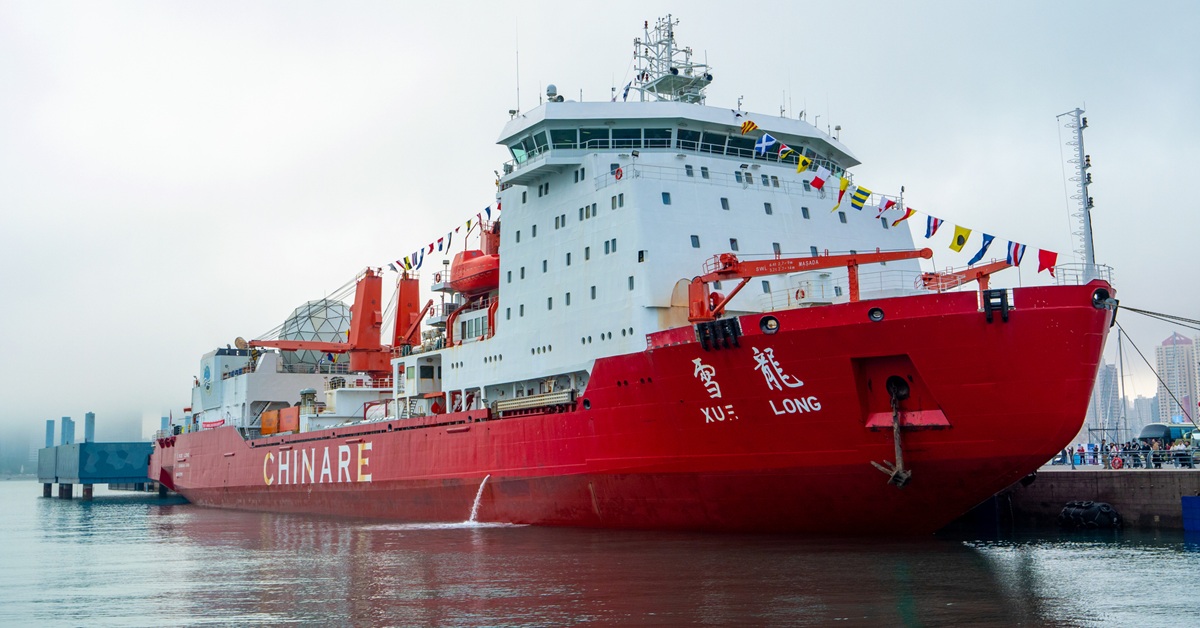
Several Chinese mining and transportation projects blossomed across the Arctic, with Russia quickly rising to prominence among China’s preferred partner. The Chinese shipping company Cosco initiated a transit journey in 2013 to assess profitability and was followed by several transits along the Northern Sea Route (NSR). The Chinese icebreaker Xuelong carried out several voyages to the Russian and Canadian Arctic areas and China undertook the construction of several icebreakers – it now operates 4 plus one light icebreaker; all being operated by research organizations. Chinese companies expressed a keen interest in the port of Kirkenes in Norway; in the Kirkenes-Rovaniemi projected railway; in the projected Belkomur railway in Russia linking Perm with Arkhangelsk and Indiga. Chinese companies also developed a solid business relation with Russian partners in the development of Siberian gas fields: China National Petroleum Corporation (CNPC) holds 20% and the Silk Road Fund 9.9% of Yamal LNG, while CNOOC and CNODC (subsidiary of CNPC) each acquired a 10% stake in Arctic LNG 2 in 2019. In 2014, China and Russia signed a 30-year gas deal worth $400 billion which made the construction of the sub-Arctic gas pipeline Power of Siberia 1 feasible – the tube was completed in 2019.
Russia and China launched the Ice Silk Road concept in 2017, which combines the development of the Arctic with China’s Belt and Road Initiative. An MoU was signed between China and Russia in 2022 framing out a deeper economic cooperation on Arctic development, and notably a pledge to develop the NSR. This MoU was followed in March 2023 by a pledge to establish a joint body to promote traffic along the NSR, and in October 2025 by yet another agreement to further develop commercial shipping along the NSR. Russia’s Federal Security Bureau and China’s Coast Guard also signed an MoU to cooperate on maritime law enforcement in 2023. Subsequently, Russian and Chinese naval vessels conducted joint patrols near the Aleutian Islands off Alaska and in 2024 in Siberian waters.
Indeed, Chinese shipping company NewNew Shipping Line and Russia’s Atomflot announced the construction of five Arc7 ice-class container ships. In September 2025, another Chinese company, Haijie/Sea Legend launched a « regular but seasonal » container line between China and Europe along the NSR.
A really special relationship?
Russia’s relationship with China in the Arctic proves not as smooth and open as media report. If indeed economic cooperation led to agreements on Chinese investments in gas extraction, in the projected development of the NSR, Russia clings to the idea Russian sovereignty is paramount and flatly rejected a Chinese proposal to use its icebreakers to escort commercial convoys along the NSR. Conversely, China did significantly increase its imports of Russian oil and gas after the outbreak of the war in Ukraine, taking advantage of much lower prices Russia had to offer in the frame of Western sanctions, but proved very reluctant to invest in the construction of the Power of Siberia 2 pipeline designed to export its vast volumes of Siberian gas it no longer sells to Europe – an MoU was signed in September 2025 but the terms can still be adjusted, especially in the context of the war between the US, Israel and Iran begun in March 2026. So far, China has also refrained from investing in the giant Vostok Oil project in the Taymyr peninsula and in coal projects in the same area, despite invitations from Moscow.
In the shipping business, indeed China became Russia’s largest foreign partner in the development of transit shipping, but this is largely because sanctions drove several foreign companies away. Chinese State-owned company Cosco withdrew from the scene in 2022 and the two active Chinese companies, NewNew Shipping and Haijie, account for about 15 transits per year. Though they pledged to further develop their activities, this traffic remains very marginal and far short of Moscow’s ambitions for the NSR. Besides, China proved very reluctant to invest in infrastructures to uphold the development of marine transportation along the NSR. China does not demonstrate any commercial interest for the Northwest Passage.
The fading away of China’s economic attraction
As far as natural resources extraction is concerned, few projects with a significant Chinese involvement proved successful. There is a nickel mine in northern Quebec owned by Jilin Jien. In Greenland, among the four mining projects that involved Chinese companies (rare earths in Kvanefjeld ; iron ore at Isua ; copper at Wegener Halvø, zinc at Citronen), all are either stalled or closed, and iron mining projects in northern Quebec have also been shelved in the past years, as have all project involving Chinese companies in the past ten years. Chinese companies willing to bid for contracts to modernize airports in Greenland were blocked and withdrew in 2019 from these public markets. In Alaska, China Investment Corp. (CIC) owns only 10% of the huge Red Dog zinc mine. The re-development of the Sydvaranger iron mine in northern Norway never materialized so far and neither the development of the port of Kirkenes, the shelved Kirkenes-Rovaniemi railway or the Perm-Indiga railway. In Iceland, the exploration for oil in the Dreki area led to nothing. Finland had nurtured high hopes with a partnership with China, with high hopes to become the Arctic Gateway to China’s Belt and Road Initiative but was disappointed and halted economic cooperation in 2022. The deepening political tensions between Western States and China, the image of an increasingly authoritarian regime in Beijing; the suspicion that Chinese vessels were involved in the cutting of gas pipes and communication cables on several occasions in 2022, 2023 and 2024, and the disenchantment about the very limited economic achievements of the cooperation led to several Nordic States stepping back from their initial keen interest in China’s economic proposals.
Conclusion
Chinese companies have invested in the Arctic region and some of these projects are economically significant for their host countries. Most business investments have been completed in Russia. China has also been very active in signing agreements with Moscow to cement economic and political cooperation. But this cooperation is not without limits, as China proves reluctant to invest in costly gas projects from Russia, and as Russia remains suspicious about China’s desire to expand its maritime activities in the Arctic.
The scale and scope of actual Chinese investments are often exaggerated in media and public debate. Many projects have either been blocked or stalled. Contrary to what is often mentioned, China did not invest in Russian ports to promote shipping along the Northern Sea Route.
Contradictory analyses circulate about China’s policy about the Arctic. Some observers stress the fact President Xi Jinping has expressed his desire at home to make China a “polar great power,” a phrase generally missing from official documents published in English. Others hint at the fact China now refrains from mentioning the concept of « near-Arctic States » as a way to appease potential tensions. Whatever China’s intentions, the fact is Beijing remains interested in the Arctic area, with most of its attention focused on Russia, after suffering several economic setbacks with Canada and Nordic States
Frédéric Lasserre
Professor
Geography Department, Laval University
Canada
Frederic.lasserre@ggr.ulaval.ca