
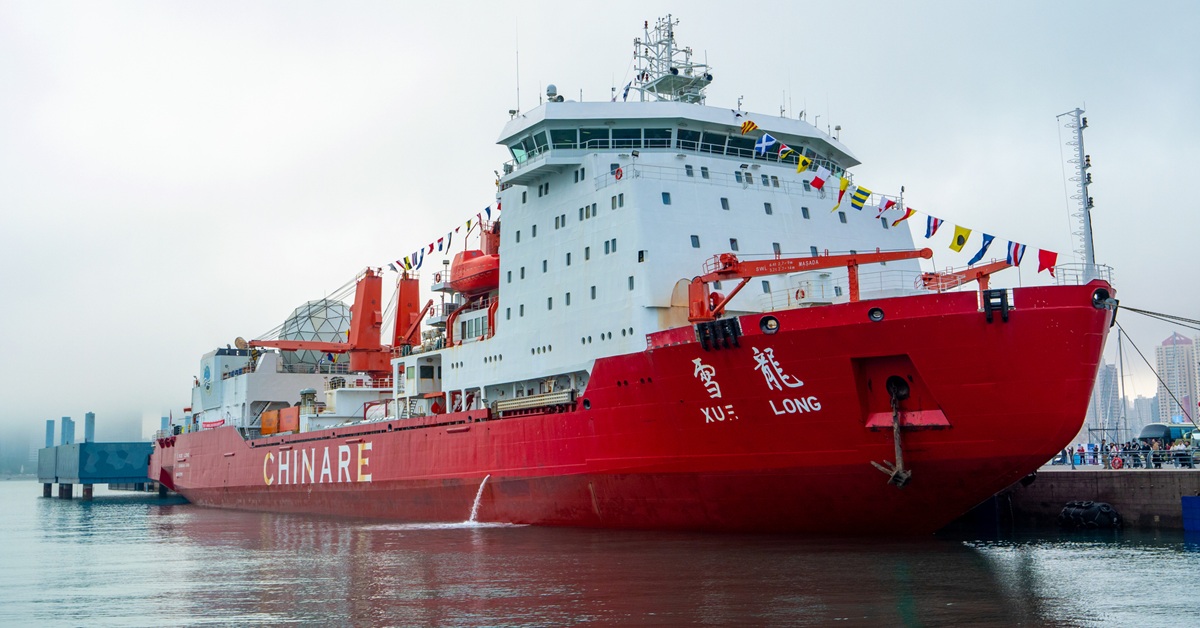
In October 2025, using the northern sea route (NSR), the containership Istanbul Bridge sailed from Ningbo-Zhoushan Port to the UK port of Felixstowe in just 20 days.1 Although the Istanbul Bridge flies the flag of Liberian,2 a flag of convenience, it is lauded by China State media as “the first ship on China-Europe Arctic route”.3 This symbolic voyage marks a return of China’s Polar Silk Road (PSR), which has evolved to focus on using shipping route and energy cooperation with the Russian Federation.
The ‘Polar Silk Road’ was officially announced by China’s 2018 Arctic Policy White Paper in Part IV, Section 3.1 ‘Utilizing Arctic Resources in a Lawful and Rational Manner’.4 Although China has strong interest in developing and using Arctic shipping routes, fearing Western sanctions, especially the U.S. secondary sanctions,5 Chinese investment and Chinese flagged vessels hold back along the PSR after the outbreak of Ukraine War for a while.6 Nevertheless, the interest is not waning away. Rather, China is adapting to new reality. This is evidenced by the establishment of NewNew Shipping Line (新新海运)in 2022, aiming to provide a regular container service only between Russian and Chinese ports, using the NSR.7 In the forseeable future, the PSR will continue to grow between China and Russia. There are two reasons for that.
The first reason is the overwhelming Western sanctions on Russia, especially since the 2022 Ukraine War. The EU has introduced a total 18 packages of sanctions against more than 2,500 Russian individuals and entities.8 Meanwhile, the United States is using powerful primary sanctions and secondary sanctions9 against Russia10. Russian oil and gas industry, the main source of income for the Russian Federation, needs to find a new market. Russia, left with limited choice,11 has become China’s largest crude oil provider since 2023.12 It also accepts Renminbi for Russia-China oil and gas trade.13
The second reason is intensified U.S. – China competition. Given the U.S. is an Arctic State, while Canada, Norway, Denmark (Greenland), Finland, Sweden and Iceland are all members of the North Atlantic Treaty Organization (NATO),14 China’s move in these parts of the Arctic got a cold shoulder. In fact, most Chinese investment in non-Russian Arctic have stalled or failed.15
A reviving PSR is consolidating a geopolitically divided Arctic, with Russia and China in the same camp. This perhaps also reflects the current world order.
Nengye Liu
Associate Professor of Law
Yong Pung How School of Law, Singapore Management University
Singapore
nengyeliu@smu.edu.sg
1See for example, Laura Paddison, This sea route has been dismissed as too treacherous, China’s taking the risk, CNN, 3 October 2025, https://edition.cnn.com/2025/10/03/climate/china-arctic-shipping-northern-sea-route
2Lawson Brigham, Arctic Voyage of the Containership Istanbul Bridge and the IMO Polar Code, Arctic Today, 3 November 2025, https://www.arctictoday.com/arctic-voyage-of-the-containership-istanbul-bridge-and-the-imo-polar-code/
3“First ship on China-Europe Arctic route docks in Britain”, Xinhua, 14 October 2025, https://english.news.cn/20251014/db56a0785f0e46aab5fde7c5ca043d5b/c.html
4State Council of People’s Republic of China, China’s Arctic Policy White Paper, 26 January 2018.
5For example, COSCO Shipping Tanker (Dalian) Co., Ltd. was sanctioned by the U.S. Treasury Department’s Office of Foreign Assets Control (OFAC) in September 2019 for alleged involvement in transporting Iranian oil. The sanctions were removed on January 31, 2020, thanks to China-U.S. Economic and Trade Agreement signed on 15 January 2020. See Cai, note 95 above, p.427.
6See for example, Joshua Minchin and Cichen Shen, Threat of sanctions is holding back the northern sea route, Lloyd’s List 9 July 2024, https://www.lloydslist.com/LL1149837/Threat-of-sanctions-is-holding-back-the-northern-sea-route
7Malte Humpert, China-Russia Announce Plans for Five Ice-Capable Containerships for Year-Round Arctic Service, High North News, 15 October 2024, https://www.highnorthnews.com/en/china-russia-announce-plans-five-ice-capable-containerships-year-round-arctic-service
8Consolidated text: Council Decision 2014/145/CFSP of 17 March 2014 concerning restrictive measures in respect of actions undermining or threatening the territorial integrity, sovereignty and independence of Ukraine. See also Council of the European Union, EU sanctions against Russia explained, https://www.consilium.europa.eu/en/policies/sanctions-against-russia-explained/
9“Sanctions may be primary or secondary in relation to the sanctions target. Secondary sanctions are used to maintain or put additional pressure on the sanctions target by penalizing third parties that engage with the primary sanctions target in activities that could undermine or evade the purpose of the primary sanctions.” Sarah Krulikowski, Economic Sanctions: An Overview, Executive Briefings on Trade, March 2024, U.S. International Trade Commission. See also, Charlotte Beaucillon, ‘ Secondary Sanctions’ What’s in a Name? in Cedric Ryngaert, Tom Ruys and Felipe Rodríguez Silvestre (eds), Cambridge Handbook of Secondary Sanctions and International Law (Cambridge University Press, 2024), 13-36.
10See U.S. Department of State, Ukraine and Russia Sanctions, https://www.state.gov/division-for-counter-threat-finance-and-sanctions/ukraine-and-russia-sanctions
1190% of the EU oil imports from Russia are covered by the EU oil ban. Further, G7+Australia and the EU has set up an Oil Price Cap Coalition. This would put sanction measures (e.g., port access and insurance service) on vessels who participate in shipments of Russian-origin crude oil and petroleum products to other countries, if prices exceed the caps. The price cap was originally set up as US$60 per barrel on 5 December 2022. At the time of writing in July 2025, it is US$ 47.6 per barrel. See Statement of the G7 and Australia on a price cap for seaborne Russian-origin crude oil, 2 December 2022.
12China-Russian Energy Cooperation a bright future, China Energy News, 20 May 2024, https://paper.people.com.cn/zgnyb/html/2024-05/20/content_26059800.htm (in Chinese).
13China-Russia energy deals now settled in yuan, rubble: official, Global Times, 23 April 2023 https://www.globaltimes.cn/page/202304/1289651.shtml
14Canada, Denmark, Norway and Iceland are NATO founding members since 1949, while Finland and Sweden joined NATO in 2023 and 2024 respectively, after the Russian invasion of Ukraine. See NATO Member Countries, https://www.nato.int/cps/en/natohq/topics_52044.htm
15Hilde-Gunn Bye, Report: Most Chinese Investments in the Arctic have not fully materialized, High North News, 25 June 2025, https://www.highnorthnews.com/en/report-most-chinese-investments-arctic-have-not-fully-materialized
Back to Table of Contents