
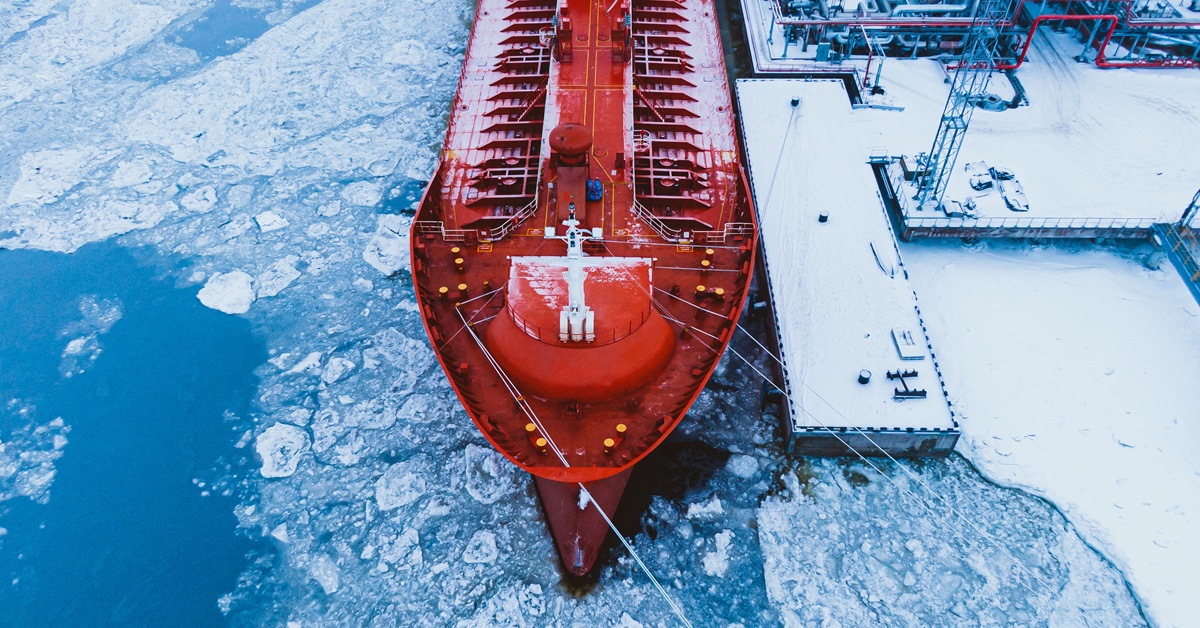
During Vladimir Putin’s latest visit to Beijing in May, the Arctic was once again on the agenda. Although Putin yet again failed to secure a Chinese commitment to the Power of Siberia‑2 gas pipeline, the joint statement did mention that Russia and China would “consistently promote practical cooperation in order to increase cargo flow along the Northern Sea Route.” This reference to Arctic shipping was a reminder of China’s Polar Silk Road initiative, which made a lot of noise a few years ago but is rarely heard from China’s official circles nowadays.
When the Polar Silk Road initiative was launched, it was hailed as China’s strategic foray into the Arctic, and as a bid to reshape the future of Arctic shipping and economic development. The US Department of Defense’s 2024 Arctic Strategy even describes the Polar Silk Road as a tool for Beijing “to gain a footing in the Arctic by pursuing investments in infrastructure and natural resources, including in the territory of NATO Allies.”
It is now nine years since China’s State Council, in June 2017, announced a desire to develop a “blue economic passage…leading up to Europe via the Arctic Ocean” as part of the 21st Century Maritime Silk Road. That vision soon became known as the Polar Silk Road (冰上丝绸之路, literally, the “Silk Road on Ice”). The term itself was coined by Xi Jinping in July 2017 during a meeting with then–Russian Prime Minister Dmitry Medvedev in Moscow. Xi declared that China and Russia “must carry out cooperation on Arctic waterways, jointly build the ‘Polar Silk Road’, and implement relevant connectivity projects.”
For Moscow, this was the result of years of work to attract Chinese investment to the Russian Arctic. Ever since Russia endorsed the Belt and Road Initiative (BRI) in 2015, Russian officials have pushed to bring the Arctic and the Northern Sea Route (NSR) into the BRI framework. That same year, the Arctic was explicitly referenced in a bilateral communiqué as an area for “joint development and utilization of the Northern Sea Route” and Arctic shipping. The Silk Road Fund went on to acquire a 9.9 percent stake in Novatek’s Yamal LNG project in 2015 and extended it a long‑term credit, which was a significant boon in light of Western financial sanctions after the annexation of Crimea in 2014. Yet from the Chinese perspective, the Polar Silk Road was always more than a piggy bank for Russian Arctic plans. Beijing conceived it as a broader, international extension of the BRI, aimed at connecting Asian and European markets via an Arctic sea corridor.
These divergent goals and expectations became visible in practice. China’s state‑owned shipping giant COSCO began experimental voyages along the Northeast Passage in 2013 and, in the years that followed, used the route to connect China and Western Europe. COSCO’s focus was on linking Chinese ports with European ones, not Russian Arctic ports. After Russia’s full‑scale invasion of Ukraine in 2022, this tentative international transit effectively stopped. COSCO halted Arctic sailings and has not resumed them yet, even on routes where it uses ice-capable ships, such as pulp shipments from Finland to China.
Smaller Chinese players have filled this vacuum. Hainan Yangpu NewNew Shipping has opened container routes between Russian ports and China via the NSR. New Polar Shipping has carved out a niche in the Russia–China trade and has even concluded a cooperation agreement with Rosatom, the Russian state enterprise that manages the Northern Sea Route and the nuclear icebreaker fleet. In August 2025, another Chinese firm, Haijie (Sealegend) Shipping, announced a new “Arctic express” route and connected Ningbo with Felixstowe. That voyage represented the first international transit through the Northern Sea Route between two non‑Russian ports since 2022.
On the political level, Moscow and Beijing have tried to give this cooperation a more formal framework. A joint body on the Northern Sea Route has been created as a sub‑commission under the Russia–China Commission for the Preparation of Regular Meetings between the Heads of Government. The two countries have even approved a roadmap to expand shipping and establish what they describe as a “sustainable transport corridor,” including advanced logistics solutions and capital projects along the route. Despite this, the cooperation between the two countries on the Northern Sea Route remains rather superficial.
The Polar Silk Road has provided a flexible label under which China and Russia can cooperate where their interests overlap, while maintaining considerable autonomy. Russia was never entirely comfortable with the Northern Sea Route being absorbed into a Chinese Belt and Road geography, and has not used the term Polar Silk Road. Likewise, it has not been heard from high-level Chinese authorities in a while. Notably, the Polar Silk Road did not appear in the outline of the 15th Five‑Year Plan presented this March. This label remains most useful for lower-level Chinese officials and journalists, as well as Western think tank experts covering China’s Arctic activities.
All this suggests that, while the Polar Silk Road has not completely fallen into obscurity, it is no longer considered a core component of Chinese economic planning. Compared to other flagship BRI corridors, which rely on large‑scale, Chinese‑financed infrastructure, built and often operated by Chinese firms, the Polar Silk Road has always been secondary and experimental. Even if this label is not used under current circumstances, Chinese interest in Arctic shipping will certainly not disappear. Under the right conditions, China might yet defrost the Polar Silk Road.
Erdem Lamazhapov
PhD Research Fellow
Fridtjof Nansen Institute
Norway
elamazhapov@fni.no
Back to Table of Contents