
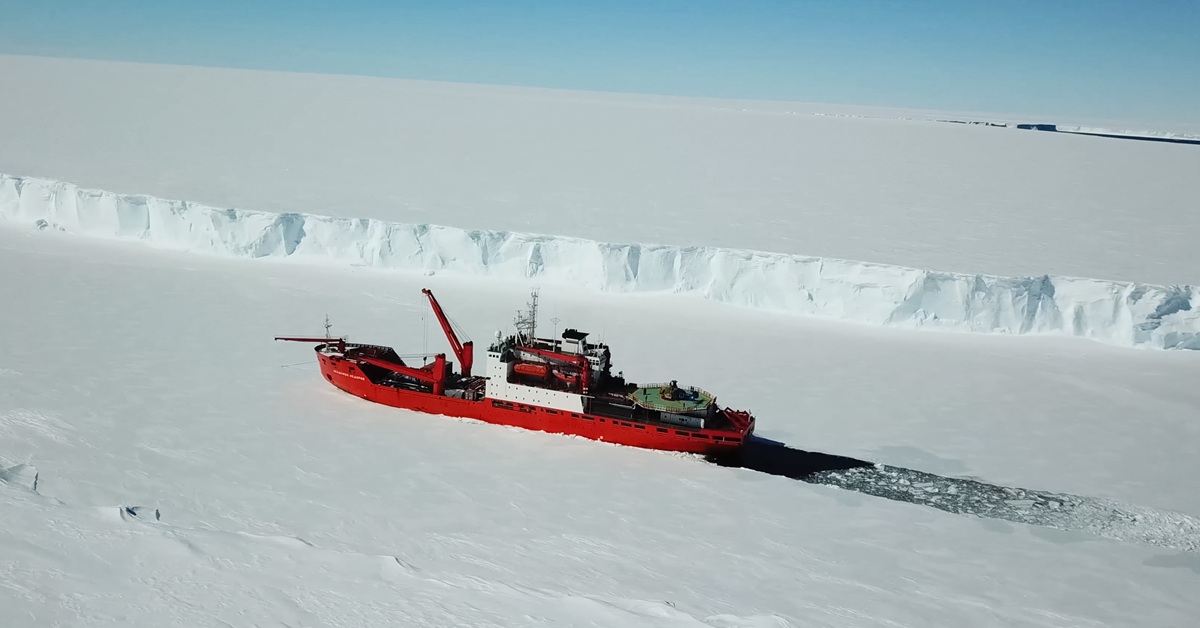
The Far North, traditionally associated with peace and ice, has turned into one of the hottest chessboards in the global economy. Although China is thousands of kilometers from the North Pole, Beijing officially declares itself a “near-Arctic state.” The “Polar Silk Road” it has drawn is already changing the trajectory of the Nordic regions’ factories, ports, and everyday commodity prices. Today, Nordic Europe faces an extremely difficult puzzle: how to restructure its economic relations with the Asian giant and how much will the average consumer have to pay for it?
Currently, an intense struggle is taking place in the North for control of new shipping routes. Melting Arctic glaciers rapidly open the Northern Sea Route. It cuts the journey from Asia to Nordic European ports to a record 18–20 days, compared to the 40-day voyage through the Suez Canal. Chinese shipping companies are not waiting for the future. The Asian company Sea Legend’s ship Istanbul Bridge made the first direct voyage from China to UK via the Arctic in just 20 days. Last navigation season, Chinese ice-class ships made a record number of container voyages on this route, and the amount of cargo reached 400,000 tons – a 2.6-fold increase compared to previous years. As traditional routes in the south become vulnerable due to geopolitical conflicts, Beijing aims to become an architect of the new geography of world trade.
This development is possible only because China has already penetrated deep into the Arctic economy. Over the past decade, Chinese capital has purposefully invested billions of euros in major Russian Arctic energy projects, such as the Yamal liquefied natural gas (LNG) production complex, where Chinese state-owned enterprises own nearly 30% of the shares. At the same time, Beijing has actively sought to acquire partial control of infrastructure and land plots in the transport hubs of Norway, Sweden, and Finland, turning the polar region into an important trading bridgehead for its industry.
The true asymmetry of this integration is best seen in the vaunted Nordic Green Deal. Sweden, Finland, and Norway have invested billions of euros to become the heart of European electric car batteries and renewable energy. However, the paradox of a clean future is that its production is technically impossible without China, which controls more than 80 percent of the world’s rare earth metal processing capacity. For comparison, the Swedish company Northvolt, which built giant battery factories in the North, must import most of its purified active materials from Asia, because industrial processing plants simply do not exist in Europe. To build a wind farm in the Baltic Sea or assemble an electric car in Scandinavia, essential components must come from Chinese hands. Even digital technology giants like Ericsson or Nokia still rely on a global production base in the East.
This structural dependence forces the region to model future scenarios. If the EU chose the strictest path – complete economic decoupling – regional industry would experience a sudden shock. If the supply of Chinese raw materials were cut off, production costs in the Nordic countries would increase by about 15–20% in the short term. For consumers, this would mean a new wave of inflation, and ambitious climate goals would simply be frozen, as alternative technologies would become financially unaffordable.
For this reason, the so-called de-risking model is gaining popularity. Nordic countries are actively looking for alternatives in Asia and trying to invest in local extraction – such as the rare earth deposits discovered in the Kiruna region of Sweden or in the Greenland ice. However, economists remind us that building new processing plants in Europe takes a decade and requires huge state subsidies. Production will become safer, but it will lose its price advantage on the global market, and taxpayers will ultimately pay the bill for this transformation.
On the other hand, there is a pragmatic stabilization scenario, supported by the logistics sector. If the region keeps its doors open to China’s ice-strengthened container ships, Arctic routes will allow Nordic exporters to earn significantly more and reach Asian consumers more quickly. However, choosing this path means that short-term gains would leave the region directly dependent on Beijing’s economic fluctuations and the conditions it dictates in the Far North.
Ultimately, the region is faced with a fundamental choice, with no easy answer. China and its Arctic ambitions have become an integral part of industrial and logistics ecosystem. Any sudden pull on the rope would be a severe blow to local businesses. Future prosperity will depend on whether governments manage to find a middle ground: to create sufficient safeguards for the local market and critical infrastructure, but not to completely close the door to global trade and the efficiency of the Arctic routes, which have guaranteed the region’s economic success for decades.
Jonė Kalendienė
Associate Professor
Vytautas Magnus University
Lithuania
Chief Economist
Lithuanian National Promotional Bank ILTE
Lithuania