
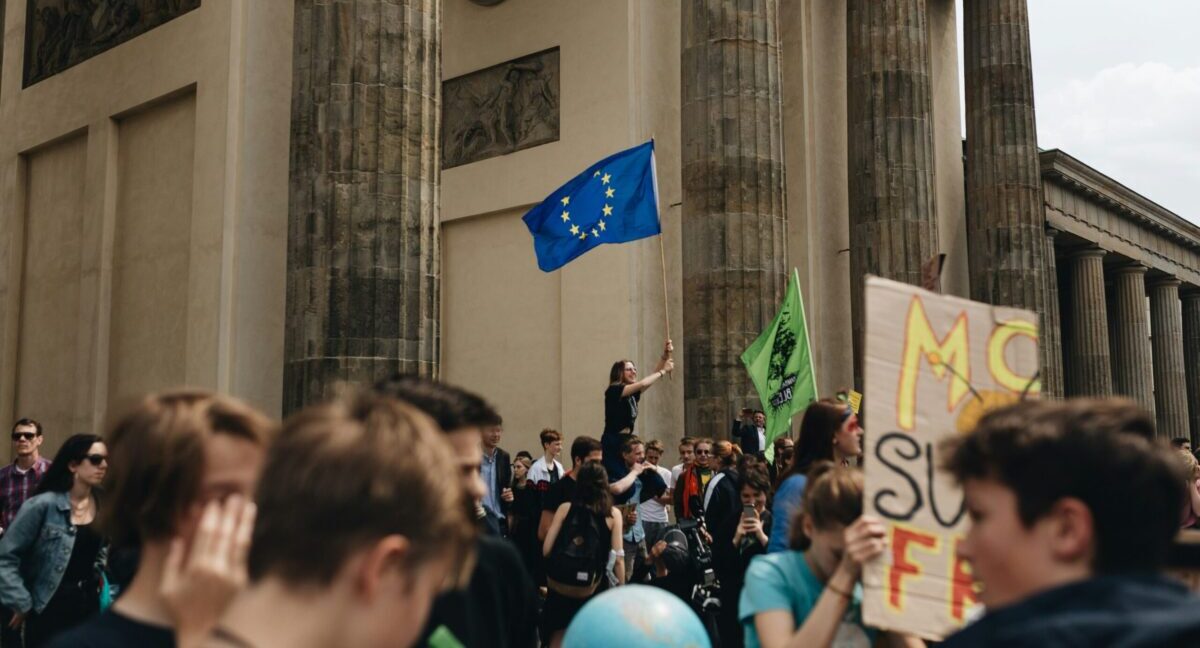
Youth activists on both sides of the Atlantic are responding to a shared sense of perpetual crisis. The formative years of Millennials (born between 1981-1996) and Generation Z (born between 1997-2012) have been characterized by economic crashes, climate catastrophes, a global pandemic, and geopolitical conflicts escalating intoforever wars while new information technologies have permanently changed all aspects of modern life.
As age cohorts, Millenials and Generation Z are more educated and more demographically diverse than the previous generations. At the same time, their lives are often defined by precarity: costly higher education degrees without corresponding employment opportunities and temporary service jobs without work protections or financial security.
The global and intertwined nature of these crises and conditions, a phenomenon sometimes called as polycrisis, has made politics existential and old institutions seem incapable of fixing problems. Studies show that the youngest cohorts are less satisfied with democracy than any generation before them.
Distrust of political institutions can lead to apathy. However, significant amounts of young people have turned towards non-traditional politics and activism. Social media in particular has changed youth political participation. Youth politics on social media are inescapably global and intensely personal. Influence and information spreads in informal and decentralized networks on social media through viral content instead of official organizations with hierarchies. Engagement with activism and politics is far easier, which has enabled fast, largescale mobilization for different issues across the world.
”“Youth politics on social media are inescapably global and intensely personal.”
Both issues and tactics travel to the most local-level politics. For example, while Palestinian advocacy has a long history on both sides of the Atlantic, the emergence of campus encampments showed how U.S. protest culture and styles influence action in Europe. Particularly during the spring of 2024, Gaza solidarity encampments were established in campuses across the U.S. The encampments were set up in response to the current Israeli military offensive in Gaza that started in the aftermath of the October 7th Hamas attacks in 2023. Students and some staff members occupied university grounds to call on universities to divest from their close financial ties with Israel and to bring an end to what protesters and several international organizations called genocide in Gaza.
The Gaza solidarity encampments quickly sparked similar action in European universities in places like the UK, the Netherlands, France, Sweden, and Finland. The encampment tactic used by the activists was not new or unique, but the speed and scale of which they were employed across the ocean was a testament to how networked and global activism is in the era of social media.
The diffusion of ideas and action works in both directions. Fridays for Future school walkouts started by Greta Thunberg in 2018 in Sweden sparked youth mass mobilization for climate action all over the world. Thunberg had been inspired by the March For Our Lives school walkouts organized earlier that year by students in the U.S., who had protested gun violence in the wake of a devastating school shooting in Parkland, Florida.
Today, Thunberg is most actively involved in the Pro-Palestine movement. The connections between movements for climate justice, gun violence prevention, and an end to the war in Gaza show how youth activism is also diffusing from issue to issue, sparking waves of protest across the U.S. and Europe. Instead of young people organizing for different causes, issues like climate change, gun violence, and war are seen to be fundamentally about the same structural problems.
That is not to say that the youngest generations, or the movements they lead, are monolithic. Distrust of political institutions has also mobilized young people for rightwing populism. The gender divide is significant among Generation Z, and particularly young men have found common cause with movements that hold nationalistic, antifeminist, and anti-immigrant views. Their political participation is often visible in online spaces and the scale and goals of their activism opaque.
Across the ideological spectrum, youth activists in Europe and United States are influenced by each other. Such direct action strategies like encampments, sit-ins, and teach-ins were made popular by the civil rights movement in the U.S. in the 1950s and 1960s. Youth movements in Europe have found ways to repurpose that long history in their own contexts when seeking liberation for traditionally marginalized groups. Conversely, youth activists in the U.S. have been able to borrow language from European youth movements on how to demand more from their government—how to frame issues such as education, housing, and healthcare as basic human rights.
Mila Seppälä
Postdoctoral Fellow
John Morton Center for North American Studies
University of Turku
Finland
mitase@utu.fi
