
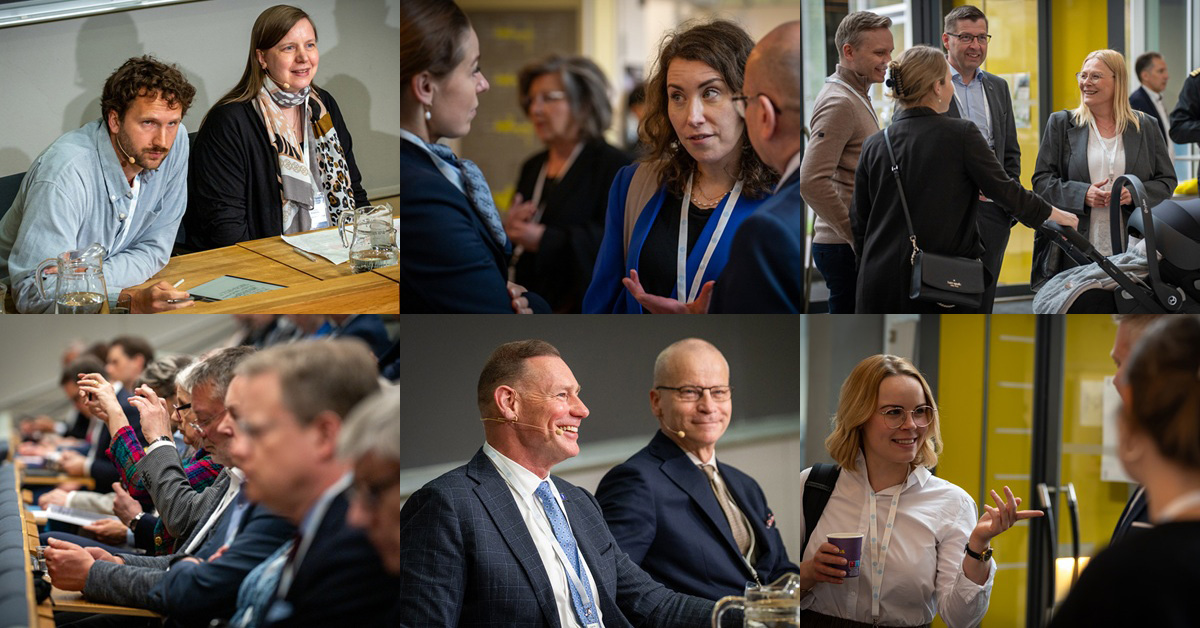
Security, strategic intelligence and logistics of the northern and Arctic area were in focus at the Baltic Sea Region Forum in Turku on 4th May. A record 580 participants had registered for the event, part of the audience followed the discussion on site and part online. It’s possible to return to the event by watching the recording on YouTube.
Europe’s global strength comes from more than military capabilities
Taneli Lahti, Director at the European Commission’s DG International Partnerships highlighted the European Union’s enduring strength as a global actor. He argued that in today’s geopolitical environment, economic tools such as trade, investment, and technology governance are central to power, not secondary to military capabilities. Lahti also underlined the EU’s role as a comprehensive security actor, able to combine diplomacy, economic policy, and regulation to strengthen resilience across critical sectors.
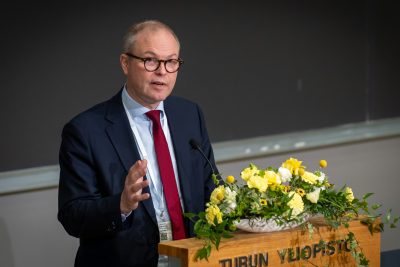
Taneli Lahti, Director for Sustainable Finance, Investment and Jobs, DG International Partnership, European Commission
Baltic Sea and Arctic security are increasingly interdependent
In his address, Chief of Defence Janne Jaakkola emphasised that the Baltic Sea and the Arctic should be understood as a single, interconnected strategic space, where tensions in one region can quickly spill over into the other. He highlighted how today’s security environment is defined by speed, with crises unfolding rapidly and decision-making timelines shrinking, while the risk of miscalculation grows. Jaakkola also stressed that Europe must take greater responsibility for its own defence as the transatlantic relationship evolves. This, he argued, requires deeper cooperation, stronger capabilities, and above all the ability to adapt quickly to a rapidly changing security landscape. “It is about readiness, it is about preparedness, but it is even more about the capacity to adapt.”
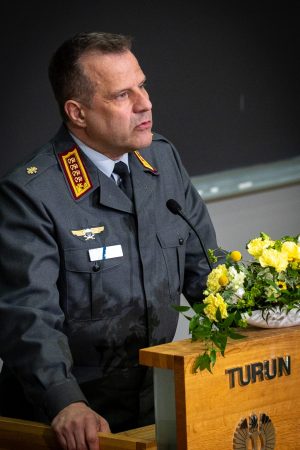
Janne Jaakkola, General, Chief of Defence, Finnish Defence Forces
Russia, China and NATO reshape the Arctic security landscape
The panel Strategic Competition in the High North explored how the Arctic is rapidly transforming from a region of low tension into a key arena of geopolitical rivalry. The discussion highlighted Russia’s view of the Arctic as a core strategic and military space tied to nuclear deterrence, energy exports and great-power status. China’s growing role in the Arctic is due to Russia’s dependence on China. “China has become inevitable for Russia economically and technologically after the invasion of Ukraine.”, as Director Alexander Gabuev from Carnegie Russia Eurasia Center in Berlin noted.
The panelists examined the security implications of Finland and Sweden’s NATO membership, and the weakening of traditional Arctic cooperation structures following Russia’s invasion of Ukraine. Speakers also stressed that environmental sustainability, climate change and critical infrastructure are now inseparable from broader security and geopolitical concerns in the High North.
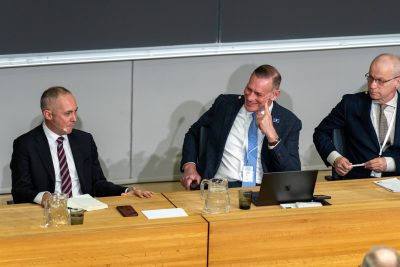
Panel participants Alexander Gabuev, Robert Hamilton and Mika Hentunen
Intelligence in transition
In the panel discussion Strategic Intelligence and the Region, experts highlighted how Russia’s intelligence and hybrid activities in the Baltic Sea Region have become more risk-tolerant, decentralized and difficult to attribute. Panelists examined whether European countries should respond more proactively to gray-zone threats, balancing deterrence, legality and the risk of escalation. “We should definitely be more aggressive because one is certain that Russia is going to escalate. And so far we are reacting to this.”, former Director General of the Estonian Internal Security Service Arnold Sinisalu stated.
Another central theme of the panel was the changing relationship between intelligence services and society: participants noted that intelligence agencies are communicating more openly with the public, seeking greater legitimacy and public participation in identifying threats. The panel also underlined the need for stronger European cooperation, democratic resilience and a more mature public debate on intelligence and security issues.
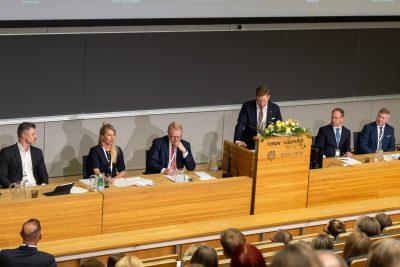
Panel participants Bjørn Grønning, Kira Vrist Rønn, Ilkka Salmi, chair Kasperi Summanen, Arnold Sinisalu and Olli Teirilä
Critical infrastructure becomes a geopolitical battleground
The panel Critical Natural Resources and Logistical Infrastructure focused on how the Arctic and Baltic Sea regions are becoming increasingly central to geopolitical competition, energy security, and economic resilience. The discussion highlighted Europe’s vulnerabilities related to external dependencies, particularly concerning Russian energy and Chinese-controlled supply chains for green technologies and critical minerals. The panelists stressed that infrastructure such as ports, undersea cables, transport routes, and energy networks has become a key security issue alongside economic and environmental concerns. The discussion also emphasized the need for stronger Nordic, Baltic, and European cooperation to strengthen resilience, secure supply chains, and balance strategic interests with sustainability and democratic values.
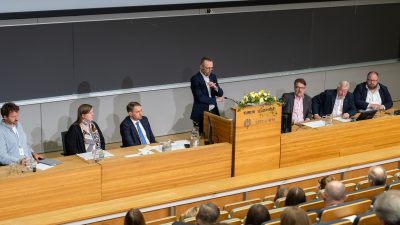
Panel participants Lars Gjesvik, Carina Keskitalo, Olli-Matti Mikkola, chair Jussi Orell, Ville Niinistö, Lauri Ojala and Benjamin L. Schmitt
Russia’s war is part of a broader struggle with the West
In his concluding remarks the Director of the Finnish Security and Intelligence Service Juha Martelius stressed that Russia’s war in Ukraine should be understood as part of a broader and enduring confrontation with the West, which will continue even if active fighting subsides. He highlighted Russia’s great power mindset as a key driver of its behaviour, alongside its reliance on China, which enables Moscow to sustain its war effort and pursue its strategic goals. “It’s not a partnership. Russia needs China. China is making the most of its relationship with Russia.”, Martelius said.
Martelius noted that the main challenges often lie not in the lack of intelligence, but in how it is interpreted and used by decision-makers. Overall, he emphasised the need for calibrated responses that impose costs while avoiding uncontrolled escalation.
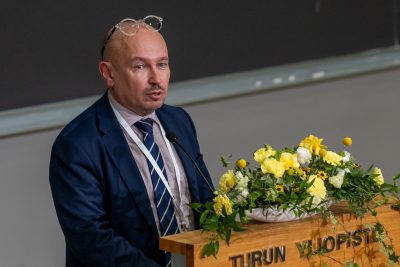
Juha Martelius, Director, The Finnish Security and Intelligence Service
More information about the Forum programme and speakers can be found on the event website.
