
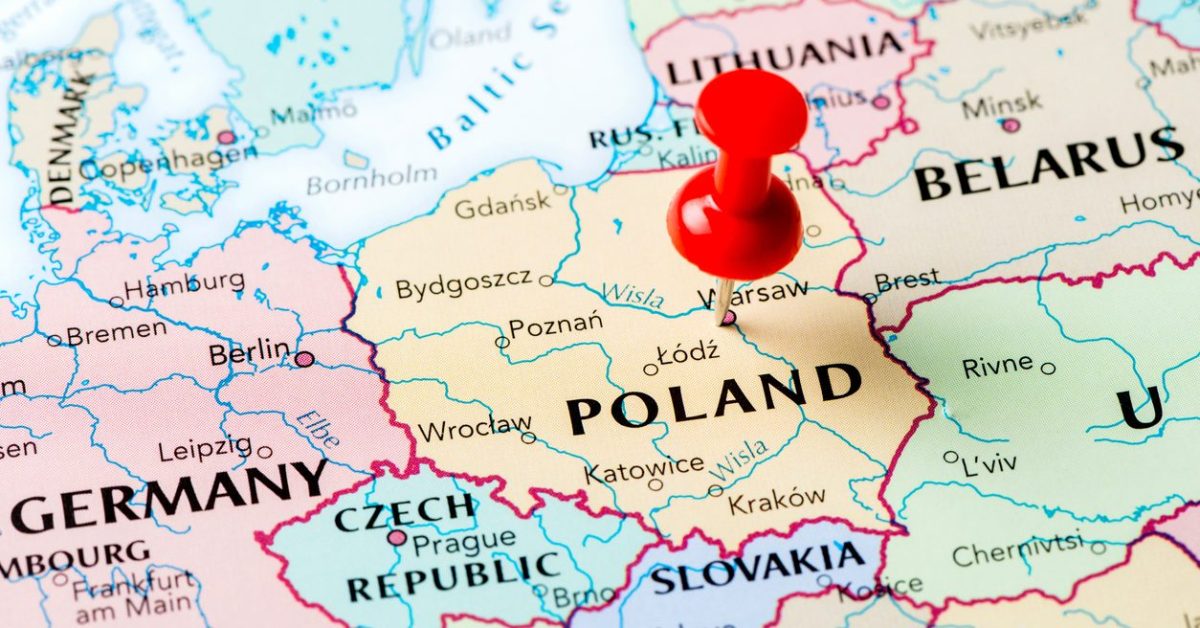
Poland was the first country to recognize Ukraine’s independence on August 24, 1991. This recognition of Ukrainian sovereignty shifted the regional security balance and distanced the historical threat posed by Moscow. Despite the continued existence of the Russian exclave of Königsberg (Kaliningrad), the emergence of a democratic Belarus and an independent Ukraine served as a safeguard against the theoretical reconstruction of the Russian Federation’s sphere of influence. From the very beginning, however, the geopolitical trajectories of Kyiv and Warsaw began to diverge significantly.
During the presidencies of Leonid Kravchuk and Leonid Kuchma, Kyiv perceived itself as a “bridge” between the European Community which was increasingly vocal about expanding into post-socialist countries and the Russian Federation, which, following Vladimir Putin’s rise to power, began exhibiting clear neo-imperialist tendencies. Poland, though also ruled at times by post-solidarity and post-communist governments, decisively chose a pro-Western orientation, aspiring to join not only the European Union but also the NATO military alliance. This division, rooted in the 1990s, has had a lasting impact on the situation unfolding in Ukraine since 2014.
Between 1991 and 2014, bilateral relations between Ukraine and Poland did not yield significant breakthroughs. Nonetheless, Poland’s supportive stance during Ukraine’s 2004 Orange Revolution and the co-hosting of the UEFA European Championship in 2012 contributed to a more positive perception of Ukraine among the Polish public. However, unresolved historical issues, such as the Volhynia massacre, in which Ukrainian nationalists committed atrocities against Polish civilians during World War II, and broader traumas from the German occupation, continued to foster mutual distrust in Polish-Ukrainian relations.
It is worth noting that it was only during Euro 2012 that Ukrainians had their first significant mass opportunity to visit Poland under simplified visa procedures. At the same time, the event brought European tourists to Ukrainian cities like Kharkiv and Donetsk, which previously had little contact with the “West”. This relatively underappreciated phenomenon had a considerable influence on Ukrainian society, particularly in the eastern and southern regions where Russian propaganda had been most pervasive. These firsthand encounters with Western lifestyles, as experienced in Poland, led many Ukrainians, particularly the generation born after 1991, to question whether Poland’s “western” development model might offer greater prosperity. This shift in perception was a critical factor behind the 2013-2014 Euromaidan movement, also known as the Revolution of Dignity.
Poland, consistent with its long-standing eastern policy, supported Ukraine’s pro-Western aspirations. However, this policy has not significantly evolved from the 20th century interwar-era Prometheanism, which sought to weaken Moscow and support independent statehood within the territories of the former Tsarist (and later Soviet) Empire. The contemporary Polish approach is focused on creating political, economic, and cultural cooperation platforms, such as the Lublin Triangle (involving Poland, Lithuania, and Ukraine, with the potential future inclusion of Belarus) and the broader geopolitical doctrine of the Intermarium. The “Three seas” initiative brings together 13 European Union member states located near the Baltic, Black, and Adriatic Seas- Austria, Bulgaria, Croatia, the Czech Republic, Estonia, Greece, Hungary, Latvia, Lithuania, Poland, Romania, Slovakia, and Slovenia- representing a combined population of 112 million EU citizens. Ukraine and Moldova currently serve as associated partners. Nonetheless, it is important to recognize that Poland, as a member of both the EU and NATO, primarily fulfils its alliance obligations.
Unlike most Western countries, Warsaw’s belief from the outset of Russia’s full-scale invasion of Ukraine in 2022 was that such aggression could be successfully repelled by Kyiv. Consequently, it did not symbolically evacuate its diplomatic missions from Ukraine’s capital or Lviv and immediately provided military and humanitarian assistance. Meanwhile, other allies hesitated, fearing escalation and broader regional destabilization. In the wake of Russia’s 2022 invasion, Poland has increasingly positioned itself not just as Ukraine’s advocate, but as a key player for regional security. Its consistent support for Ukraine has earned Warsaw greater credibility among NATO members and within the European Union. Furthermore, Poland’s calls for stronger sanctions on Russia, enhanced NATO presence in the region, and broader energy diversification have shifted the balance of influence within the EU and challenged the traditionally dominant positions of Germany and France. This evolution signals Poland’s emerging role as a bridge between Western Europe and the Eastern frontier, advocating for a more assertive stance against authoritarian threats. Poland’s early military aid was especially effective, as it consisted primarily of Soviet or modernized Soviet-era equipment that Ukrainian forces were already familiar with and could use without additional training. Moreover, repair infrastructure for such equipment was readily available ⎼ unlike the modern NATO gear provided later. Western military support began to materialize only weeks after Ukrainian resistance demonstrated competence.
Poland has also played a critical humanitarian role during the crisis. It not only opened its borders but provided substantial support to millions of Ukrainian refugees. In many cases, Polish citizens welcomed Ukrainians into their private homes, an invaluable response at a time when central authorities were unprepared for such a massive influx. While this now seems like a moral imperative, it is worth noting that many culturally similar countries have not extended similar support in the wake of other recent global conflicts, even when neighbouring populations faced starvation or war.
Over time, however, Poland’s priorities have shifted, both in terms of military and humanitarian aid. As a result of Minsk’s artificially created migration crisis on the Polish Belarusian border (with Lithuania facing the same issue), involving refugees from Syria, Afghanistan, and Sudan among others, fears of aggression from the East have heightened. Consequently, Poland is significantly expanding its armed forces and modernizing its military via large-scale arms purchases from the United States and South Korea as well as preparing defence structures to bolster its national defence. This evolving context necessitates a more strategic reassessment of ongoing military support to Ukraine. It should be emphasized that Poland, as a frontline state, faces different security imperatives than other NATO member states such as Spain or Italy, which at present do not face direct threats on NATO’s flank.
Public attitudes toward Ukrainian refugees are also evolving. Some of those currently residing in Poland originate from regions not directly affected by the land conflict, while new arrivals often seek social protection rather than immediate refuge from war. This dynamic has impacted public perception and intensified discussions around creating conditions conducive to the return of refugees to Ukraine, an outcome that could prove beneficial not only for Poland but also for Ukraine’s economic and demographic recovery. It is also important to acknowledge that a portion of Ukrainian migrants in Poland are Russian-speaking and, in some cases, hold pro-Russian views or repeat Russian propaganda narratives, which may pose risks to internal security.
In conclusion, the continued existence of a strong and independent Ukraine is essential for Poland, not only from a security standpoint but also for broader social and regional stability. However, despite the early enthusiasm and calls for solidarity, longstanding historical grievances and new strategic challenges are resurfacing. The issues of return, integration, and assimilation of Ukrainian migrants remain unresolved. Therefore, it is imperative that Kyiv and Warsaw create spaces for continued dialogue and cooperation- militarily, economically, and socially- to ensure long-term partnership and mutual security. Looking forward, Poland and Ukraine must not only navigate present-day crises but proactively plan for Ukraine’s postwar reconstruction. Polish firms and institutions are well-positioned to assist in rebuilding infrastructure, reforming governance, and restoring economic resilience. A coordinated Polish Ukrainian strategy for recovery, aligned with EU frameworks, could set a precedent for regional post-conflict stabilization efforts. Ultimately, a democratic, prosperous, and secure Ukraine is not just in Poland’s interest, it is the cornerstone of a stable European future.
Mateusz Kamionka
Assistant Professor
Department of Polish-Ukrainian Studies
Faculty of International and Political Studies
Jagiellonian University
Poland
mateusz.kamionka@uj.edu.pl