
China’s self-declaration as a “near-Arctic” state fueled skepticism among Arctic and non-Arctic States regarding Chinese strategic interests in the Arctic region. While in the early 2000s, academic and public debates largely focused on the security implications of China’s growing presence in the Arctic, more recent analyses converge in assessing China’s actual investment in the region as relatively limited. Instead, China’s most consistent growth has been in its scientific presence.
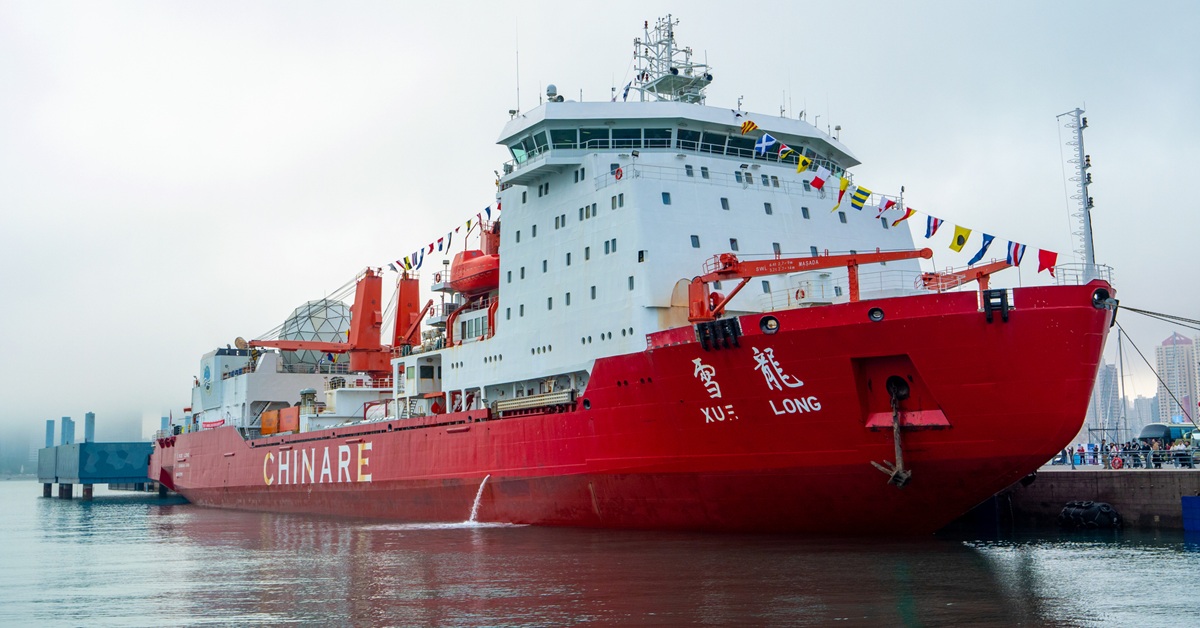
Since its first Arctic expedition in 1999, on board the icebreaker Xuelong purchased from Ukraine, China has considerably improved its polar capabilities. Since 2016, China has conducted yearly research expeditions often lasting nearly two months and involving scores of scientists. Over time, the domestically built second icebreaker Xue Long 2, and other vessels joined the polar-capable fleet. The 15th Arctic Research expedition (2025) represents China’s largest expedition, including the deployments of both icebreakers Xue Long and Xuelong 2, and three other ships: Tan Suo San Hao, Zhong Shan Da Xue Ji Di, and Shenhai-1. Notably, China also deployed the Jiaolong manned submersible, which performed a deep-sea dive beneath the polar ice and completed the world’s first coordinated crewed-uncrewed submersible operation in the Arctic. Beyond the headlines, these developments reveal how rapidly China has expanded its Arctic scientific and technological capabilities in recent decades.
Such an improvement is no coincidence. Strategic and long-term planning is a hallmark of China’s leadership and its Arctic interests. An analysis of the Arctic’s engagement in recent Five‑Year Plans (FYP) shows that science and technological development have become central pillars of the national agenda, highlighting the deep interdependence between scientific capacity‑building and China’s evolving governance objectives in the Arctic.
The XII FYP (2011-2015) called for enhancing the Arctic maritime capabilities, a goal realized through the construction of Xuelong 2. This was followed by the XIII FYP (2016-2020), which focused on “actively expand the space for marine economic development” (积极拓展海洋经济发展空间). By the XIV FYP (2021-2025), the strategy shifted towards “strong participation in the oceans’ global governance” (深度参与全球海洋治理) and the development of “blue partnerships” (蓝色伙伴关系). Furthermore, the plan advocated for extensive involvement in the formulation and implementation of international maritime governance mechanisms to promote a “maritime community with a shared future”. This implies deepening a pragmatic cooperation with coastal countries regarding the monitoring and protection of the marine environment, scientific research and search and rescue and participating in pragmatic cooperation and building the ‘Polar Silk Road’ (冰上丝绸之路).
The trajectory spans from building physical infrastructure and participating in governance mechanisms to developing an indigenous and autonomous scientific system. The objectives set in previous FYPs have been achieved, positioning China as a relevant actor in Arctic science, as reflected in the surge of Chinese publications between 2000 and 2024, which focused particularly on the Central Arctic Ocean and the Gakkel Ridge.
The Arctic is an area of interest rather than a top priority for China’s leadership, and scientific research remains crucial for several reasons. Monitoring Arctic environmental shifts is vital for understanding how global climate change affects China’s own food security and places its terrestrial, coastal, and marine ecosystems at risk. Furthermore, China’s deeper engagement has facilitated cooperation within international platforms such as the International Arctic Scientific Committee (IASC) and the Sustaining Arctic Observing Network (SAON), alongside regional initiatives like the China-Nordic Arctic Research Centre (CNARC). Ultimately, scientific research serves as a tool for China to gain regional access and recognition as a legitimate stakeholder in Arctic affairs. Active participation in emerging governance mechanisms, such as the Joint Program of Scientific Research and Monitoring (JPSRM) of the Central Arctic Ocean Fisheries Agreement (CAOFA), allows for deeper Chinese influence that extends beyond its work in Arctic Council Working Groups. As a signatory of the Agreement, which enforces a “science-first” moratorium on fishing, China is demonstrating its increased technological reach, and its participation confirms a gradual shift in China’s role from a rule-taker to a rule-maker in the Arctic.
Future investments in Chinese science are expected to expand into cutting-edge fields such as next-generation AI, quantum information, integrated circuits, neuroscience, and biotechnology. These technologies will increasingly enhance China’s ability to collect and process complex polar data. By developing a multidimensional observation platform embedded within a multilevel, science-based governance architecture, China is positioning itself for a more prominent role in the region. Currently, China occupies a delicate position: while it continues to strengthen ties with Russia, particularly in the energy sector, it remains unwilling to jeopardize its relations with European and North American stakeholders, who are essential for scientific cooperation and broader interests. In an era increasingly defined by distrust and geopolitical confrontation, Arctic science must remain a primary channel for dialogue. Ultimately, maintaining credible environmental monitoring and data transparency is not just a scientific necessity, but a strategic imperative to preserve channels of trust and ensure that international cooperation remains a resilient, long-term mechanism in the High North.
Marco Volpe
Ph.D. Candidate
Faculty of Social Sciences
University of Lapland
Finland
Visiting Researcher
Arctic International Relations Team, Arctic Centre
Rovaniemi, Finland
mvolpe@ulapland.fi