Since the collapse of the Soviet Union in 1991, Russia has repeatedly arrived at major societal turning points — moments that could have redirected its development along an entirely different trajectory or even endangered the state’s existence. Foresight analyses conducted over this decade indicate that Russia continues to experience lingering aftereffects of the USSR’s disintegration, and some projections suggest that the country may be drifting toward instability or chaos. This highlights the importance for Western analysts of anticipating Russia’s future direction.
The purpose of this column is to contribute to intelligence studies on Russia by pinpointing the most pressing information gaps that will likely influence the country’s long-term development. To achieve this, the article compiles the perspectives of ten Finnish senior experts on Russia concerning these critical information needs. The empirical material was gathered through surveys and in-person interviews in January-May, 2025.
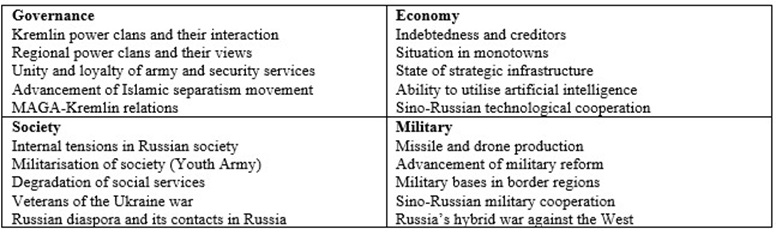
Governance: According to the experts, one of the foremost priorities is identifying the individuals who actually hold political power — particularly those operating outside the formal structures of the state. Equally significant is understanding the interconnections between dominant power clans and regional authorities. The experts express concern over the political role of the armed forces and security institutions, focusing on their internal cohesion, loyalty to the Kremlin, and the degree of competition or rivalry among the so-called ‘power ministries’. Additional areas of concern include the rise of Islamic separatism and the emerging relationship between the Kremlin and a business elite aligned with the US MAGA movement.
Economy: The experts call for deeper insight into Russia’s overall debt levels — spanning the public sector, private enterprises, and households. The socioeconomic situation of ‘monotowns’ also emerged as a central issue. These towns, whose economies depend almost entirely on a single enterprise, number more than 300 across Russia and are home to approximately 14 million people. One expert underscored the deteriorating state of Russia’s strategic infrastructure as a particularly urgent concern. The ongoing war is draining the resources required to maintain the nation’s highways, rail networks, and oil and gas pipelines, developments that may severely weaken both societal resilience and economic competitiveness. Another recurring theme in the interviews was Russia’s artificial intelligence (AI) capacity, identified as a critical area requiring closer scrutiny. The experts also emphasised the importance of understanding the true nature of the Sino-Russian economic relationship — including Russia’s dependence on Chinese goods, the scope of China’s business footprint in Russia, and the depth of technological cooperation between the two countries. This focus is understandable given that by 2024, roughly 50 percent of Russia’s imports originated from China. When Vladimir Putin became first time President of Russia in the year 2000, this share was only less than three percent.
Society: The experts also concentrated on the growing internal strains within Russian society. This is a particularly important topic, as many of these tensions predated the invasion of Ukraine and have likely intensified since. Long-standing sources of friction include inequality in living standards, ethnic and religious conflicts, tensions between locals and migrants, and disputes related to sexual orientation. The Russian military’s expansion of youth-focused education — often bordering on chauvinistic indoctrination — has further heightened the experts’ interest in understanding how young Russians perceive their own future. Rising military expenditure has come at the expense of social spending, worsening the already poor state of housing and communal services — a sector that was below Western standards even before the invasion. Experts view this as a vital area of investigation, as the system’s ongoing decay may deepen public dissatisfaction. Moreover, discontented veterans returning from the war in Ukraine could, in time, form a politically destabilising force. Several experts also drew attention to the views of Russian intellectuals and cultural figures, who increasingly constitute the final bastion of public dissent in the country.
Military: In the military sphere, experts seek to better understand the real capabilities of the Russian armed forces. They highlight the importance of assessing the state of conventional weapons stockpiles and Russia’s capacity to manufacture advanced systems — including hypersonic missiles, drones, and other unmanned platforms. Attention is also directed toward the progress of Russia’s ongoing military reform. Given that Finland shares NATO’s longest land border with Russia — more than 1,300 kilometres — it is unsurprising that Finnish experts are particularly interested in the condition of Russian military bases near this frontier. Equally, they express strong interest in the development of Sino-Russian military cooperation. Lastly, the experts underline the growing necessity of understanding Russia’s hybrid operations across Europe, which have expanded markedly in recent years.
Table. A summary of selected critical information needs
This column is based on my article published in a book “Inevitable Instability in Russia: Strategic Information, Intelligence and Foresight on Russia” (eds. Kari Liuhto and Joonas Sipilä) by Palgrave Macmillan in 2026.
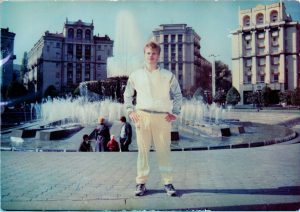
Photograph: The Maidan Nezalezhnosti (The Independence Square of Ukraine), September 1987.
Kari Liuhto
Professor of Intelligence Studies
National Defence University and University of Turku
Finland