
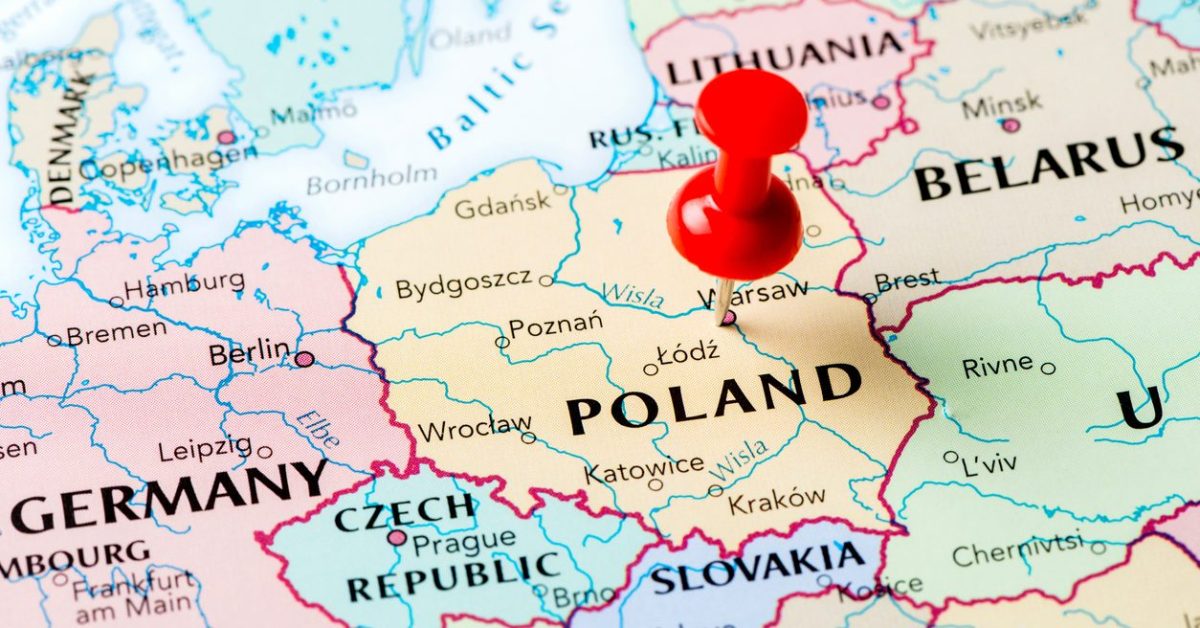
Poland’s geographical location, history and institutional memberships are important factors influencing strategic policy choices. Since December 2023 the strategic decisions have been made by the government led by Donald Tusk formed after the victory in October 2023. The new coalition has been implementing policy that in many respects has been different from that of their predecessors. One of the innovations was more focus on relations with Poland’s neighbours in the North.
However, due to the Russia’s aggression against Ukraine the new coalition decided to continue the rearmament program launched by its predecessors. In 2025 Poland is to spend 4.7% of the country’s GDP on defence related matters. By 2030 Poland is to have a well-equipped 300 000 strong army with 1000 modern tanks (Abrams, K2, Leopard, PT-91 Twardy), 1400 infantry fighting vehicles (Borsuk and others), more than 500 modern artillery systems (K9, Krab), more than 300 rocket artillery systems (HIMARS and K-239 Chunmo), 96 Apache helicopters, 32 F-35, 48 F-16 and 48 FA-50 aircraft and 8 air-defence Patriot batteries.
To address security related challenges the new government has decided to reverse some negative trends strengthening relations with France and Germany in the Weimar Triangle format. Poland has also been pursuing its security objectives in close cooperation with the EU partners by taking part in EU-led security related-projects such as Permanent Structured Cooperation (PESCO), European Defence Fund (EDF) or the Coordinated Annual Review on Defence (CARD). Poland’s security cooperation with NATO allies is still the backbone of the Polish security policy. Poland today stands at the intersection of two strategic paths. It continues to treat NATO and the U.S. as central to its defence posture, but it no longer treats EU defence policy as symbolic or irrelevant.
However, in addition to this institutionalised dimension of the country’s security policy with focus on NATO and EU cooperation, Poland has also embarked on strengthening various forms of regional security cooperation as a way of dealing with security problems. There are several reasons why regional security cooperation should be developed. First, it is often so that various types of security challenges countries encounter have a regional dimension. Second, regional cooperation on common regional challenges can be a solution to what could be termed ‘consensus dilemma’ in a situation when decisions in NATO with its 32 members and the EU with 27 members must be taken by all members with differing perceptions of security challenges. Third, regional security cooperation can also transcend institutional borders.
From the very beginning of the full-scale war in Ukraine Poland decided to support Ukraine’s fight against aggression by becoming a substantial provider of military hardware. Poland is also an important transit hub for supplies of weapons to Ukraine provided by other partners from the pro-Ukrainian coalition of willing. As a way of increasing the level of regional security cooperation Poland has also been active in the Bucharest nine format in which Poland works closely with other regional partners facing similar security challenges on NATO’s and EU’s eastern flank. Poland’s cooperation with the three Baltic States – Lithuania, Latvia, and Estonia – is one of the most important regional forms of security cooperation as all four play a critical role in defending the Suwałki Gap, the narrow land corridor between Belarus and Kaliningrad that serves as NATO’s only direct connection to the Baltic States. Finally, because of the recent NATO enlargement to Finland and Sweden that has turned the Baltic Sea into an area where enlarged NATO meets Russia, also Poland’s security cooperation with the Nordic countries has intensified.
Poland’s recent strategic turn to the North was clearly signalled by the fact that Poland’s Prime Minister Donald Tusk decided on several occasions to join Nordic and Baltic partners in discussions on security related matters. This is sometimes viewed as a sort of strategic innovation, because Polish power elites have been traditionally most interested in dealing with strategic issues along the east-west axis. This strategic turn to the North can signal a shift in Polish strategic thinking and practice but can also be viewed as a natural development in a situation when all Nordic and Baltic neighbours have become NATO members and must deal jointly with what all of them perceive as a growing Russian threat. In that sense this strategic turn to the North can be viewed not as a rupture with the Polish traditional strategy, but rather as a natural move complementing Poland’s engagements in other geographical, strategic and institutional settings.
Jakub M. Godzimirski
Research Professor
Norwegian Institute of International Affairs NUPI
Norway
jmg@nupi.no