
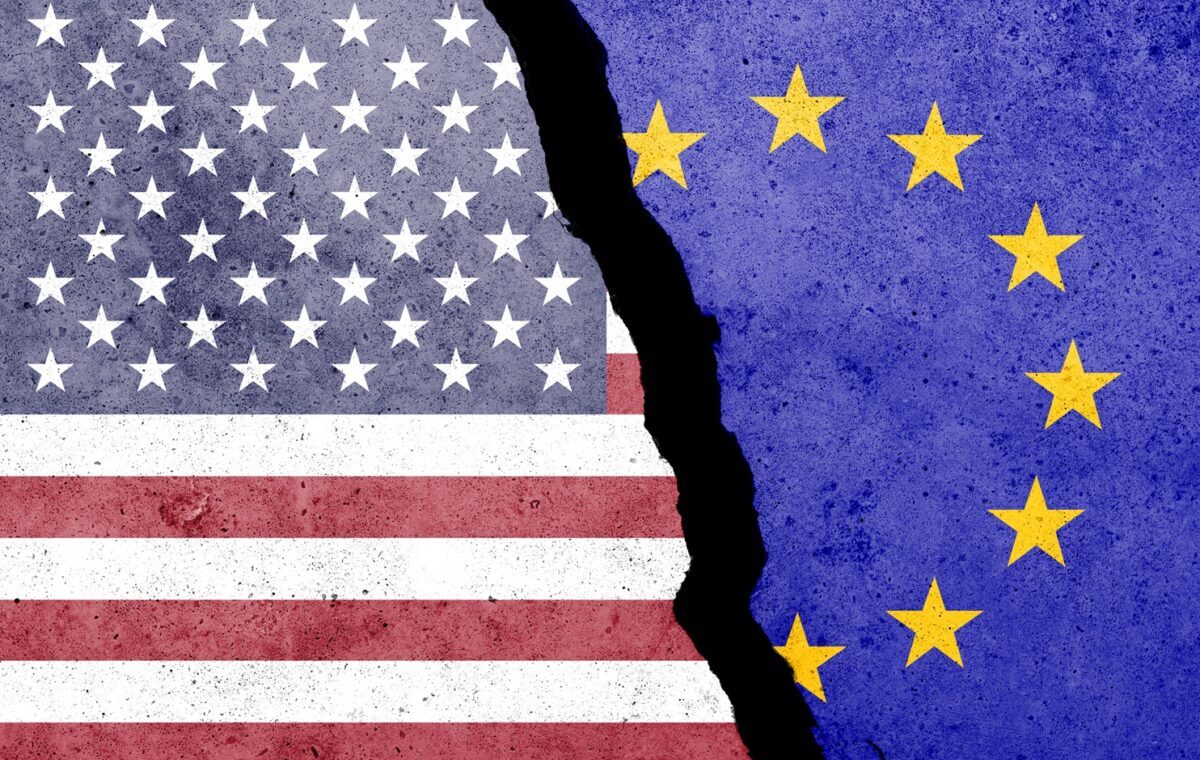
For decades, the European Union and the United States stood side by side as architects of the global trading system. Together, they built a world defined—at least in principle—by open markets, multilateral rules, and predictable economic cooperation. That world is now gone.
The European Union remains the world’s largest trading bloc, with unmatched weight in global commerce. Yet its ability to shape international trade has been fundamentally challenged—not by distant rivals, but by its closest partner. The protectionist turn in Washington has not just disrupted transatlantic trade. It has forced Europe to confront an uncomfortable reality: the United States is no longer a reliable steward of the system it helped create.
This shift did not happen overnight. The EU’s trade policy has long been rooted in a supranational framework, with the European Commission negotiating on behalf of member states under the Common Commercial Policy. Over time, this system has evolved, incorporating new regulatory areas and giving the European Parliament greater influence. Throughout, the EU has tried to strike a balance—opening markets abroad while shielding vulnerable sectors at home.
That balancing act was sustainable as long as the broader system held. It no longer does. The decisive break came with the return of aggressive US protectionism. The Trump administration’s 2025 trade offensive—raising tariffs to levels not seen in decades—marked a clear departure from the transatlantic consensus. The subsequent EU–US agreement, which imposed a 15% tariff on most European exports while granting broad concessions to the US, was less a negotiated settlement than a managed retreat.
European leaders presented the deal as damage control. In truth, it revealed the limits of Europe’s leverage. Faced with the threat of even higher tariffs, the EU accepted terms that would have been unthinkable just a few years earlier. The economic costs are real—higher barriers in the EU’s most important export market, with measurable impacts on growth. But the political consequences are far more significant.
The transatlantic relationship has changed in kind, not just in degree. For most of the postwar period, the EU and the US acted as joint custodians of global trade rules. Even when disagreements arose, they shared a common interest in maintaining the system. Today, that shared interest has eroded. The United States is increasingly willing to use its market power unilaterally, extracting concessions from allies as well as rivals. Trade policy has become an instrument of strategic competition, not cooperation.
Europe is poorly positioned for this new reality. Its large trade surplus with the US makes it particularly vulnerable in any escalation. Its dependence on American security guarantees further constrains its willingness to retaliate. And the weakening of the World Trade Organization means that legal remedies have given way to power politics. In short, the EU faces a structural disadvantage in a game it did not choose to play.
What, then, is to be done? First, Europe must abandon the illusion that restraint will be rewarded. The hope that accommodating US demands will stabilize the relationship has already proven misguided. If anything, the opposite is true: concessions invite further pressure. The EU does not need to seek confrontation, but it must be willing to respond in kind. Credible retaliation is not escalation for its own sake—it is the minimum requirement for being taken seriously.
”“Diversifying trade partnerships is no longer just good economic policy; it is a strategic necessity.”
Second, Europe must reduce its dependence on the American market. Diversifying trade partnerships is no longer just good economic policy; it is a strategic necessity. Agreements with Latin America, Asia-Pacific economies, and other regions will not replace the US overnight, but they can provide alternatives—and, crucially, leverage. A Europe with options is a Europe that negotiates from strength.
Third, the EU must fully embrace its role as a geoeconomic power. In recent years, it has begun to develop the necessary tools: mechanisms to screen foreign investments, counter unfair subsidies, and respond to economic coercion. These instruments mark an important shift away from the EU’s traditional reliance on rules alone. But tools are only as effective as the willingness to use them. If Europe hesitates, they will remain symbolic.
None of this means abandoning the idea of an open trading system. On the contrary, the EU has a strong interest in preserving it. But openness cannot be defended with passivity. In a world where others are willing to weaponize trade, Europe must be prepared to defend its interests with equal determination.
The uncomfortable truth is that the era of easy transatlantic cooperation is over. The United States has made clear that it will pursue its trade interests with little regard for past partnerships. Europe can lament this shift—or it can adapt. Adapting will not be easy. It will require political will, internal cohesion, and a readiness to accept short-term costs in pursuit of long-term autonomy. But the alternative is worse: a slow erosion of Europe’s position in the global economy, one concession at a time. For a union built on the promise of economic strength and strategic influence, that is not a future worth accepting.
Arlo Poletti
Professor of International Relations
University of Trento
Italy
