
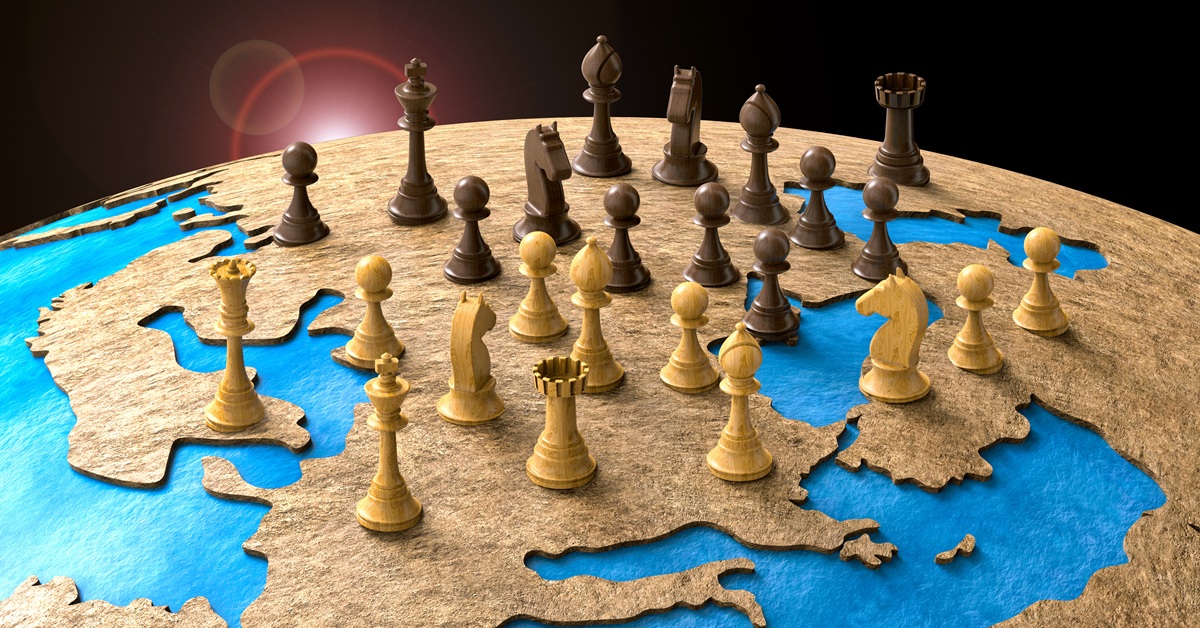
President Xi Jinping’s stated ambition to establish the People’s Republic of China (China) as a global leader, a military power, and a major polar power carries significant implications for the Arctic region and Nordic countries, in particular with respect to both economic and strategic dimensions. But these implications in a world shifting towards the rule of force rather than the rule of law cannot be dealt with the same logic of thought that has so far prevailed: it requires a new way of thinking the Arctic and to bring along a political community capable of responding to the current challenges: a Northern-European-Canadian Community.
Despite an apparent slowdown of activities in the Arctic, China is still present and has ambitions to impose its political and economic model of governance. The 2018 launch of the Polar Silk Road — formally incorporating the Arctic into Beijing’s Belt and Road Initiative — provided an institutional framework through which China deepened its regional influence. While Chinese investment activity has since contracted across several sectors and many contracts have been cancelled, Beijing continues to pursue its Arctic interests through multiple vectors (access to oil and gas, projects of port control, land acquisition, dual-use facilities…).
Of particular concern is the intensification of Sino-Russian cooperation in the region, whereas China has not condemned the invasion of Ukraine and is providing logistical support to Russia in the war. In 2019, the two countries elevated their bilateral relations to a comprehensive strategic partnership and signed in 2023 a MoU on the application of maritime law which opens for extensive cooperation between their coast guards. Joint air and naval military exercises across the Bering Strait have taken place. But the bilateral cooperation has limits and the rivalry remains latent, and it is just as worrying for stability in the region. Indeed, the strategic visions of China and Russia are not compatible: both countries want to be a leading world power, but bolstered by its current status as a regional Arctic power, Russia considers the region as its own backyard.
If the US is still concerned by ‘deterring China’, it is refocusing its efforts on the American continent and is destabilizing Europe. De facto, the US cannot be considered as the reliable ally it used to be, as evidence by a triple reversal across (1) its disengagement from its commitment to support defence in Europe, (2) the weaponisation of the economy through erratic threats of tariff increases, and (3) a political offensive characterised by an attempt of annexation of Greenland, a sharp rhetoric against the EU and a support to European far-right movements.
The concept of Arctic exceptionalism, flawed from the outset, prevents from asking the right question — namely that of the appropriate institutional format of response to Russia’s hostility, to growing dependence on China, and to the United States new positioning. The circumpolar dimension no longer makes sense in the current context, in which both Russia and the United States have become unpredictable and hostile actors. The functioning of the Arctic Council has been hampered since 2014 and the forum is at a complete standstill since 2022. Furthermore, its mandate explicitly excludes security matters.
It is a Northern-European-Canadian community that we must think now to discuss issues of economic and defense and security. Such an intergovernmental forum would gather the Nordic countries, from Finland to Iceland, the Baltic states, since Baltic and Arctic security are now strategically interconnected, EU member states, the United Kingdom, but also Canada. The Nordic countries have built an identity that forms the basis of strong cooperation, particularly in defense with Nordefco. The UK is directly affected by the projection of power in the North Atlantic. Canada recently engaged in reducing its dependence on the US and on China which controls 90% of the rare earth elements market, and is deepening its ties with Europe. While not an EU institution, the Northern-European-Canadian Community could function as a wider European political space around the EU.
The question of the impacts of China in the Arctic region can no longer be considered independently of an international context that has hardened and where expansionism seems to be a right that the great powers grant themselves. International law could dangerously become a law of spheres of influence, as theorized by Carl Schmitt in the 1930s. Similarly, the future of the Arctic cannot be thought of within the limits of the Arctic circle. It is a Northern-European-Canadian Community which needs to gather now, to commonly support the democratic values to which the Nordic countries, the Baltic states, the EU, the UK and Canada are deeply attached but which are alarmingly threatened today.
Cécile Pelaudeix
Ph.D., Political Scientist, Associated Member
Pacte Sciences Po Grenoble-UGA
France
Fellow
Academy of International Affairs
Bonn, Germany