
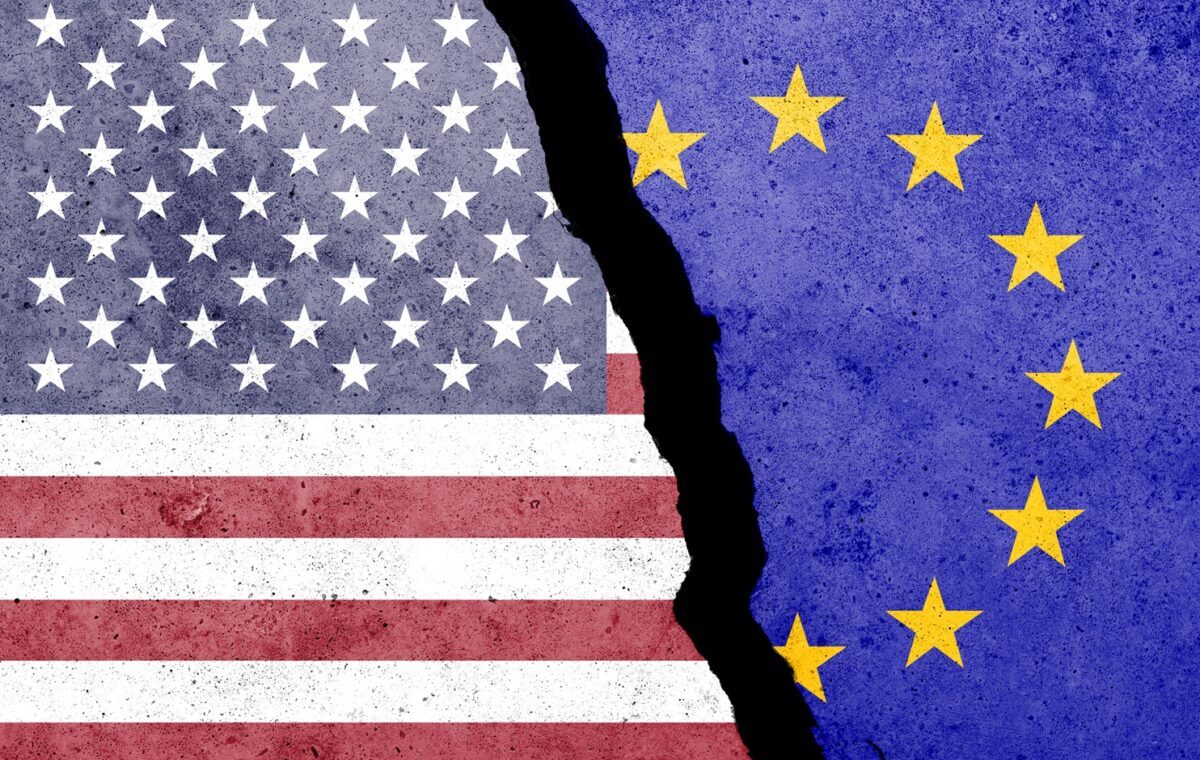
The second Trump administration has done significant damage to the transatlantic relationship, which is now marked by suspicion and frustration. The economic side of the relationship is no exception. After the dramatic disruption of Liberation Day, when President Trump announced the imposition of unlawful 20% tariffs on imports from the European Union, the EU and the US negotiated their way to a truce that has now been in place for a bit over a year.
The terms of the truce are lopsided. Under the framework agreed at Turnberry in July 2025, the United States applied a 15% ceiling, inclusive of existing duties, to most imports from the EU, though steel, aluminum, and copper stayed at 50%. The EU, for its part, agreed to eliminate its tariffs on American industrial goods, open its market to a list of agricultural and seafood products, and shelve the €93 billion package of countermeasures it had prepared. The average American tariff on European goods, below 2% a year earlier, is now close to 10%; the average European tariff on American goods approaches zero. Europe accepted this agreement—inconceivable just a year earlier—as the price of stability.
”"Europe accepted this agreement—inconceivable just a year earlier—as the price of stability."
The trade component of the truce also rests on unstable legal ground. The tariffs it was negotiated against were imposed under the International Emergency Economic Powers Act (IEEPA), but the Supreme Court ruled in February that IEEPA does not authorize tariffs at all. The administration then turned to Section 122 of the Trade Act of 1974, under the pretext that the US faces a “large and serious balance-of-payments deficit.” The Court of International Trade declared those tariffs ultra vires in May. The government appealed that ruling, and the tariffs expired after 150 days in late July. Since then, the tariffs on European goods have come from a pretextual Section 301 action against forced labor, over which litigation is ongoing as well.
The tax aspects of the truce have drawn less attention. The House version of the One Big Beautiful Bill Act included Section 899, which would have introduced a surtax of up to 20% on the returns to investment earned in the United States by foreign investors from countries with “unfair” tax practices, including digital services taxes and Pillar Two’s under-taxed profits rule (UTPR). Foreign multinationals from those countries that operate in the US would also have been subjected to a more stringent base erosion anti-abuse tax. Section 899’s taxes would have applied to individuals and corporations based in the European Union. It was withdrawn only after the G7 agreed in June 2025 to exempt American-parented groups from Pillar Two, a concession the OECD’s Inclusive Framework formalized this January. Digital services taxes, effectively a tariff on imports of digital services, remain a point of contention. The first Trump administration found that they are actionable under Section 301, the same provision underpinning the current round of tariffs, and even announced tariffs, which remain suspended. The second Trump administration has not revived them. Yet.
While the threat of measures like Section 899 is a deterrent for European investment in the US, the Turnberry framework nonetheless projected $600 billion in new European investment in the United States by 2028, alongside $750 billion in purchases of American energy. Although it has been clear all along that these numbers are fake—the Commission does not invest or buy gas and cannot order firms to—the inevitable failure to hit them may cause renewed tension.
Technology policy is perhaps where the truce is most fragile. At Turnberry the EU committed to address “unjustified digital trade barriers,” but there is stark transatlantic disagreement over what that means in practice. The Digital Markets Act and Digital Services Act are irritants for Washington, which went so far as to ban former Commissioner Thierry Breton from the country. The business strategies and political messaging of American tech firms, especially Elon Musk’s support for Europe’s far right, have long annoyed Europe’s political class.
There is also unresolved tension around transatlantic policymaking toward the semiconductor industry. As in the defense and trade realms, European officials want to cooperate with the US to fend off Chinese (and Russian) threats. At the same time, the line between cooperation and weaponizable dependence is often fuzzy. The MATCH Act would extend American restrictions on chipmaking equipment to ASML unilaterally, while Pax Silica, the State Department’s AI supply-chain club, is at least nominally a voluntary coalition.
Similar concerns circle around other sectors, from payment systems to email and from cloud to AI. It has been remarkable to see center-right politicians and straight-laced central bankers treat the US as, at best, an unreliable legacy partner. We are slowly discovering how stable such a partnership can be.
Stan Veuger
Senior Fellow
The American Enterprise Institute for Public Policy Research
Washington, DC, United States of America
