
Jussi Fabre is a Senior OT/IT Security Architect, independent consultant and strategic advisor based in Finland. For more than 25 years, he has worked across critical infrastructure, industrial cybersecurity, carrier-grade telecommunications and cloud platforms. His expertise covers the IEC 62443 standard series, the NIS2 Directive and the IACS Unified Requirements E26 and E27 for the cyber resilience of ships. He holds a Bachelor’s degree in Maritime Management from the master mariner programme of Novia University of Applied Sciences and was certified as an STCW deck officer in 2021, which gives him first-hand understanding of how incidents at sea unfold on a ship’s bridge. He is a native speaker of French and Finnish. His work focuses on the security of industrial, maritime and energy systems.
linkedin.com/in/jussi-fabre
Abstract
Between October 2023 and January 2026, subsea cables and a gas pipeline in the Baltic Sea were damaged in at least eight incidents. In most cases, a merchant ship dragged its anchor across the seabed, often in exclusive economic zones where coastal states have limited jurisdiction over foreign-flagged vessels. Measurements by the RIPE NCC show that the Internet routed around the damage largely without packet loss, although a second winter of cuts produced the first signs of congestion. This briefing argues that such technical resilience should not be mistaken for national resilience. It reads the incidents through three lenses: the network, the ship and the state. Network telemetry dates a cable failure to the minute. On a ship’s bridge, an anchor dragging on the seabed usually shows up within minutes as speed loss without an engine order, and it leaves traces in the ship’s own records. At the level of the state, the Eagle S and Fitburg cases show how contested the legal room for coastal states has been, and how Finnish courts have begun to define it, most recently in a first-instance judgment, not yet final, in the Fitburg case in November 2026. The briefing then contrasts the peacetime grey-zone pattern with a hypothetical large-scale hybrid campaign, in which several links would fail at once, AIS and satellite navigation would be degraded, and repair ships could not work freely. It introduces the concept of a sovereign minimum service: the functions that must continue in Finland when all international links are down. It also maps perspectives on data-centre growth and the economic costs of disruption. Russia’s shadow fleet is treated separately, as an additional risk to the same waters rather than as the explanation for the incidents. The briefing does not attribute any incident to a state actor. It concludes with recommendations for Finland, the European Union, NATO, infrastructure operators and planners of new links, ranging from guaranteed repair capacity and route diversity to anchor-drag detection and pre-agreed legal procedures.
Key words: Baltic Sea; subsea cables; critical undersea infrastructure; hybrid threats; shadow fleet; resilience; sovereignty; data centres; Finland; NIS2; IEC 62443
Abbreviations
| AIS | Automatic Identification System | NIS2 | Directive (EU) 2022/2555 on a high common level of cybersecurity |
| BCS | BCS East-West Interlink (Lithuania–Sweden telecom cable) | OT | Operational technology |
| BGP | Border Gateway Protocol | RIPE NCC | Réseaux IP Européens Network Coordination Centre |
| EEZ | Exclusive economic zone | RIS | Routing Information Service (of the RIPE NCC) |
| GNSS | Global navigation satellite system | SOLAS | International Convention for the Safety of Life at Sea |
| HE | Hallituksen esitys (Finnish government proposal to Parliament) | STCW | International Convention on Standards of Training, Certification and Watchkeeping for Seafarers |
| IACS | International Association of Classification Societies | UNCLOS | United Nations Convention on the Law of the Sea |
| IEC | International Electrotechnical Commission | UR | Unified Requirement (of IACS) |
| IXP | Internet exchange point | VDR | Voyage Data Recorder |
Disclaimer: The opinions expressed in this report represent those of the author and do not represent the opinion of the Centrum Balticum Foundation, and thus, the Centrum Balticum Foundation does not bear any responsibility for the opinions expressed in the report.
1. Introduction
At 04:04 Finnish time on 18 November 2024, the C-Lion1 submarine cable between Helsinki and Rostock stopped carrying traffic (Cinia, 2024a). In the words of its operator, C-Lion1 is the only Finnish submarine cable that runs directly to Central Europe (Yle, 2024). Within the next three months it was damaged twice more: on 25 December 2024, as one of the cables affected when the Eagle S dragged its anchor across the Gulf of Finland, and again in early 2025 near Gotland (Cinia, 2025; Portal Stoczniowy, 2025).
For the Internet, the damage was almost invisible. According to the RIPE NCC, traffic between Finland and Germany found new routes, and its measurements showed no added packet loss (Aben, 2024a; 2024b). For investigators, prosecutors and governments, the picture was much less reassuring. In most cases the ship concerned sailed under a foreign flag, the damage occurred outside territorial waters, and the legal basis for action was still contested almost two years later.
This briefing argues that these two pictures must be read together. It approaches the Baltic Sea incidents of 2023–2026 through three lenses. The network lens shows how much redundancy the region’s connectivity contains, and what that redundancy hides. The ship lens, drawing on the author’s background as a deck officer, shows that an anchor dragging along the seabed is not a momentary event but a process that leaves traces on the bridge and in the ship’s own records. The state lens examines jurisdiction, flags of convenience and dependency, which together form what is called here the sovereignty gap.
The second argument concerns a severe crisis. The incidents so far have occurred at a peacetime pace: one or two cables at a time, with repair ships free to sail and courts free to deliberate. A hypothetical hybrid campaign in the context of an armed conflict would remove those conditions. The relevant question then is not whether the network can route around a single cut, but what Finland can keep running when its international links are lost. This briefing calls that capability a sovereign minimum service.
The analysis is based solely on public sources: measurement analyses by the RIPE NCC, the author’s own analysis of public RIPE Atlas and RIPEstat data, operators’ press releases, investigation reports, court decisions and reporting, and policy documents of Finland, the European Union and NATO. The measurement data are publicly available from the RIPE NCC, so the network analysis can be checked independently. The research questions, the analysis of the measurements, the maritime and OT security assessment and the conclusions are the author’s own; AI tools were used for drafting, language editing and source checking, and facts and references were checked against the original sources. Developments are covered up to 10 November 2026, and the briefing was submitted for publication on 14 November 2026. Several of the matters discussed were still developing at that date, notably sanctions packages, pending court cases, legislation before Parliament and data-centre projects, and readers should check their current status. In pending cases, the persons concerned are presumed innocent until proven guilty by a final judgment. The analytical approach, however, is intended to remain applicable as the details change and as new challenges emerge. Cable routes and damage sites on the maps are indicative. The briefing draws only on information that is already public, presents it at the level of detail needed for the argument, and does not set out new route-specific vulnerabilities. The briefing does not attribute any incident to a state actor, and where investigators concluded that damage was accidental, this is stated. It does argue that, for resilience planning, the distinction between accident and sabotage matters less than public debate often assumes.
Section 2 describes the Baltic Sea as an infrastructure space and Section 3 summarises the incidents. Sections 4 and 5 present the network and the ship perspectives. Section 6 discusses the sovereignty gap, and Section 7 reviews the responses taken so far. Section 8 contrasts the grey-zone pattern with a severe-crisis scenario, and Section 9 sets out the perspectives on Finland’s growing data-centre sector. Section 10 discusses Russia’s shadow fleet as a separate risk, Section 11 examines the economic dimension, and Section 12 sets out recommendations. Section 13 concludes.
2. The Baltic Sea as an infrastructure space
The Baltic Sea is shallow, semi-enclosed and intensively used. Its mean depth is only about 54 metres, and that of the Gulf of Finland about 37 metres (Marine Finland, n.d.). A merchant ship’s anchor can therefore reach the seabed across most of the sea. At the same time, the sea is crossed by a dense web of telecommunications cables, electricity interconnectors and gas pipelines connecting the Nordic countries, the Baltic states, Poland and Germany (Map 1).
For Finland, the sea is also the main external lifeline. For security reasons, its long land border with Russia can no longer be used for many purposes, and energy imports from Russia have ended. More than 90% of Finland’s merchandise trade by volume therefore moves by sea (Ojala, 2023), and energy and logistics flows run either across the Baltic Sea or overland through the Nordic countries. Mikkola (2026) captures this with the metaphor that Finland is an island.
Map 1. Selected subsea cables and pipelines in the Baltic Sea and damage sites, 2023–2026
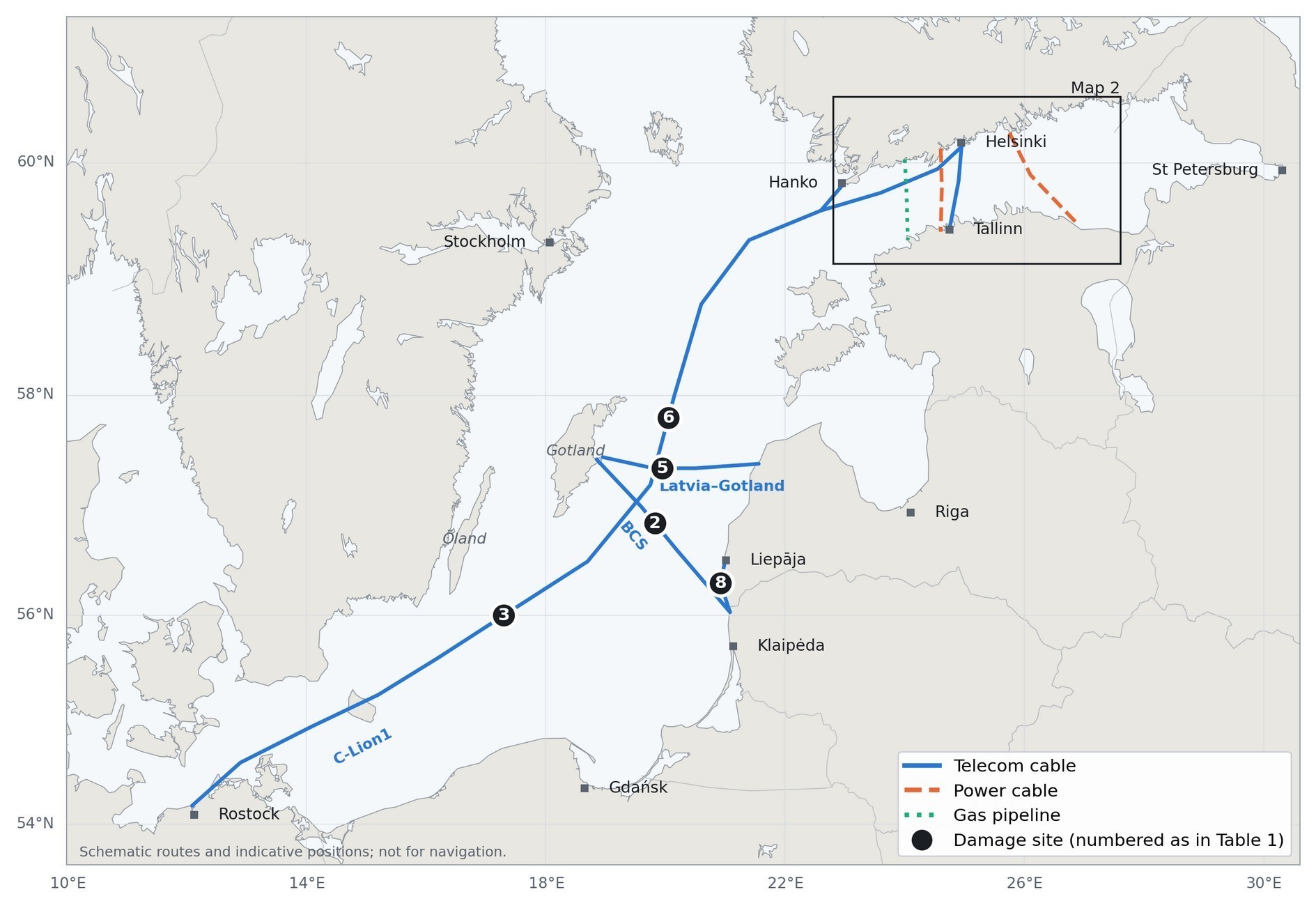 Source: Author’s compilation based on Cinia (2024a), Aben (2024b), Baird Maritime (2026) and the sources listed in Table 1. Routes are schematic and positions indicative. Base map: GSHHG shoreline data (Wessel and Smith, 1996).
For Finland, the most important data link is C-Lion1. The cable was laid from Santahamina in Helsinki in October 2015 and opened in May 2016, with about EUR 100 million invested by the Finnish state and two institutional investors (Yle, 2015; Smolaks, 2016). It is about 1,173 kilometres long, has eight fibre pairs with a design capacity of 144 terabits per second and a branch to Hanko, and is operated by Cinia, a company more than 77% owned by the Finnish state (Yle, 2024). The project was promoted as a way to attract data-centre investment and to give Finland a direct route to Central Europe, independent of the routes through Sweden (Yle, 2015). For ease of deployment, much of the cable was laid along the route of the Nord Stream gas pipeline (Smolaks, 2016), a choice that reflected a very different security environment from today’s.
The Gulf of Finland, at most about 130 kilometres wide (Encyclopaedia Britannica, 2026), concentrates several critical links into a narrow corridor (Map 2). The Estlink 1 and Estlink 2 power cables connect the Finnish and Estonian grids, the Balticconnector pipeline links the two countries’ gas systems between Inkoo and Paldiski, and several telecommunications cables run between Helsinki and Tallinn. The same corridor carries heavy merchant traffic to and from Russian ports in the eastern Gulf. Ships also wait at anchor in the area for long periods: in March 2026, nearly 40 shadow-fleet tankers were reported to be waiting in the Gulf of Finland (ERR, 2026a; see Section 10). Ships waiting at anchor in or near cable corridors raise the risk of accidental damage and could also provide cover for a deliberate act.
Map 2. Infrastructure and damage sites in the Gulf of Finland
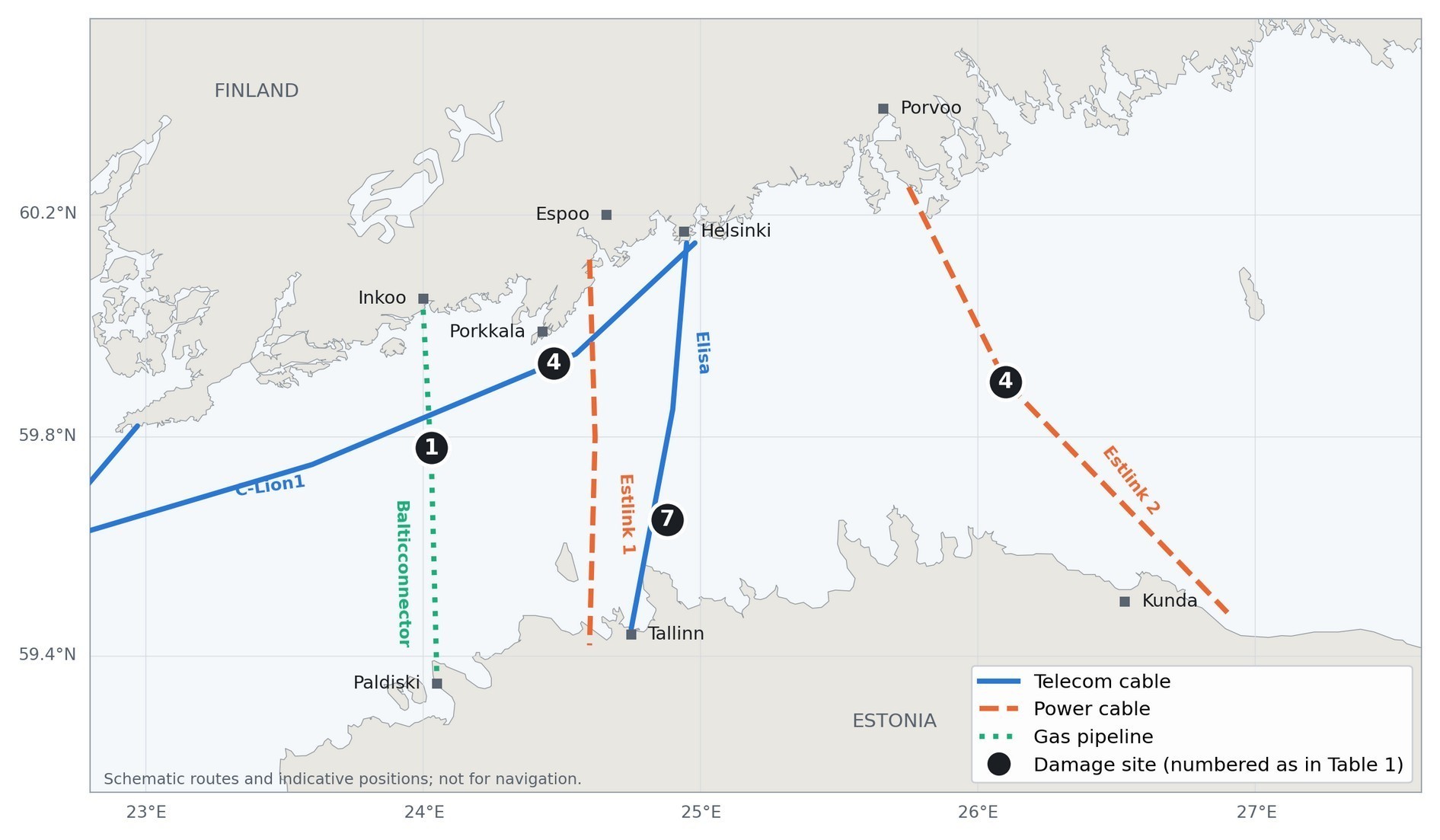 Source: Author’s compilation based on Cinia (2025), Martin (2026a; 2026b), Yle (2025) and Baird Maritime (2026). Routes are schematic and positions indicative. Base map: GSHHG shoreline data (Wessel and Smith, 1996).
Damage to subsea cables is not unusual in itself: around 200 faults are recorded worldwide each year, most of them caused by fishing gear and ship anchors (Qiu, 2025). What distinguishes the Baltic Sea since 2023 is the combination of shallow water, dense infrastructure, heavy traffic from Russian ports, and a deteriorated security environment in which incidents are assessed for possible hostile intent.
3. Incidents 2023–2026
Table 1 lists eight incidents in which subsea cables or pipelines in the Baltic Sea were damaged between October 2023 and January 2026. The numbering corresponds to Maps 1 and 2. The Nord Stream explosions of September 2022 are excluded, as they followed a different pattern. As far as the author has been able to establish, no further damage of this kind had been publicly reported in the Baltic Sea by early November 2026. RIPE NCC data also show outages on two Sweden–Estonia links on 28 and 30 December 2025, which are not counted separately in Table 1 (Aben, 2026).
Table 1. Damage to subsea cables and pipelines in the Baltic Sea, October 2023 – January 2026
| No. | Date | Infrastructure damaged | Vessel (flag) | Outcome and status |
| 1 | 7–8 Oct 2023 | Balticconnector gas pipeline; Estonia–Finland and Estonia–Sweden telecom cables | NewNew Polar Bear (Hong Kong, China) | China acknowledged in 2024 that the ship damaged the pipeline, describing it as an accident caused by a storm (ERR, 2024; Maritime Executive, 2024; Baird Maritime, 2026) |
| 2 | 17 Nov 2024 | BCS East-West Interlink, Lithuania–Gotland | Yi Peng 3 (China) | Swedish accident investigators could not determine whether the anchor was released deliberately; access to evidence was restricted (Maritime Executive, 2025) |
| 3 | 18 Nov 2024 | C-Lion1, Finland–Germany, Swedish EEZ east of Öland | Yi Peng 3 (China) | Repaired on 28 November 2024 (Cinia, 2024a; 2024b) |
| 4 | 25 Dec 2024 | Estlink 2 power cable and four telecom cables, including C-Lion1 and two Elisa cables | Eagle S (Cook Islands) | District court declined jurisdiction in October 2025; Court of Appeal reversed this on 27 August 2026; the defendants and the ship’s operator have sought leave to appeal to the Supreme Court (Cinia, 2025; Reuters, 2025b; Martin, 2026b; Yle, 2026c) |
| 5 | 26 Jan 2025 | Latvia–Gotland fibre cable | Vezhen (Malta) | Swedish prosecutor concluded the damage was accidental; case closed in October 2025 (The Local, 2025) |
| 6 | Jan–Feb 2025 | C-Lion1 near Gotland, Swedish EEZ | No vessel identified | No traffic impact reported; Swedish preliminary investigation (Portal Stoczniowy, 2025; Baird Maritime, 2026) |
| 7 | 31 Dec 2025 | Elisa Helsinki–Tallinn and Arelion telecom cables | Fitburg (St Vincent and the Grenadines) | Captain and boatswain convicted of aggravated sabotage on 5 November 2026 and sentenced to 3 years 6 months and 2 years 10 months in prison; judgment not final (Helsinki District Court, 2026; Reuters, 2026) |
| 8 | 2 Jan 2026 | Šventoji–Liepāja telecom cable | Vessel boarded at Liepāja | Latvian police found no evidence linking the vessel to the damage (Baird Maritime, 2026) |
Source: Author’s compilation based on the sources indicated in the table; status as of 10 November 2026.
Four patterns stand out. First, the mechanism is strikingly consistent. In six of the eight incidents, investigators established or strongly suspected that a ship had dragged an anchor along the seabed, sometimes for very long distances. The Eagle S continued for about 90 kilometres after Finnish authorities first contacted it (Martin, 2026b), the Fitburg dragged its anchor for at least 130 kilometres (Martin, 2026a), and the Yi Peng 3 for roughly 180 nautical miles (about 330 kilometres) over a day and a half (Maritime Executive, 2025).
Second, several of the vessels were carrying Russian cargo. The Yi Peng 3 had loaded its cargo at Ust-Luga and was bound for Port Said (Humpert, 2024), the Fitburg was sailing from St Petersburg with a cargo that Finnish Customs described as sanctioned steel (Martin, 2026a), and the cargo of the Eagle S was detained by Finnish Customs as subject to EU import sanctions (Baird Maritime, 2025).
Third, the incidents clustered in the winter months, from October to February. Heavy weather and icing make anchor securing harder and are a recurring element in the defence arguments. In the Vezhen case, Swedish prosecutors concluded that a combination of harsh weather, technical deficiencies and a suspected lack of seamanship caused the anchor to drop (The Local, 2025).
Fourth, the outcomes differ widely. Swedish prosecutors closed one case as an accident, Swedish accident investigators reached no firm conclusion in another, one Finnish case has so far been decided only on jurisdiction and awaits the Supreme Court’s decision on leave to appeal, and in another a Finnish district court convicted the captain and boatswain of aggravated sabotage in November 2026, in a judgment that is not yet final. This variety is itself significant: the region has not yet developed a predictable way of establishing what happened and who is responsible.
4. What the network saw
The most detailed public evidence on the effect of the cuts comes from RIPE Atlas, a global measurement network operated by the RIPE NCC, the regional Internet registry for Europe, the Middle East and parts of Central Asia. RIPE Atlas anchors are well-connected measurement devices that continuously measure latency and paths to each other. When C-Lion1 was cut, the analysis drew on 100 anchors in Germany and 12 in Finland, an unusually rich dataset (Aben, 2024b).
The preliminary analysis found that around 20% of anchor paths between Sweden and Lithuania, and 30% between Finland and Germany, showed significant latency changes after the two November 2024 cuts. No significant packet loss was detected in either case (Aben, 2024a). Traffic statistics from Cloudflare likewise showed no apparent impact on traffic volumes in the affected countries (Belson, 2024). Routing data tell the same story: Cloudflare saw no change in the address space announced by the affected Lithuanian networks, and no notable BGP activity in Finland or Germany when C-Lion1 failed (Belson, 2024). The author’s analysis of the BGP updates recorded by the RIPE NCC’s Routing Information Service (RIS) for the address space of the measuring anchors points the same way: around each cut from 2024 onwards, routing activity stayed within its normal daily range, with at most about a hundred updates in a quarter of an hour (RIPE NCC, 2026).
The resolution of these measurements matters for reading them. The anchors ping each other every four minutes and run traceroutes to each other every 15 minutes (Taylor Muzzin, 2013). They cannot time the rerouting itself, which takes anything from milliseconds to minutes depending on the layer at which it happens. What they show is whether packets were lost, how much longer the new paths were and when the change occurred: for each pair to within one four-minute round, and for many pairs together to within a minute or two.
A follow-up analysis used traceroute data to examine how the network adapted (Aben, 2024b). Of 2,141 bidirectional paths between anchors in Germany and Finland, about 30% changed the networks they traversed, meaning that inter-domain routing (BGP) found new routes. Almost half kept the same networks but changed the internal path within them. The remaining fifth showed no change at the IP level, yet some of these paths gained about 3 milliseconds of latency, which corresponds to roughly 300 kilometres of additional fibre. This suggests that protected circuits failed over to backup routes below the IP layer, possibly via terrestrial routes (Figure 1).
Figure 1. How traffic between Finland and Germany was rerouted after the C-Lion1 cut of 18 November 2024
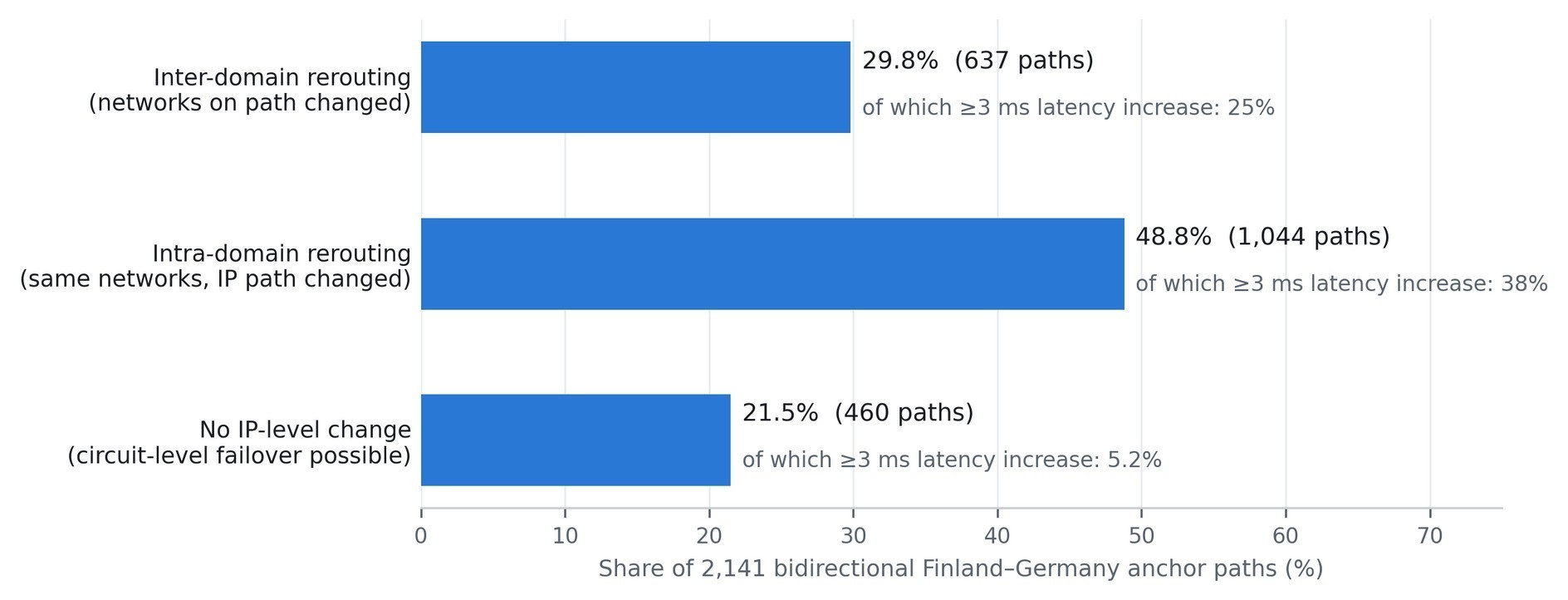
Source: Author’s illustration based on data reported in Aben (2024b). Percentages of latency increase are shares within each category as reported in the source.
The same analysis shows how the load shifted between networks and exchange points. Paths through the DE-CIX exchange in Frankfurt decreased, while paths through FICIX in Helsinki, AMS-IX in Amsterdam and the Nordic research network NORDUnet increased (Aben, 2024b). After the repair was completed on the evening of 28 November 2024, the measurements showed paths shifting back to lower latency, accompanied by a short spike in latency and packet loss as traffic moved back (Aben, 2024b; Cinia, 2024b).
These findings are good news for network engineering. The RIPE NCC concludes that the region maintains an ample reservoir of decentralised connectivity, built from diverse transit providers and interconnection at geographically diverse exchange points, with further redundancy at circuit level within networks (Aben, 2024b). The resilience is real, and it was built largely by commercial operators for commercial reasons.
From a state perspective, however, three limitations matter. First, in the winter of 2024–2025 the reservoir was tested one cable at a time. The RIPE NCC itself notes that it is very hard to model what it would take to cause a more serious outage (Aben, 2024b). The depth of the reservoir is therefore unknown. Second, much of the backup capacity appears to run through Sweden and the Baltic states. Its independence from the failed route is assumed rather than demonstrated. Third, the ability to see these effects depends on measurement coverage. The RIPE NCC regards five diverse anchors per country as a bare minimum; at the time of the analysis, Finland had 13 anchors in total, Estonia 3 and Latvia 2 (Aben, 2024b). Even with full coverage, public measurements would see traffic that moves, not redundancy that is lost. In October 2023 the damaged Estonia–Finland cable was used mainly as a backup (Reuters, 2023), and none of the 53 anchor pairs measured between Estonia and Finland or Sweden changed for good (RIPE NCC, 2026). The C-Lion1 damage found near Gotland in early 2025 did not interrupt traffic at all (Portal Stoczniowy, 2025). Such losses of redundancy are visible only to the operators. Independent measurement is part of situational awareness, and in the Baltic states it is thin.
The second winter of cuts points in the same direction. Between 28 December 2025 and 2 January 2026, five links connecting Sweden, Finland, Estonia, Latvia and Lithuania failed within six days. This time the RIPE NCC found the effects harder to read: latency rose only slightly on paths between Sweden and the Baltic states, with a similar picture from Finland, daily congestion patterns began to emerge, and the event stretched its measurement capability. The RIPE NCC asks whether this reflects hidden centralisation, a lack of data from the right places, Internet capacity across the Baltic states being reached, a holiday effect or large shifts in traffic, and concludes that resilience is not guaranteed (Aben, 2026). A different combination of cables produced a different footprint, which is precisely why the depth of the reservoir cannot be read from any single event.
The author’s analysis of the public anchor-mesh data for 26 December 2025 to 4 January 2026 adds detail to this picture (RIPE NCC, 2026). After the first Sweden–Estonia failure, paths between Sweden and the Baltic states switched back and forth for three days between their usual routes and detours 10 to 30 milliseconds longer, mostly in the afternoon and evening. The switching stopped on the morning of 31 December. Late on 2 January, 16 of 41 Estonia–Sweden and Lithuania–Sweden paths moved to routes about 20 milliseconds longer, and they were still there, day and night, on 4 January. Paths from the only Latvian anchor with data to anchors in Finland and Sweden mostly kept their routes at night but slowed in the evening: between 1 and 4 January, evenings were slower than nights by 2 milliseconds or more on 58–60% of path-days, by a median of 8 to 10 milliseconds. There had been no such evening rise on 26–27 December, before the cuts, although that too was a holiday period. Daily congestion is a different signal from a latency step. It indicates that on these paths the remaining capacity no longer covered peak demand, the first such sign the author has found in public measurements of these incidents. Table 2 summarises the measured network effect of each incident.
Table 2. Network effect of the incidents, 2023–2026
| No. | Date | Telecom links damaged | Measured network effect | Back in service after |
| 1 | 7–8 Oct 2023 | Estonia–Finland (mainly a backup) and Estonia–Sweden | No lasting change on any of 53 anchor pairs; no added packet loss | Not published |
| 2 | 17 Nov 2024 | BCS, Lithuania–Sweden | 20% of Sweden–Lithuania pairs slower, median +12 ms (up to +20 ms); no added packet loss | About 10 days |
| 3 | 18 Nov 2024 | C-Lion1, Finland–Germany | 30% of Finland–Germany pairs slower, median +6 ms (up to +23 ms); no significant added packet loss | About 11 days |
| 4 | 25 Dec 2024 | Four (Table 1), including C-Lion1 | A quarter of Finland–Estonia pairs (median +9 ms) and a third of Finland–Germany pairs (+6 ms) slower; no added packet loss | C-Lion1: 12 days |
| 5 | 26 Jan 2025 | Latvia–Gotland | 1 of 41 pairs from the only Latvian anchor with data slower (+3 ms) | 33 days |
| 6 | Jan–Feb 2025 | C-Lion1 (damaged, not cut) | No measurable effect; the cable continued to carry traffic | No outage |
| 7–8 | 28 Dec 2025 – 2 Jan 2026 | Five: Sweden–Estonia (2), Finland–Estonia (2), Lithuania–Latvia (1) | Three days of route switching; then detours of about +20 ms on 16 of 41 Estonia/Lithuania–Sweden pairs and evening slowdowns (median +8 to +10 ms) on Latvian pairs; 0.75% evening probe loss on Finland–Estonia pairs | Not published |
Source: Author’s analysis of RIPE Atlas data (RIPE NCC, 2026); Aben (2024a; 2026); Reuters (2023). Slower: median minimum round-trip time up by 1 millisecond (ms) or more, four hours after against four hours before. Row 6: damage that does not cut a cable leaves no trace in network data.
The network view also contributes something that is easily overlooked: precise timing. Network telemetry establishes the moment of failure to the minute. For the November 2024 cuts, the RIPE NCC placed the BCS failure shortly before 08:00 UTC on 17 November and the C-Lion1 failure at about 02:00 UTC on 18 November (Aben, 2025), which matches the 04:04 Finnish time reported by Cinia (2024a). Combined with ship-tracking data, such timestamps can narrow down which vessels were above a cable when it failed.
5. What the bridge saw
To a network engineer, the incidents in Table 1 are outages. To a deck officer, they are watches during which a heavy object was attached to the bow of a moving ship and, in several cases, the ship continued on its way.
A merchant ship’s anchor weighs several tonnes and is attached to a heavy chain. At sea, it is held in the hawse pipe by the windlass brake, a chain stopper and, in heavy weather, additional lashings. Checking that the anchors are secured before departure is a routine element of a ship’s safety management system. When an anchor drops unintentionally and the ship continues at speed, the anchor ploughs through the sediment and acts as a powerful brake. This produces anomalies that a competent watch can observe, summarised in Table 3.
Table 3. Observable indicators of an unintended anchor drag on a merchant ship
| Indicator | What the bridge team can observe | Where it is recorded |
| Speed loss | Speed over ground falls without any change in engine order | Voyage Data Recorder (VDR), electronic chart system, AIS |
| Increased propulsion load | Engine load, shaft revolutions or propeller pitch rise to hold speed | Engine data logger, alarm system, VDR where integrated |
| Steering anomalies | Heading becomes unstable; the autopilot applies more rudder to hold course | VDR, autopilot and gyro records |
| Noise and vibration forward | Unusual vibration and chain noise at the bow | Crew observations, deck log |
| Equipment state | Windlass brake, chain stopper or lashings not as logged; worn brake linings or chain links that keep the stopper from closing | Deck inspection, closed-circuit television, maintenance records |
| Track behaviour | Loitering, zigzagging or AIS gaps over a cable corridor | Shore and satellite AIS, coastal radar |
Source: Author’s compilation based on professional practice and on the cases reported by Maritime Executive (2025; 2026b), The Local (2025) and USCG (2015), and on Hilden (2026).
The recent cases show how these indicators appear in practice. In the Vezhen case, the anchor normally had three independent securing devices, two of which had been out of order for some time; the third failed after a large wave. The autopilot compensated for the resulting drag, so no alarm sounded on the bridge (The Local, 2025). This is a realistic accident scenario, and it shows how automation can mask a developing problem from the watch.
Captain Mikael Hilden, a master mariner consulted for this briefing, points out that the securing arrangement is only as reliable as its weakest element, which is often the fit between the chain and the chain stopper. The chain links must sit correctly for the chain stopper to close as designed. If the chain is worn so that it has effectively stretched, the chain stopper does not close properly, and if the windlass brake then fails while the stopper is not engaged, the anchor runs out under its own weight (Hilden, 2026). In his professional view, a simultaneous failure of all three securing layers, the brake, the stopper and the lashing, on a properly maintained vessel with good procedures, and where all mandatory inspections are done, is in his experience extremely unlikely (Hilden, 2026).
The United States Coast Guard has documented how such failures accumulate. In 2015, the starboard anchor of a cargo ship underway in heavy seas slipped 10 to 15 links and punctured the hull. The windlass brake pads had worn to 2–3 millimetres, a replacement anchor of different dimensions prevented the riding pawl from engaging the chain, and the wire sling used as an additional securing device broke. The Coast Guard stressed that preventive maintenance programmes should cover the windlass brakes, and that the purpose of the International Safety Management (ISM) Code and the safety management system is to detect, correct and prevent such conditions (USCG, 2015). An unintended drop therefore typically requires several securing layers to have failed or been left unused, which makes the maintenance and inspection records of the anchor gear evidence in their own right. This briefing does not assess the evidence in individual pending cases.
The Yi Peng 3 dragged its port anchor for roughly a day and a half. Swedish accident investigators found no marks on the windlass indicating that the brake had been applied, could not establish whether the anchor had been secured after departure, and found no damage that would be expected if the anchor had broken free. They also noted that equipment covers may have been changed before they boarded. China, as the flag state, limited the Swedish investigators’ access: they could not examine electronic evidence such as the VDR, and crew interviews were restricted. Their conclusion was that it could not be determined with certainty whether the anchor was released deliberately (Maritime Executive, 2025).
In the Eagle S case, the crew told Finnish authorities that both anchors were raised and secured. The vessel then continued for about 90 kilometres, dragging its port anchor for more than three hours and damaging four further cables (Martin, 2026b). In the Fitburg case, the vessel was found with its anchor chain lowered. Its defence argued that ice and mud had covered the anchor equipment and that the crew believed the anchor to be secure, while prosecutors stated that investigators had found no mechanical faults (Maritime Executive, 2026b).
The closing arguments in the Fitburg trial in October 2026 showed how such evidence is weighed. The prosecution held that an accidental drop could be ruled out: the windlass and chain stopper were completely iced over and could not have been operated for some time, an uncontrolled drop would have caused noise and damage that nobody noticed, the drag mark matched the shape of the vessel’s anchor and ran back to Russian territorial waters, and the cables had been stretched before they broke. Prosecutors nevertheless conceded that the investigation had not established how, when or by whom the anchor had gone into the water. The defence replied that nothing in the ship’s course, speed or fuel consumption had indicated a dragging anchor, and pointed to a possible latent technical fault (STT, 2026b).
The District Court’s judgment of 5 November 2026, which is not yet final, largely followed the prosecution’s reading of the evidence. It found that the anchor’s locking mechanism was in working order, that the anchor had been raised when the ship left St Petersburg the previous day, and that the drag mark on the seabed ran back to the border of Russian territorial waters. It concluded that the anchor had been lowered at some point after the ship left port and before it left Russian territorial waters, and that it was raised only after Finnish authorities had detected the drag and alerted the ship. How the anchor was lowered and by whom remained unresolved, and no motive emerged during the trial. The court nevertheless held that the captain and the boatswain must have known that the anchor was down while the ship crossed nine cables and a gas pipeline (Helsinki District Court, 2026; STT, 2026d).
From a seamanship perspective, a drag lasting hours and covering tens of kilometres produces sustained anomalies in speed, propulsion load and steering. Unless the signals were weakened, for example by a broken anchor or by automation compensating for the drag, there are essentially two explanations: either the watch failed to notice what the ship’s own systems were showing, or it noticed and continued. The first is a serious failure of seamanship and safety management. The second is a matter for criminal law. Both are relevant for prevention, and both leave traces in the ship’s records. The same reasoning applies to the anchor gear itself: if a simultaneous failure of all three securing layers is extremely unlikely on a properly maintained ship (Hilden, 2026), an anchor that runs out at sea calls for examining whether a layer was worn, neglected or left unused, or whether the anchor was released deliberately, and the ship’s maintenance and inspection records are where the difference shows.
The prosecution in the Fitburg case framed its charge in exactly these terms: the captain either accepted that the ship proceeded with its anchor dragging or, at the least, failed to make sure that the anchor was up (STT, 2026a). The District Court found the first: the captain had accepted the ship’s passage with the anchor dragging, and the boatswain had actively helped to continue the voyage for about two hours after Finnish authorities first contacted the ship (Helsinki District Court, 2026). The case also calls for a qualification. What the Fitburg dragged was its anchor chain with the remains of a damaged anchor (STT, 2026b), which is likely to brake a ship considerably less than an intact anchor biting into the seabed. The indicators in Table 3 are therefore strongest when the anchor holds. When it does not, the decisive evidence may be physical rather than electronic: the state of the anchor gear, the drag mark and the strain on the cables. The first-instance judgment in the Fitburg case rested on exactly such evidence.
This makes the VDR a key piece of evidence. Under the International Convention for the Safety of Life at Sea (SOLAS), it is mandatory on passenger ships and on cargo ships of 3,000 gross tonnage and above, and it records positions, speed, heading, bridge audio and, depending on the installation, data from other systems (IMO, 2020). Access to that evidence, however, depends on the cooperation of the flag state and the ship’s operator, as the Yi Peng 3 case showed. The integrity of the evidence also depends on the cyber resilience of the ship’s systems. The IACS Unified Requirements E26 and E27, which apply to new ships contracted for construction on or after 1 July 2024, require cyber resilience of onboard operational technology, including navigation and data-recording systems (IACS, 2023a; 2023b; 2023c). Few of the vessels involved in Baltic incidents are new, but for the future fleet, tamper-resistant logging is a realistic and valuable requirement.
The bridge perspective also clarifies where the legal line should fall. An anchor that drops unintentionally in heavy weather can be an accident. Continuing to drag it for hours, especially after authorities have warned the ship, is much harder to explain as one. As Section 6 shows, Finnish courts have recently drawn the line in this place, although neither decision is yet final.
6. The sovereignty gap
The deeper lesson of 2023–2026 is not that cables break. It is how little control a coastal state has when they do. This sovereignty gap has three dimensions: jurisdiction, flags and deniability, and dependency.
Peltola (2026), adapting Kilcullen’s threshold model, distinguishes three thresholds that hostile activity must cross before it meets a response: detection, attribution and response. He adds a fourth, an intellectual threshold: without prior knowledge of an adversary’s aims and methods, an operation may not be detected at all. Read through this model, the Baltic Sea incidents sit between the attribution and response thresholds. The damage is detected within minutes and a suspect vessel is usually identified, but no state sponsor has been proven in any of the cases, so the response remains a criminal case against a crew.
6.1 Jurisdiction
Most of the incidents occurred in exclusive economic zones (EEZs), outside the territorial sea. In the Gulf of Finland, this is partly by design: Finland and Estonia have kept their territorial seas narrower than the maximum 12 nautical miles, leaving a six-nautical-mile-wide EEZ corridor in the middle of the Gulf. After the Balticconnector incident in 2023, Finnish police noted that because the suspect ship was sailing in Finland’s EEZ, it could not legally be detained (ERR, 2023).
Under the United Nations Convention on the Law of the Sea (UNCLOS), all states enjoy freedom of navigation and of laying submarine cables in the EEZ, and the high-seas provisions of the Convention apply there insofar as they are compatible with the EEZ regime (United Nations, 1982, Art. 58). Article 113 obliges every state to make the wilful or culpably negligent breaking of a submarine cable a punishable offence for ships flying its flag and persons subject to its jurisdiction. Article 97(1) provides that, in the event of a collision or any other incident of navigation, penal proceedings against the master or crew may be instituted only by the flag state or by the state of which the accused is a national (United Nations, 1982).
The Eagle S case shows how these provisions play out. In August 2025, Finnish prosecutors charged the captain and two senior officers with aggravated criminal mischief and aggravated interference with communications, estimating the immediate repair costs at no less than EUR 60 million (Reddick, 2025). On 3 October 2025, the Helsinki District Court dismissed the case, holding that jurisdiction lay with the flag state, the Cook Islands, or with the defendants’ home countries, Georgia and India.
On 27 August 2026, the Helsinki Court of Appeal reversed that decision. It held that the alleged crimes were committed in Finland because the damage and its effects on Finland’s power and telecommunications supply occurred there, so that Finland’s jurisdiction ran in parallel with that of the flag state. It accepted that the initial loss of the anchor could be regarded as accidental. However, an “incident of navigation” under Article 97 requires an occurrence comparable to a collision, and the continued dragging after Finnish authorities contacted the ship, when the crew stated that the anchors were secured, no longer met that description. Had the vessel stopped and checked its anchors when contacted, the court reasoned, at least the last four cables would have remained undamaged. The court also held that Article 113 does not limit a coastal state’s jurisdiction (Martin, 2026b; Seppälä and Krumina, 2026). The case was returned to the District Court. The decision is not final: the three officers and the ship’s operator have applied to the Supreme Court for leave to appeal, so the question of jurisdiction may yet be settled at the highest level (Yle, 2026c; STT, 2026c). The three officers have left Finland (Martin, 2026b; Maritime Executive, 2026a).
The Fitburg trial began in the Helsinki District Court on 8 September 2026. The captain and boatswain were charged with aggravated sabotage and aggravated interference with telecommunications for damaging two telecommunications cables in Estonia’s EEZ, with some damage also in Finnish territorial waters (Yle, 2026b). The court indicated that it considered itself competent to proceed, while the defence contested Finland’s jurisdiction (Maritime Executive, 2026b). The trial ended on 8 October 2026 with prosecutors seeking unconditional prison sentences of at least two and a half years (MTV Uutiset, 2026b). In the closing arguments, the prosecutors located the consequences of the offences in Helsinki, where Elisa and Arelion Finland are domiciled, while the defence argued that without intent there could be no Finnish criminal jurisdiction, an argument that turns the line drawn by the Court of Appeal in the Eagle S case into a question of fact (STT, 2026b).
The District Court answered that question on 5 November 2026. It convicted both men of aggravated sabotage, sentenced the captain to three years and six months and the boatswain to two years and ten months in prison, longer than the minimum the prosecutors had sought, and ordered their immediate detention. The charge of aggravated interference with telecommunications was dismissed as being included in the sabotage conviction. On jurisdiction, the court held that the charges could be tried in Finland and that the case was not a matter for a maritime court, noting, among other things, that the offences were intentional and that their consequences had occurred in Finland (Helsinki District Court, 2026; STT, 2026d). The captain’s lawyer has said that he will appeal, so the judgment is not final (Reuters, 2026). Taken together, the two cases show that jurisdiction over seabed damage in the EEZ is being established case by case in national courts, years after the events, rather than designed in advance. They also show where the courts have drawn the line: in both cases, what the crew knew and did once the anchor was in the water proved decisive.
Legal scholars have also questioned whether criminal law is the right primary tool. Wilbur (2026) argues that criminal jurisdiction is structurally ill-suited to deterring grey-zone activity, because flag-of-convenience states are unlikely to prosecute and intent is hard to prove. He recommends greater use of civil remedies, such as the arrest of vessels in rem and claims against cargo, which do not depend on resolving criminal jurisdiction.
6.2 Flags and deniability
The ships involved in the incidents sailed under the flags of China, Hong Kong, the Cook Islands, Malta and St Vincent and the Grenadines (Table 1). Outside the territorial sea, the flag state rather than the coastal state has primary authority over a ship, which is why access to evidence such as the VDR can depend on the flag state’s cooperation, as the Yi Peng 3 case showed (Section 5). Officials from several countries bordering the North and Baltic Seas have reportedly said that there is increasing confidence among their governments that the incidents were accidental (Martin, 2026b), and the Swedish conclusion in the Vezhen case supports the view that accidents do happen. The first-instance judgment in the Fitburg case, which is not yet final, points the other way for that case: the court found the act intentional, although it did not establish who lowered the anchor or why (STT, 2026d).
For resilience planning, however, the distinction matters less than it appears. The features that make accidents likely — old ships, deferred maintenance, crews under commercial pressure, weak insurance and opaque ownership — are the same features that would make a deliberate act deniable. Any actor seeking to disrupt infrastructure without crossing a clear threshold could use the same toolset. Prudent planning should therefore consider that the pattern could be used deliberately, whether or not it has been used that way so far. Ahlqvist and Uotila (2026) place the cable incidents among signals in which the event and its target are clear but the actors and motives are not, and argue that such uncertainty can be produced deliberately. On this reading, the ambiguity is not a gap in the evidence that will eventually close but part of the effect.
The financial dimension reinforces the point. The owners of Estlink 2, Fingrid and Elering, are claiming about EUR 105 million from the three Eagle S officers, including EUR 55.3 million in repair costs and EUR 50 million in lost income (Martin, 2026b). In the Fitburg case, the court ordered the captain and the boatswain to pay about EUR 1.9 million in damages jointly, and the captain a further EUR 85,000 (Reuters, 2026). Recovering such sums from individual seafarers or from opaque owners is uncertain at best. The response itself also has a price: according to a Ministry of the Interior estimate obtained by Yle, the Eagle S operation and investigation caused the police alone about EUR 1.39 million in additional costs, 80% of them in overtime because the operation fell over the Christmas holidays (Yle, 2026c). The economic cost of the incidents falls largely on the coastal states and their infrastructure operators.
6.3 Dependency
C-Lion1 illustrates the third dimension. The cable is owned by a majority state-owned company and is, in that sense, a sovereign asset. But the seabed on which it lies is largely in other states’ EEZs, the ships above it fly other flags, and the vessels that repair it are commercial assets based outside the Baltic Sea. After the November 2024 cut, the repair ship Cable Vigilance left Calais on 21 November, reached the fault site on 25 November and completed the repair on the evening of 28 November, using specialised equipment that had to be brought in from outside the Baltic Sea (Cinia, 2024a; 2024b). In peacetime, this is a good result. It nevertheless shows that Finland’s ability to restore its only direct cable to Central Europe depends on the availability of a foreign-based vessel and on safe passage through several other states’ waters.
The industry itself has warned that this model is fragile. The European Subsea Cables Association and the International Marine Contractors Association have pointed out that the fleet of vessels supporting telecom cable maintenance is ageing with limited investment certainty, that vessels needed for power-cable repairs are often committed to installation projects, and that inconsistent permitting across EU Member States can delay repairs (ESCA and IMCA, 2025).
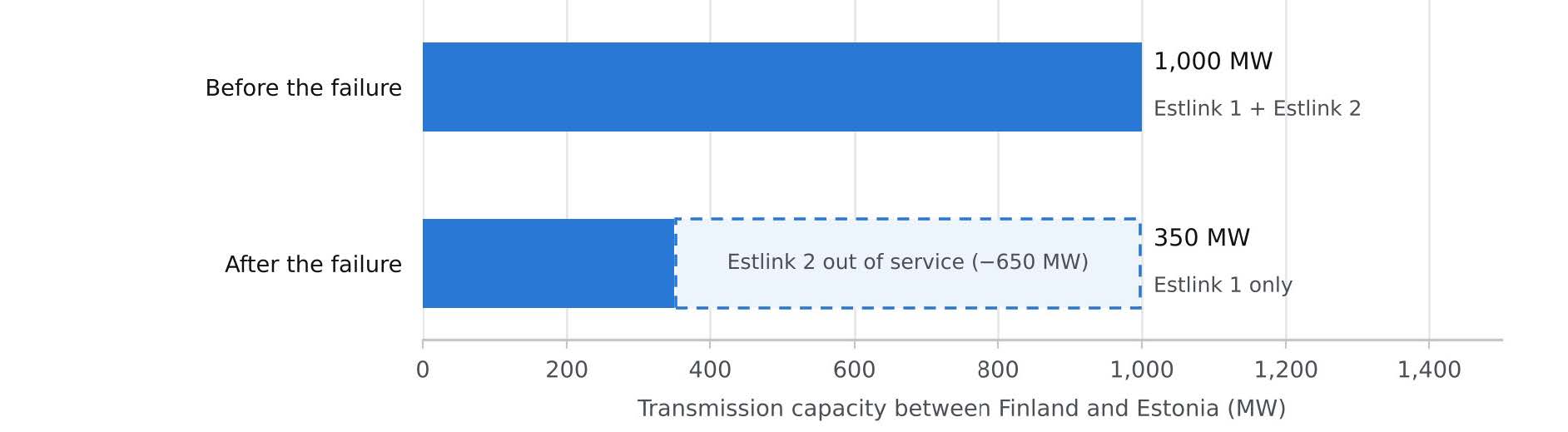
Estlink 2 shows the scale of the consequences when repair takes longer: the power link was out of service for about six months after the Eagle S incident (Martin, 2026b). Finland and Estonia are connected by only two transmission links, the 350-megawatt (MW) Estlink 1 and the 650 MW Estlink 2, so the damage cut import capacity from Estonia from 1,000 MW to 350 MW (Figure 2). At the time, Fingrid estimated that the repair would take several months (Fingrid, 2025).
Figure 2. Electricity transmission capacity between Finland and Estonia before and after the Estlink 2 failure of 25 December 2024
 Source: Author’s compilation based on Fingrid (2025).
The timing also mattered. The damage occurred about six weeks before the Baltic states were due to disconnect their power systems from the BRELL synchronous area shared with Russia and Belarus. In early January 2025, the Latvian transmission system operator AST warned that the planned test of isolated operation might have to be rescheduled because of the Estlink 2 outage (The Baltic Times, 2025). The NATO Energy Security Centre of Excellence assessed that the damage meant a loss of 0.65 gigawatts of potential supply for the rest of the winter, although the Estonian transmission system operator Elering expected no negative impact on the disconnection (NATO ENSEC COE, 2025). The disconnection went ahead on 8 February 2025, and the Baltic grids were synchronised with continental Europe the next day (PISM, 2025), with Estlink 2 still out of service. An outage at such a moment reduces the margin available while the system is in transition.
Repair time is an exposure window: the telecom cables cut in 2024 and 2025 were back in service after 10 to 33 days (Table 2), and throughout that time the corridor ran with less redundancy than before. The return can itself be disruptive. On 28 November 2024, the day C-Lion1 was repaired, latency between Finnish and German anchors fell back in four stages over about ten hours, and in the main stage 7.6% of ping rounds lost packets for a quarter of an hour, against less than 1% at any time around the cut itself (RIPE NCC, 2026). The sovereignty gap can thus be defined as the distance between owning an asset and being able to see what happens to it, protect it, hold those responsible to account and restore it on one’s own terms.
7. Responses so far
The incidents have prompted a substantial response at the level of NATO, the European Union and the coastal states.
NATO launched the Baltic Sentry activity on 14 January 2025, at a meeting of the Baltic Sea Allies in Helsinki. It involves frigates, maritime patrol aircraft and naval drones, and aims to enhance surveillance and deterrence around critical undersea infrastructure (AP, 2025). The activity is led by Allied Joint Force Command Brunssum as part of NATO’s enhanced vigilance activities and is supported by the NATO Maritime Centre for Security of Critical Underwater Infrastructure (Allison, 2025). At the same meeting, the foreign ministries of the Baltic Sea Allies agreed to set up a group of legal experts to assess what action could be taken against suspect vessels without affecting freedom of navigation (AFP, 2025). In October 2026, about 50 US Marines from a reconnaissance unit, equipped with small drones and coastal sensors, were sent to work with Finnish forces as part of Baltic Sentry (Sampson, 2026). In November 2026, the commander of the Finnish Navy said that there had been no new incidents affecting Finnish undersea infrastructure since the Fitburg case and that he believed the actions of NATO countries had had an effect (Vilmusenaho, 2026).
The European Union adopted an Action Plan on Cable Security on 21 February 2025 (European Commission and High Representative, 2025). It covers both communication and electricity cables and is organised around four priorities: prevention, detection, response and recovery, and deterrence. It proposes greater repair capacity, including vessels with icebreaking capability, and calls for better surveillance and information exchange between Member States (Finnish Government, 2025a). The Commission indicated that almost EUR 1 billion within the existing budget would be redirected to these goals (Reuters, 2025a).
Implementation has followed in stages. In February 2026, the Commission adopted a Cable Security Toolbox of risk-mitigating measures and a list of 13 Cable Projects of European Interest, supported by about EUR 347 million from the Connecting Europe Facility (EU Blue Economy Observatory, 2026). It opened a EUR 20 million pilot call for repair modules in the Baltic Sea, followed by a EUR 40 million call to increase European cable repair capacity. Finland sought funding from the pilot call for a project coordinated by the National Emergency Supply Agency with partners from Finland, Sweden and Estonia; decisions were expected in autumn 2026 (Finnish Government, 2026). The Commission also granted EUR 5.8 million to the first two regional cable hubs, of which the Baltic Sea hub, coordinated by Finland together with Denmark, Germany, Estonia, Latvia and Sweden, received EUR 2.5 million (Ernst, 2026). The hubs are intended to strengthen security operations centres, information sharing and threat detection for critical marine infrastructure. In Finland, the hub is to build on existing Border Guard structures rather than new facilities (Blackburn, 2026). A second call, open until 14 January 2027, will fund hubs for further sea basins or allow more Member States to join the existing ones (Ernst, 2026; Republic of Cyprus, 2026). A separate EUR 3.94 million pilot will examine how data held by cable operators, satellite providers and other private entities could support the hubs, with work expected to begin in spring 2027 (SubTel Forum, 2026a).
Research is being organised as well. The NEPTUNE project, funded under Horizon Europe from August 2026 to July 2029 and coordinated by Laurea University of Applied Sciences, is drawing up a European research and innovation roadmap for submarine cables that follows the Action Plan’s cycle of prevention, detection, response and repair, and deterrence. Its partners include Turku University of Applied Sciences, the Finnish Ministry of the Interior, the Estonian Ministry of Defence and the Danish Cable Protection Committee (CORDIS, 2026).
Finland has supported the EU Action Plan, identifying increased repair capacity as a key action and stressing that the Baltic Sea should be prioritised (Finnish Government, 2025a). Nationally, Finnish authorities intercepted both the Eagle S and the Fitburg at sea, brought them into Finnish waters and pursued criminal proceedings. The response has become faster with each incident: the first suspect ship left before the authorities could act, whereas the most recent one was under control within hours (Lehto and Little, 2026). Peltola (2026) notes that the Balticconnector case sparked learning among the Finnish authorities, who were better prepared to respond when the Eagle S damaged cables in December 2024. In June 2026, the Border Guard field-tested distributed acoustic sensing together with the Navy, the Naval Academy, Fingrid, Gasgrid, the Geological Survey of Finland, the Institute of Seismology at the University of Helsinki and Elisa. The method turns a subsea fibre-optic cable into a sensor that registers seabed vibrations, such as those caused by a dragging anchor (Border Security Report, 2026). In September 2026, the Coast Guard, police special forces and the Defence Forces practised boarding a ship at sea in the Gulf of Finland, an exercise the Coast Guard described as reflecting “the new normal” (Lehto and Little, 2026). Around the same time, the Government presented a bill to Parliament (HE 158/2026 vp) that would give the Border Guard a new duty to monitor critical undersea infrastructure in Finland’s territorial sea and EEZ, with the right to prevent or interrupt damage to it, and the right under UNCLOS Article 110 to stop and inspect ships suspected of being without nationality in the EEZ (Government of Finland, 2026).
The bill has been referred to Parliament’s Administration Committee (Parliament of Finland, 2026). It would also oblige companies that own undersea critical infrastructure to report damage to it (Finnish Council of Regulatory Impact Analysis, 2026). In the courts, the Fitburg case was decided at first instance in November 2026 with convictions that are not yet final (see Section 6.1).
These measures address important gaps, particularly in detection and repair. Three issues nevertheless remain largely open. The first is repair under threat: the funded repair modules are designed to be installed on existing commercial vessels, whose availability in a crisis is not guaranteed. The second is the legal framework: as far as the author has been able to establish, no common procedures resulting from the legal expert group’s work had been made public by early November 2026, and national courts are still resolving basic questions of jurisdiction. The third is national continuity: the European and allied measures aim to protect the cables, but they do not define what each state must be able to do when the cables are lost.
8. From grey zone to severe crisis
The incidents of 2023–2026 are best understood as a stress test conducted at peacetime pace. Damage occurred one or two links at a time; investigators could board ships and interview crews; repair ships could sail freely; and courts could take years to decide. A hypothetical hybrid campaign in the context of an armed conflict would remove each of these conditions. Table 4 contrasts the two situations.
Table 4. Grey-zone incidents compared with a large-scale hybrid campaign
| Dimension | Grey zone, 2023–2026 | Large-scale hybrid campaign |
| Damage pattern | One or two cables at a time; anchor drags whose cause is hard to establish | Several data and power links at once, possibly combined with cyber attacks and disinformation |
| Detection | AIS tracks reviewed after the event | AIS switched off or spoofed and satellite navigation jammed; national and allied sensors become the main source |
| Attribution | Investigations over months or years | Attribution delayed or irrelevant to the immediate response |
| Repair | Telecom repair ship arrives within days; power cable repair takes months | Repair ships unable, uninsured or unwilling to work in contested waters |
| Network | Traffic reroutes via Sweden and the Baltic states with little or no measurable packet loss | Alternative routes may also be affected; capacity may fall short rather than reroute |
| Cross-sector coupling | Power and telecom cables damaged on the same day | Energy, telecommunications, payments and industrial control systems degrade together |
| Response | Police seizure and criminal proceedings | Military boarding, rules of engagement and allied command |
Source: Author’s assessment.
The severe-crisis scenario is a planning case: the loss of international connectivity should be planned for from the onset of a crisis rather than after a period of warning.
Three differences deserve particular attention. The first is simultaneity. The resilience observed by the RIPE NCC rests on the availability of many alternatives. A deliberate campaign could also target the alternatives as well as the primary route, for example by combining damage to submarine cables with attacks on terrestrial links through Sweden or on key data centres and exchange points. Even the cut of a single terrestrial cable between Finland and Sweden in December 2024 measurably affected around 5% of paths between Finnish and Swedish anchors (Aben, 2024b).
The second is the degradation of the sensor picture. Much of today’s maritime situational awareness relies on AIS, whose data the ships report themselves and can switch off or falsify, and on satellite navigation. Interference with satellite navigation is already a reality: by early October 2024, Traficom had recorded 145 instances affecting maritime traffic and 1,779 affecting aviation that year, originating from outside Finland’s borders (Traficom, 2024). It has since intensified: Traficom reported a clear rise in interference observations from February 2026, detected spoofing, and in April 2026 submitted new official interference reports to Russia and the International Telecommunication Union (Traficom, 2026). The disruption is already a hazard in peacetime. In June 2025, Finland and Estonia issued a joint navigational warning for the Gulf of Finland, noting that disruptions had already caused near misses and that spoofing of AIS position data had become more common (Traficom, 2025b). The Gulf of Finland Coast Guard has also reported ships switching off their AIS transponders and misreporting their positions on online tracking platforms (Marine Insight, 2024). An AIS track alone is therefore weak evidence of where a ship was when a cable failed; the ship’s own records and independent sensors carry more weight (Section 5). In a severe crisis, both AIS and satellite navigation should be assumed to be unreliable. Detection of anchor drag and other suspicious behaviour would then have to rely on sensors under national and allied control: coastal radar, maritime patrol aircraft, satellite imagery, seabed sensors and the operators’ own fault detection on the cables themselves.
The third is repair. In peacetime, a repair ship from Calais needed almost four days to reach the C-Lion1 fault site (Cinia, 2024a). In a severe crisis, commercial repair ships may not be available at all, insurers may refuse cover, and crews may refuse to work in waters where mines or hostile vessels are present. A foretaste came in 2026, when Finland repeatedly closed parts of its airspace over concerns about stray military drones; on 14 August it also restricted maritime traffic in the eastern Gulf of Finland for about four hours during Ukrainian drone attacks on the St Petersburg region (Yle, 2026a). Repair capacity that cannot operate under protection is of limited value in the scenario that matters most.
These differences lead to a change of objective. In peacetime the aim is to avoid outages. In a severe crisis the aim shifts to guaranteeing a sovereign minimum service: a defined set of functions that continue on Finnish soil when all international data and power links are unavailable, for a defined period. Such a list would include at least government and defence communications, emergency services, the core of the payment system, the control systems of the power grid and water supply, and the logistics of ports and fuel distribution. Mikkola (2026) reaches a similar conclusion for energy: in his view, Finland, as a neighbouring state to Russia, needs a renewables-based energy system that can withstand a military conflict.
Finland has a strong foundation for this work in its comprehensive security model, renewed in the Security Strategy for Society adopted by the Government on 16 January 2025, and in its security of supply system (Security Committee, 2025). The task is to bring subsea and international connectivity explicitly into that framework, with severe-crisis scenarios rather than only commercial service levels.
This is also where operational technology (OT) security and seabed security meet. A substation, water treatment plant or port terminal whose control system depends on a cloud service, an identity provider or a remote maintenance connection hosted abroad is only as resilient as the cable behind it. The IEC 62443 series offers a practical design method: by dividing systems into zones and conduits, it allows the external conduit to be treated as something that can fail, and the system to be designed to keep operating locally and safely when it does (IEC, 2020). In practice, this means local authentication, independent time sources that do not rely on satellite navigation, locally stored operating data and procedures for manual operation, all of which must be exercised rather than assumed.
The same reasoning applies to digital services more broadly. Domain name resolution, certificate validation and cloud-based identity management are often hosted outside Finland. They are rarely considered critical until they fail. A sovereign minimum service therefore requires an inventory of such hidden external dependencies for each essential function. Dependence also shapes the threat. The more society-critical data and services are processed in data centres abroad, including those of the large cloud providers, the more damage a cut does, and the more attractive the cables may become as targets. Keeping essential functions able to run on infrastructure in Finland, with copies of critical data also held elsewhere, reduces both the consequences of a cut and the incentive to make one.
9. Data centres and the seabed: competing perspectives
Finland’s growth as a location for data centres connects the two kinds of seabed infrastructure examined in this briefing: the power interconnectors that help balance the grid, and the fibre that carries international traffic. The pipeline is large relative to the national power system. Fingrid has received non-binding connection enquiries for more than 100 gigawatts (GW) of new demand, over half of them from data-centre projects, while Finland’s peak electricity consumption is currently below 16 GW (Fingrid, 2026a). If all projects that have signed a connection agreement were built in full, electricity consumption would rise by almost 40% from its 2025 level (Fingrid, 2026c). Announced projects include a campus in Forssa that could reach about 450 MW, about 500 MW planned in Rovaniemi, a 310 MW AI campus under construction in Lappeenranta, and two data centres of about EUR 1 billion each for TikTok in Kouvola and Lahti (Blackridge Research, 2026).
How this growth should be steered is contested. This section sets out the main perspectives without taking a position between them, because each bears on the questions of dependency and continuity raised in Sections 6.3 and 8. Table 5 summarises where they diverge.
Economic and industrial policy. The government’s approach rests on a national data-centre roadmap by the Prime Minister’s rapporteur, Veli-Matti Mattila, which sets national goals and principles for attracting high value-added data centres. On that basis, the government is preparing a state aid programme for data centres that benefit the national economy, together with a registration obligation intended to give the authorities a fuller picture of data-centre investment and operation (Finnish Government, 2025b). At the same time, electricity used in data centres was moved from the reduced tax class II to the general class I from 1 July 2026, raising tax revenue by about EUR 47 million a year (Government of Finland, 2025), and the new support may cost no more than the tax relief it replaces (Parliament of Finland, 2025). Operators stress the wider economic effects: Microsoft’s own projections for its data centres in Finland include EUR 143 million of economic activity and 725 local jobs from operations in 2028, and 12,650 construction-related local jobs in 2026–2028 (Microsoft, 2026).
Sceptics question how much of the value stays in Finland. The Director General of the Finnish Tax Administration has said that data centres currently yield very little tax revenue for the state (MTV Uutiset, 2026a). A science brief by the Finnish Academy of Science and Letters notes that data centres do not by themselves create a data economy, that the number and quality of permanent jobs is a central open question, and that, according to a Business Finland estimate, only 10–30% of a data centre’s investment stays in Finland (Finnish Academy of Science and Letters, 2025). MP Mari Holopainen (Greens) argues that no separate subsidy is needed, since Finland’s climate, clean power and stable grid are advantages in themselves, and that policy should instead decide which data centres are worth having and how their electricity use fits the energy system (Holopainen, 2026). MP Mai Kivelä (Left Alliance) has proposed a separate data-centre tax so that society can obtain an appropriate benefit from data centres (Kivelä, 2026).
The electricity system. The transmission system operator has begun to set conditions. In June 2026, Fingrid published technical requirements for all demand connections of 30 MW or more, citing an urgent need to regulate large loads, data centres in particular (Fingrid, 2026b). Since new connection principles were introduced in June 2026, connections have generally been processed according to project maturity (Borenius, 2026), and the government is preparing rules that would end first-come, first-served connections altogether. Under the proposed priority categories, data centres above 1 MW would rank below critical infrastructure, although those of up to 10 MW could be treated differently if they hold flexibility agreements covering at least 80% of their peak demand (TechRadar, 2026).
Concern over electricity prices has prompted legislative proposals. MP Heikki Vestman (National Coalition Party) estimates that data centres with investment decisions would need more than 2,100 MW, about twice the output of the Loviisa nuclear power plant, and could raise Finland’s electricity consumption by up to about 30% in the coming years. His legislative initiative would allow large data centres to connect to the grid only after securing balancing capacity that matches their power needs and new generation that matches their annual consumption (Vestman, 2026). MP Seppo Eskelinen (Social Democratic Party) argues that data-centre investment must not lead to unreasonable price rises for consumers or businesses, and that data centres, as major consumers, should commit to taking part in future energy investments (Eskelinen, 2026). The chief executive of Finnish Energy has said that data centres could eventually consume about 20 terawatt hours a year, roughly a quarter of Finland’s current electricity production (MTV Uutiset, 2026a).
Others see data centres as a resource for the electricity system. The head of the Energy Department at the Ministry of Economic Affairs and Employment considers it justified to encourage, and if necessary require, data centres to make use of flexibility, and according to pv magazine, Fingrid requires data centres above 30 MW to be able to reduce 30% of their consumption in real time (pv magazine, 2026). Fortum argues that fast grid connections, efficient permitting and low energy costs make the Nordic countries well suited to data centres (Laitinen, 2025), and an industry supplier describes demand growth driven by new investment as a good problem to have (Schneider Electric, 2026). Researchers point out that a data centre’s ability to provide demand response depends on its business model and purpose (Finnish Academy of Science and Letters, 2025).
Heat and local benefit. For municipalities, waste heat is the clearest local gain. Once Microsoft’s data centres in Espoo and Kirkkonummi operate at full capacity, their waste heat is expected to cover around 40% of the heat needed by about 250,000 district-heating users (City of Espoo, 2023). Data-centre heat is, however, low-grade, and data centres are rarely located close to district-heating networks that can use it (Datacenter Dynamics, 2022a). The Academy’s science brief also warns municipalities not to overestimate tax income: property tax is reliable, but international groups can reduce corporate tax through their group structures (Finnish Academy of Science and Letters, 2025).
International connectivity. From the network perspective, data-centre demand drives new routes. Midgard Infra plans a 200-kilometre unrepeated subsea cable between Sweden and Finland, with construction from early 2027 and services by 2029, to meet the connectivity needs of Finland’s growing hyperscale and colocation market (SubTel Forum, 2026b; W.Media, 2026). The projects of GlobalConnect and Cinia discussed in Section 12.1 point the same way. Longer-term options lie in the Arctic. Polar Connect was listed in early 2026 among the 13 priority projects in the EU’s report on Cable Projects of European Interest, and CSC – IT Center for Science considers that it could give Finland-based data centres more resilient international connectivity (CSC, 2026). Sceptics point out that the time needed to secure partners and build a commercial case in an unstable geopolitical climate keeps the Arctic projects far from realisation; Far North Fiber is expected to be operational by 2029 and Polar Connect by 2031 (Middleton and Rønning, 2026). Meanwhile, the existing geography concentrates exposure: Finland’s data-centre market is dominated by Helsinki, and its subsea landing stations lie along the south coast (DC Byte, 2025).
The Red Sea lesson. The Red Sea shows what concentration means on a global scale: over 90% of communications between Europe and Asia are estimated to pass through cables on its seabed (Gulf News, 2024). In February 2024, four cables, AAE-1, EIG, Seacom and TGN-Gulf, were cut, most likely by the anchor of the Rubymar, a cargo ship that had been struck by a Houthi missile and later sank (gCaptain, 2024). The Hong Kong operator HGC estimated that about a quarter of the traffic through the Red Sea was affected. It rerouted northbound traffic from Asia overland through China to Europe, eastbound traffic across the United States to Europe, and the rest over the remaining cables in the Red Sea (Capacity Media, 2024). Smaller markets that depend on few routes were also affected: internet access in Djibouti, which Seacom serves, was disrupted within two days (Gulf News, 2024). In September 2025, cuts to the SMW4, IMEWE and FALCON GCX systems near Jeddah degraded connectivity in India, Pakistan, the United Arab Emirates and other Gulf states. Microsoft rerouted its Azure cloud traffic over longer paths outside the Red Sea, so services continued but with higher latency, and Cloudflare measured delays up to 30% higher between India and Europe (Tom’s Hardware, 2025; Gulf News, 2025). Early industry analysis again pointed to a ship dragging its anchor (Gulf News, 2025). The pattern is the one measured in the Baltic Sea in Section 4, on a larger scale: traffic does not stop but takes a longer path, and the regions served by the fewest routes tend to be hit hardest.
The Arctic option. For its proponents, this experience is the strategic case for the Arctic projects. Polar Connect would follow the shortest route between Europe and East Asia, across the Arctic Ocean near the North Pole towards Japan and North America, while Far North Fiber would run through the Northwest Passage between Greenland and Canada (NORDUnet, n.d.). Polar Connect’s second phase, coordinated by the Swedish Research Council and co-funded by the EU’s Connecting Europe Facility, runs from 2026 to 2028 and covers the cable route study, seabed surveys with the icebreaker Oden, the cable design and repair capability in severe ice (Swedish Polar Research Secretariat, n.d.). Proponents argue that such a route would reduce Europe’s dependence on the Red Sea and on transit through third countries, add redundancy to existing routes and strengthen Europe’s digital sovereignty (Swedish Polar Research Secretariat, n.d.). Sceptics point to the cost, estimated at about USD 2.3 billion for Polar Connect, to repair under ice, and to earlier attempts: Quintillion was formed to build a cable from Japan to Europe via the Arctic but completed only a cable in northern Alaska (IndexBox, 2026). Two further points matter for this briefing. An Arctic cable would leave the region by a different sea and so add physical diversity that new Baltic routes cannot, but its value to Finland would depend on the Nordic backhaul that connects its landing point to the data centres in the south. And its repair would depend on ice-capable ships that are even scarcer than those available in the Baltic Sea (Section 6.3).
Security and ownership. The security perspective focuses on who owns and uses the capacity. In June 2026, the Finnish Security and Intelligence Service (Supo) said that a new investment screening law would help counter risks linked to data centres in particular, noting that authoritarian states have several reasons to seek ownership of data centres in Finland, including opportunities for cyber espionage (Kaleva, 2026). Supo has also warned that authoritarian states could use data centres to circumvent sanctions (Yle, 2026d). Under the draft law, data centres with a potential capacity of at least 100 MW would need a permit, with the National Emergency Supply Agency deciding at the first stage and the Ministry of Economic Affairs and Employment at the second. Business organisations raised concerns: the Confederation of Finnish Industries warned that an unclear scope or unpredictable procedures would weaken Finland’s investment environment, and Finnish Energy that the law must not unduly reduce foreign financiers’ interest in investing in Finland (Kaleva, 2026). Data-centre service providers already fall within the scope of the Cybersecurity Act as part of the digital infrastructure sector, supervised by Traficom’s National Cyber Security Centre (Traficom, 2025a).
The data centres planned for TikTok show how far the perspectives can diverge. The company presents its facilities in Kouvola, due to begin operating by the end of 2026, and in Lahti, starting at 50 MW and scalable to 128 MW from 2027, as part of a European data-sovereignty initiative whose data controls are monitored independently by the cybersecurity firm NCC Group (Net Influencer, 2026). When the Kouvola project became public in 2025, the then Minister of Economic Affairs, Wille Rydman, said that the government had learned of it only at a very late stage and described the arrangement as unusual (MTV Uutiset, 2025), while Prime Minister Petteri Orpo stated that, according to the Ministry for Foreign Affairs, building data centres involves no foreign or geopolitical risks (Kaleva, 2025). MP Jarno Limnell (National Coalition Party) argues that data centres are concentrations of computing power and therefore part of technological great-power competition, and that municipalities should not be left to assess such projects alone (Limnell, 2026).
Sovereignty and continuity. Two models of digital sovereignty point in different directions. The first is localisation. In its National Security Review 2026, Supo called for Finland to develop domestic cloud solutions to protect sensitive government data (Helsinki Times, 2026). At EU level, the Commission proposed a Cloud and AI Development Act in June 2026 that aims to triple the EU’s data-centre capacity within five to seven years, arguing that the shortage of capacity forces European businesses to run critical workloads on the infrastructure of foreign hyperscalers (European Commission, 2026). The proposal would ease permitting in designated data-centre acceleration zones and introduce sovereignty risk assessments by Member States (European Parliament, 2026). Critics note that tripling capacity implies a very large rise in electricity demand at a time when grids are already under pressure from electrification (EU Transition Pathways, 2026).
The second model is dispersion. A week before Russia’s full-scale invasion, Ukraine adopted a law on cloud services that allowed state registries to be transferred abroad (dev.ua, 2025). Amazon Web Services reports that it alone has migrated more than 10 petabytes of data from 42 Ukrainian government authorities, 24 universities and dozens of private companies (AWS, 2022), and early in the war a government data centre was damaged by Russian missiles (Datacenter Dynamics, 2022b). In 2025, Ukraine decided that state registries may remain in data centres abroad after the war (dev.ua, 2025). Estonia adopted the model in peacetime: under an agreement signed with Luxembourg in 2017, it keeps copies of critical databases in a Tier 4 data centre in Luxembourg, a data embassy with the same protection and immunity as a traditional embassy (e-Estonia, 2020; Estonian World, 2017).
For this briefing, the two models expose different vulnerabilities. Localised data remain under Finnish jurisdiction but share the exposure of the national grid and the seabed. Dispersed copies survive physical attack, but reaching them depends on the international links examined in Sections 4 to 6. The sovereign minimum service of Section 8 draws on both: it concerns functions that must keep running locally, whereas copies held abroad protect the data themselves.
Table 5. Where the perspectives on data centres diverge
| Issue | Emphasis of proponents | Emphasis of critics | Open question |
| Economic value | Investment, construction jobs and spill-overs to suppliers | Few permanent jobs, low tax yield and a limited share of investment staying in Finland | Which facilities count as high value-added |
| Electricity | Flexibility, waste heat and demand that justifies new generation | Higher prices, grid congestion and competition for baseload power | Who bears the costs of grid capacity and price effects |
| Connectivity | Demand that funds new, diverse routes | Capacity concentrated on the south coast and a few sea routes | Whether route diversity keeps pace with load |
| Security and ownership | Foreign capital is needed; screening and independent oversight exist | Espionage, sanctions evasion and late information to government | Scope and timing of investment screening |
| Sovereignty | Domestic capacity reduces dependence on foreign clouds | Domestic capacity shares the exposure of the grid and the seabed | Balance between localisation and dispersion |
Source: Author’s compilation based on the sources cited in Section 9.
Questions for resilience planning. The perspectives leave several questions open, without presupposing their answers: whether the physical diversity of a facility’s international connectivity should count in grid connection, screening or state aid decisions; in what order large data-centre loads would be curtailed if interconnectors or international cables were lost in a crisis, and whether that order is agreed in advance; which data and services must remain in Finland and which should also be copied abroad, and over which links; and whether the share of new capacity that serves Finnish and European users should affect priority in a crisis.
10. The shadow fleet: a separate risk
This briefing has deliberately kept Russia’s so-called shadow fleet out of its main analysis. The fleet is often presented as the explanation for the cable incidents, but the public record does not support that shortcut. As far as the author has been able to establish, only one of the eight incidents in Table 1, the Eagle S case, involved a vessel that the authorities themselves described as part of the fleet. The other vessels involved sailed under the flags of China, Hong Kong, Malta and St Vincent and the Grenadines (Table 1). The fleet nevertheless adds risks of its own to the same narrow waters, and it shapes the conditions under which the coastal states act.
The fleet is estimated to comprise up to 1,000 ageing vessels with opaque ownership structures, sailing under flags of convenience to export sanctioned Russian goods, particularly oil (Martin, 2026b). It is central to Russia’s export economy: at the end of 2024, about 80% of the tankers carrying Russian crude oil belonged to it (Haaja and Mäkinen, 2026), and mineral fuels accounted for about two-thirds of Russia’s export earnings in the first half of 2025 (Liuhto, 2026).
Much of this traffic passes through the Gulf of Finland. In January 2026, the Finnish Border Guard estimated that an average of 45 shadow-fleet ships a week were still passing through it (Blackburn, 2026). In spring 2026, after Ukrainian strikes on the oil terminals at Ust-Luga and Primorsk, nearly 40 shadow-fleet tankers were reported to be waiting in the Gulf of Finland (ERR, 2026a). The Baltic Sea Allies had already stated in January 2025 that the fleet poses a particular threat to maritime and environmental security (AFP, 2025). In November 2026, the commander of the Finnish Navy described the unprofessional crews of the shadow fleet and very old tankers as the biggest threat at the moment, warning that a tanker running aground could cause something like a natural catastrophe. In his view, the greatest danger in the Baltic Sea is an accident of some kind (Vilmusenaho, 2026).
The clearest link between the fleet and the cable incidents is the Eagle S. Finnish Customs detained its cargo of unleaded petrol and diesel as subject to EU import sanctions and described the tanker as part of the shadow fleet used to circumvent sanctions on Russian oil, although it found no grounds for a criminal sanctions investigation of the crew, since the ship had entered Finnish waters at the authorities’ request (Baird Maritime, 2025). The EU later listed the vessel in its sanctions against the fleet (Ministry for Foreign Affairs of Finland, 2025). One case shows that the fleet can be involved in damage to infrastructure. It does not make the fleet the explanation for the pattern as a whole.
Enforcement against the fleet is being tested by military means. In May 2025, as Estonia tried to stop the stateless tanker Jaguar, according to Estonian authorities a Russian fighter aircraft briefly entered Estonian airspace, and the tanker continued into Russian waters (Reuters, 2025c). In April 2026, reporters observed a Russian naval corvette near tankers waiting in the Gulf of Finland (ERR, 2026b). In April 2026, the commander of the Estonian Navy said that Estonia would not detain shadow-fleet vessels because the risk of escalation was too high, and would intervene only if infrastructure had been damaged or an oil spill was imminent (ERR, 2026b). A coastal state that must weigh the risk of a naval confrontation before boarding a tanker has less practical control over its EEZ than the law alone suggests. The legal ground for boarding is also narrowing: according to the maritime analytics firm Windward, nearly 70 tankers began broadcasting Russia as their flag between May 2025 and February 2026, many of them after boardings of stateless or falsely flagged ships (Schuler, 2026). This limits the reach of the inspection power proposed for the Finnish Border Guard in HE 158/2026 (see Section 7).
The coastal states’ own shipping is also exposed. Overnight from 30 September to 1 October 2026, Russia’s border guard held the Cyprus-flagged cargo ship Västerbotten for several hours on the route to the Estonian port of Sillamäe, which crosses Russian territorial waters under an agreement between Russia, Estonia and Finland. Russia gave no explanation. It was the second such case after the tanker Green Admire in 2025, and the Estonian Transport Administration has decided to route future traffic to and from Sillamäe through Estonia’s own territorial sea, even though the route through Russian waters is used because it is safer for large ships than passing between the shallows on the Estonian side (ERR, 2026c). In the Gulf of Finland, the shipping of all the coastal states depends in part on routes through each other’s waters.
Sanctions have become the main European instrument against the fleet. In May 2025, the EU’s 17th sanctions package listed further shadow-fleet vessels, including the Eagle S, bringing the total number of listed vessels to 342 (Ministry for Foreign Affairs of Finland, 2025). The 21st package of July 2026 raised the total to 673, extended the measures to vessels that support the fleet with bunkering and other services, and for the first time listed a crewing agency (Council of the European Union, 2026a). It also allowed Member States to confiscate and sell the cargoes of shadow-fleet vessels they detain, a question raised when Germany’s Federal Fiscal Court suspended the confiscation of the tanker Eventin and its cargo, citing reasonable doubts about its legal basis (PwC, 2025; North Standard, 2026). The measure targets sanctions evasion rather than damage to infrastructure, but it shows that action against the cargo, and not only against the crew, is becoming legally available. The 22nd package of 12 October 2026 consisted mainly of listings aimed at Russia’s military-industrial complex (Council of the European Union, 2026b). Enforcement in the Baltic Sea rests largely on the European coastal states.
The implications differ from those for cable protection. Enforcement against the fleet in the Gulf of Finland could be backed collectively, so that no single coastal state has to weigh the risk of escalation alone, as Estonia did in 2026, and the same backing could extend to the coastal states’ own shipping, which can be held up on routes that cross Russian waters. Proof of adequate insurance could be verified systematically for tankers and cargo ships associated with the fleet, and sanctions listings could continue to target vessels involved in damage to infrastructure. Liuhto (2026) proposes making public which Western companies transport, refine or sell Russian oil. The same transparency would help port states and insurers identify the high-risk vessels that serve this trade. These measures address an environmental, economic and security risk in its own right. They do not replace the measures in Section 12, which are needed whichever ships are involved.
11. The economic dimension: costs, incentives and resilience
The incidents also have an economic dimension that is easy to overlook when the network routes around the damage. This section examines three questions: what an outage costs, who bears that cost, and what the costs imply for the choice of resilience measures. It relies on published figures; estimates made by market participants are identified as such. Table 6 summarises the exposure by type of infrastructure.
Dependence. Finland’s economy reaches its markets largely across the Baltic Sea. In 2025, 90.2 million tonnes of goods moved in Finland’s foreign sea transport (Statistics Finland, 2026), and, as noted in Section 2, more than 90% of Finland’s merchandise trade by volume moves by sea. Goods exports were worth EUR 74.3 billion and imports EUR 75.2 billion in 2025 (Finnish Customs, 2026). The seabed carries the complementary flows: electricity and gas through the interconnectors, and the data on which trade, payments and the growing data-centre sector depend (Section 9). Ships and seabed links share the same narrow waters, and ship anchors are among the main causes of cable faults worldwide (Section 2).
Direct costs: repair. Repair costs differ by an order of magnitude between types of infrastructure. An industry overview puts a typical repair of a subsea fibre-optic cable at about USD 0.5–1 million and of a subsea power cable at USD 10–100 million, depending on many variables (Qiu, 2025). The Baltic cases are of the same order. Gasgrid Finland estimated the repair of the Balticconnector gas pipeline, carried out with remote-controlled equipment at a depth of about 60 metres, at around EUR 35 million (World Pipelines, 2024). Elering estimated the repair of Estlink 2 after the Eagle S incident at EUR 50–60 million, to be shared equally with Fingrid (ERR, 2025b), which is consistent with the EUR 55.3 million in repair costs that the owners are claiming (Section 6.2). An earlier malfunction of the same cable had taken about seven months and more than EUR 30 million to repair in 2024 (ERR, 2025a). For planning purposes, the duration of an outage appears to depend more on the type of asset than on the cause of the damage. According to the marine insurance industry, a telecom cable repair can generally be completed within 10 to 15 days of the failure, whereas a power cable repair often takes 40 to 60 days (IUMI, 2018); Estlink 2 took considerably longer, partly because a suitable vessel first had to be found (ERR, 2025a).
Indirect costs: prices and adequacy. Further costs fall outside the repair bill. The Estonian energy company Eesti Energia estimated, on the basis of its own forecasts, that the Estlink 2 outage raised electricity prices in the Baltic region by an average of 2.2 cents per kilowatt hour from January to June 2025 (Enefit, 2025). The effect was uneven: according to Elering, prices in Finland dropped slightly while those in Estonia rose significantly (ERR, 2025c). This is consistent with the usual direction of flow: in 2024, electricity flowed from Finland to Estonia in almost 90% of the hours of the year (Fingrid, 2025). For Finland, the main effect concerned adequacy rather than price. Fingrid assessed that the outage weakened the adequacy of electricity on very cold and windless winter days, while supply on a typical winter day remained sufficient (Fingrid, 2025). The Balticconnector outage shows the equivalent in the gas market. Finland’s gas supply remained secure through the liquefied natural gas (LNG) terminal at Inkoo (Gasgrid Finland, 2024), but the Finnish market was isolated: prices were volatile and often well above those further south, and the price difference peaked at nearly EUR 58 per megawatt hour in mid-January 2024, when a cold spell coincided with low stocks at Inkoo (Argus, 2024). In telecommunications, the indirect cost has so far been small because traffic found other routes (Section 4); it appeared as added latency, reduced redundancy and, in the second winter, evening congestion rather than lost service.
Who bears the cost. Most of these costs are borne first by the infrastructure operators and then by their customers and owners. Owners of telecom cables commonly self-insure and pay into consortia or maintenance agreements that keep repair ships on standby (IUMI, 2018). Fingrid and Elering financed the Estlink 2 repair themselves and are claiming compensation in the criminal proceedings against the Eagle S officers (Section 6.2). Elering said it would pay its share from congestion income, which is intended for maintaining and increasing cross-border transmission capacity (ERR, 2025b). Costs that are not recovered fall ultimately on the operators’ grid customers and owners, and price effects fall on consumers in the importing market. The public response is a further cost: the police costs of the Eagle S operation (Section 6.2), naval and coast guard surveillance, and the EU funds redirected to cable security (Section 7). Because recovery from those responsible is uncertain, the costs remain largely with the coastal states and their operators, whether the damage was accidental or not.
Table 6. Economic exposure by type of seabed infrastructure in the Baltic Sea incidents
| Infrastructure | Outage | Repair cost | Wider economic effect |
| Telecom cables (C-Lion1 and others, 2023–2026) | 10–33 days where published | Typically USD 0.5–1 million per repair (industry estimate) | Traffic rerouted; added latency, reduced redundancy and, in 2025–2026, evening congestion |
| Power interconnector (Estlink 2, 2024–2025) | About six months | EUR 50–60 million (Elering estimate) | Baltic prices raised by an estimated 2.2 cents per kWh on average in January–June 2025 (Eesti Energia estimate); weaker adequacy in Finland on cold, calm days |
| Gas pipeline (Balticconnector, 2023–2024) | About six and a half months | About EUR 35 million (Gasgrid Finland estimate) | Finnish market isolated; price difference with markets further south peaked at nearly EUR 58 per MWh |
| Oil spill from a tanker (hypothetical) | Not applicable | Clean-up about USD 860 million for a full Aframax cargo in Europe (CREA estimate) | Costs may fall on coastal states if insurance is inadequate |
Source: Author’s compilation based on Table 2, Qiu (2025), ERR (2025b), Enefit (2025), Fingrid (2025), World Pipelines (2024), Argus (2024) and Katinas and Wickenden (2024).
The repair market. The capacity to repair is itself an economic bottleneck. A study by TeleGeography and Infra-Analytics estimated that about USD 3 billion of investment, covering at least 15 replacement ships and five additional ones in Asia, is needed by 2040 just to maintain current service levels, as roughly 65% of cable maintenance ships will reach the end of their lifespan within 15 years; half of the respondents to its industry survey said they would pay more for faster repairs (Bryan, 2025). Repair speed can also be bought case by case. Elering explained that the 2025 Estlink 2 repair would be more expensive than the previous one because, to save time, a third-party general construction vessel was adapted for the work; a specialised cable-laying ship would have pushed the repair to the end of the year (ERR, 2025b). In that case, a faster return to service was bought at a higher price, with Elering’s share coming from revenue intended for cross-border capacity.
Environmental liability. The shadow fleet adds a contingent liability of a different order (Section 10). The Centre for Research on Energy and Clean Air, applying average clean-up costs per tonne from an international spill database, estimated that cleaning up after a spill of the full cargo of an Aframax-class tanker, about 100,000 tonnes of crude oil, could cost about USD 860 million in Europe. Where the tanker lacks adequate liability insurance, the cost would fall largely on coastal states and their taxpayers (Katinas and Wickenden, 2024). The verification of insurance discussed in Section 10 is therefore also an economic measure.
Strategic analysis. Taken together, the figures point to three asymmetries that shape the choices open to states and operators. The first lies between cause and consequence. An anchor dragged along the seabed, whether through negligence, technical failure or intent, can cause damage in the tens of millions of euros and price effects that last for months, while the costs of surveillance and response are borne continuously, whether or not an incident occurs. The second lies between types of asset. Telecom cables are relatively cheap and quick to repair and are backed by commercial redundancy, whereas power and gas links are expensive and slow to repair and have few substitutes, so in the incidents to date the economic exposure has been concentrated in energy rather than in data. In the severe-crisis scenario of Section 8, in which many or all international links could be lost at once, this balance would change. The third lies between those who pay for resilience and those who benefit from it. Commercial redundancy is generally planned for traffic and revenue rather than for a severe crisis, and the benefit of reserve capacity accrues to the economy as a whole while its cost falls on individual operators.
These asymmetries bear on the choice of measures, because different measures buy different things. Surveillance and protection reduce the likelihood of damage; repair vessels, spare cable and pre-agreed permits shorten its duration; and route diversity and alternative supply limit its consequences. The Inkoo terminal illustrates the last category: it did not prevent price spikes in the winter of 2023–2024, but it kept gas supply secure through a winter without the pipeline. The figures above suggest that for energy links the duration of an outage drives most of the cost, whereas for telecom cables, which are repaired quickly, the main value lies in diversity that keeps services running in the meantime. Resilience also has a deterrent value that is hard to price: the less an outage costs, the less there is to gain from causing one. Whether the expected benefits justify the cost of each measure is for those who would bear it to judge.
Questions for resilience planning. The economic perspective leaves several questions open, without presupposing their answers: whether price and adequacy effects, and not only repair costs, should be counted when the value of repair readiness, spare cable and reserve capacity is assessed; who should pay for capacity held for a crisis that the market does not price; whether congestion income, security of supply funds or EU programmes are the appropriate source; and how the contingent liability of an inadequately insured oil spill should be reflected in the verification of insurance.
12. Recommendations
The following recommendations are addressed to Finland, the European Union and Baltic Sea partners, NATO, infrastructure operators, and those who plan new links and international projects. They aim to move the region from absorbing incidents to controlling them. They are offered as considerations for the authorities, operators and planners concerned: each involves trade-offs in cost, legal feasibility and freedom of navigation that those responsible are best placed to weigh. Measures that concern the shadow fleet specifically are set out at the end of Section 10. Table 7 summarises both.
12.1 Finland
Secure guaranteed repair capability. Finland could consider securing guaranteed access to at least one repair vessel, a stock of spare cable and joints, and vetted crews able to work in Finnish and neighbouring waters under military escort. This could build on the EU’s repair-module funding and include binding arrangements for use in a severe crisis.
Define and exercise the sovereign minimum service. The functions, duration and responsible authorities could be defined within the framework of the Security Strategy for Society and the security of supply system. The Cybersecurity Act (124/2025), which implements the NIS2 Directive in Finland and entered into force on 8 April 2025, already requires essential and important entities to manage cybersecurity risks (European Parliament and Council, 2022; Roschier, 2025). Its supervisory authorities could expect these risk assessments to include a scenario in which all international links are unavailable. The same scenario belongs in the risk assessments that critical entities must carry out at least every four years under the Act on the Protection of Critical Infrastructure and Improving Resilience in Society (310/2025), which implements the EU’s Critical Entities Resilience Directive (Finlex, 2025). As Peltola (2026) notes, neither the directive nor the Finnish act explicitly mentions the role of intelligence, apart from security vetting, although without up-to-date threat assessments operators’ own vulnerability assessments may be misinformed. In practice, the sovereign minimum service would mean that critical OT systems can operate in island mode and essential digital services can run on infrastructure in Finland when data centres abroad are out of reach (Section 8), with both exercised jointly by operators, the Finnish Border Guard, the Finnish Defence Forces and the Finnish Transport and Communications Agency Traficom.
Build route diversity by design. New capacity could favour routes that do not share corridors with existing cables, pipelines and power links, including northern routes through Sweden and Norway. Cinia’s planned second system, C-Lion2, intended to connect hubs in Finland, Sweden and Germany (Cinia, n.d.), could be routed with this principle in mind. New projects show both the opportunity and its limits. GlobalConnect’s cable from Stockholm to Turku via Åland, due for completion at the end of 2026, avoids the Gulf of Finland, whereas its planned Gotland–Saaremaa–Hiiumaa–Tallinn–Helsinki link, targeted for 2027, adds a route through Estonia but crosses the same corridor (GlobalConnect, 2025; SubTel Forum, 2026c). The planned Amber Cable, still at the study stage, would add a six-country route with sensing along the cable (Datacenter Dynamics, 2026; Telecom Review Asia, 2026). Because such infrastructure takes years to plan and remains in use for decades, security requirements should be set at the planning stage rather than added afterwards (Peltola, 2026). Satellite capacity could be reserved for the sovereign minimum service rather than for bulk traffic.
Test the independence of backup routes. Traficom could consider collecting from operators, in confidence, which international circuits share cables, landing points or ducts, so that the independence of backup routes can be tested rather than assumed (Section 4). The register should stay confidential: a list of the links that would still carry a corridor’s traffic after a cut is as useful to an attacker as to a planner.
Create a fused national picture of the seabed. Network telemetry, which dates a cable failure to the minute, could be combined in real time with AIS, coastal radar, satellite and seabed sensor data, including distributed acoustic sensing on the cables themselves, which the Border Guard tested in 2026 (Border Security Report, 2026). Information must flow both ways: operators need current threat assessments to judge their own vulnerabilities, and the authorities need operators’ technical knowledge of their networks (Peltola, 2026). The picture would also need to remain under national control. Experience from the war in Ukraine shows that external support, including intelligence sharing, can change at short notice (Ossa, 2026). Automated alerts on anchor-drag signatures — speed loss without an engine order, loitering over cable corridors and AIS gaps — can give authorities minutes rather than hours to act. In the Eagle S case, the Court of Appeal noted that only the intervention of Finnish authorities prevented further damage (Martin, 2026b). The Border Guard’s proposed monitoring duty for critical undersea infrastructure would provide a natural legal home for this picture (Government of Finland, 2026).
12.2 European Union and Baltic Sea partners
Agree legal procedures before the next crisis. The Baltic Sea states could consider agreeing, in peacetime, on common procedures for stopping and boarding ships suspected of damaging infrastructure in EEZs, for preserving evidence such as VDR data, and for mutual legal assistance. National criminal law could implement UNCLOS Article 113 consistently, and civil remedies, including arrest of vessels and claims against cargo, could be prepared alongside criminal proceedings, as Wilbur (2026) suggests for the latter. The United Kingdom’s proposals of October 2026 offer a model: a new offence of compromising the security of critical undersea infrastructure, covering remote electronic interference and certain preparatory acts, with maximum sentences graded from 14 years for intentional to 10 years for reckless and two years for grossly negligent conduct (UK Government, 2026; Martin, 2026c). Whether or not the Finnish Supreme Court agrees to hear the Eagle S case, the reasoning of the Finnish courts in the Eagle S and Fitburg cases, once final, could inform a common regional interpretation.
Use port state control. Anchor-securing arrangements and their maintenance could be a focus of port state control inspections for high-risk vessels calling at Baltic ports. The first-instance judgment in the Fitburg case, which turned in part on whether the anchor-locking mechanism was in working order, shows how much can depend on the state of a ship’s anchor gear (Helsinki District Court, 2026). Inspections could cover the wear of windlass brake linings and of the chain, and whether the chain sits correctly in the stopper, the weaknesses identified by the United States Coast Guard and by Captain Hilden (USCG, 2015; Hilden, 2026).
12.3 NATO
Extend Baltic Sentry from presence to protection of repair. Baltic Sentry could plan for the escort and protection of cable repair operations in contested conditions, and integrate operators’ fault alarms into the allied maritime picture so that a cable failure immediately triggers a search for vessels above the affected section.
12.4 Infrastructure operators and the maritime industry
Treat the ship as part of the attack surface. Ship operators, yards and suppliers, with classification societies verifying, could apply IACS UR E26 and E27 to the systems that record navigation, propulsion and anchor-handling data, so that these records remain intact and trustworthy (IACS, 2023a; 2023b). Cable and grid operators could share fault timestamps and locations with authorities in real time. In Finland, the reporting duty proposed in HE 158/2026 would give this a legal basis (Finnish Council of Regulatory Impact Analysis, 2026).
Strengthen independent measurement. Operators, universities and public bodies in the Baltic states and Finland could host additional RIPE Atlas anchors, particularly in Estonia and Latvia, where coverage is below the minimum the RIPE NCC recommends (Aben, 2024b), towards its target of at least five anchors in three cities on three networks per country (Aben, 2026). In the second winter of cuts only one Latvian anchor had data in the anchor mesh, so the effect on most Latvian networks could not be measured. Operators could also peer with the RIPE NCC’s RIS route collectors, so that routing changes become visible as well as latency. Independent measurement is inexpensive and directly supports regional situational awareness.
12.5 Planners of new links and international projects
This briefing will also be read by those who plan the next generation of links: operators, the state authorities that license, fund and supervise them, and the developers of larger international projects, including the Cable Projects of European Interest supported by the EU (EU Blue Economy Observatory, 2026). For them, the incidents of 2023–2026 translate into design questions that are far cheaper to answer at the planning stage than after the first cut. The following points merit attention in every new project.
Failures that stack. The region’s links absorbed single cuts, but in the second winter five links failed within six days, and on some paths the remaining capacity no longer covered evening peak demand (Section 4). A useful test is whether a corridor still carries peak-hour traffic with its two most important links out of service, for as long as a repair takes, and whether exercises confirm that assumption.
Verified physical diversity. Two routes are independent only if they share no cable, landing station, duct, corridor or power supply. Including shared-risk data in project documentation and in the register proposed in Section 12.1, and stating the physical route in contracts for leased capacity, would make this verifiable.
Geography-aware routing policy. Most of the rerouting measured in these incidents happened inside networks rather than between them (Section 4), so the backup path was chosen by each operator’s internal routing as much as by BGP. Both can be configured to prefer backup paths far from the failure, for example across the Bothnian Sea or over land in the north rather than through the same part of the Baltic Sea. A network engineer consulted for this briefing also suggests that, after a first failure, operators could be ready to move traffic away from other cables in the same sea area, where the remaining capacity allows (Pasanen, 2026). The second winter showed why: one cut can be followed by others within days. Shared-risk groups inside networks, and BGP communities that mark the corridor a route uses between them, make such policies possible.
Corridors chosen with the ship in mind. Assessing routes against anchorages, waiting areas and the density of traffic above them helps here. Where a busy crossing cannot be avoided, burial and protection can be specified against the anchors of the ships that pass. Keeping the landing points of different systems apart also reduces shared risk, and a new route through the Gulf of Finland adds capacity but not independence from the corridor that already concentrates the region’s power, gas and data links (Section 2).
Separation of power and data. On 25 December 2024 a power cable and four telecom cables in the same corridor failed on the same day (Table 1). Avoiding shared corridors for new power interconnectors and telecom systems where possible, and checking each for hidden dependence on the other, reduces this risk: landing stations need power, and grid operation needs telecommunications.
Repair and the return to service. Telecom cables were back in service after 10 to 33 days and the Estlink 2 power cable after about six months (Table 2; Martin, 2026b). Repair is faster when repair arrangements, spare cable and joints, and the permits needed in every EEZ the route crosses are in place before the cable is laid (ESCA and IMCA, 2025). A staged and monitored switch-back also merits planning, since the return of C-Lion1 caused more packet loss than its cut (Section 6.3).
Sensing and independent measurement by design. New cables can be specified with fibre sensing, as planned for the Amber Cable (Telecom Review Asia, 2026), together with agreed procedures for passing alarms and sensor data to the authorities in real time. RIPE Atlas anchors and peering with the RIS route collectors at both ends cost little and make the effect of a failure visible independently of the operator.
Services designed for the backup path. Detours added from a few to about 30 milliseconds of latency in these incidents (Section 4; Table 2). Latency-sensitive services, such as synchronous data replication, remote operation of industrial control systems, or protection and control signalling for power interconnectors, benefit from being designed and tested against the latency of the backup route, or from a dedicated diverse path.
Security of the system’s operational technology. Landing stations, power-feeding equipment and network management systems are operational technology, often managed remotely. Designing their security to the IEC 62443 series from the outset, with particular attention to remote access and the supply chain, addresses this risk (IEC, 2020). An attacker who can reach these systems does not need a ship.
Protection of planning data. Route surveys, capacity figures and shared-risk analyses are what an adversary would need to choose targets. Classifying them and sharing them on a need-to-know basis with the authorities that need them would reduce this exposure, while the positions that mariners need remain on the charts.
Table 7. Summary of recommendations
| Actor | Recommendation | Time horizon |
| Finland | Guaranteed repair vessel, spares and vetted crews for use in a severe crisis | 1–3 years |
| Finland | Defined and exercised sovereign minimum service, with essential digital services able to run in Finland; Cybersecurity Act risk assessments with all international links down | 1–2 years |
| Finland | Route diversity by design, including for C-Lion2; reserved satellite capacity | 3–5 years |
| Finland | Confidential register, held by Traficom, of international circuits that share cables, landing points or ducts | 1–2 years |
| Finland | Fused national seabed picture with automated anchor-drag alerts; a monitoring mandate such as that proposed in the Border Guard bill | 1–3 years |
| EU and Baltic Sea partners | Common procedures for boarding, evidence preservation and civil remedies, informed by the Eagle S and Fitburg rulings once final | 1–2 years |
| EU and Baltic Sea partners | Port state control of anchor-securing arrangements on high-risk vessels | Within 1 year |
| NATO | Protection of repair operations; operators’ fault alarms in the allied picture | 1–3 years |
| Operators and industry | IACS E26/E27 with tamper-resistant logging; real-time fault sharing, backed in Finland by a statutory reporting duty | Ongoing |
| Operators and industry | Additional RIPE Atlas anchors in Estonia and Latvia, towards five per country in three cities on three networks; peering with the RIS route collectors | Within 1 year |
| Planners of new links and international projects | Capacity for stacked failures at peak demand; proven physical diversity; geography-aware routing policy; ship-aware corridors; repair, switch-back and sensing built in; OT security to IEC 62443; protected planning data | At the planning stage of each project |
| EU and Baltic Sea partners (shadow fleet, Section 10) | Collective backing for enforcement and for the coastal states’ own shipping; insurance checks; continued listings; transparency on Western companies’ trade in Russian oil | 1–2 years |
Source: Author’s recommendations.
13. Conclusions
The Internet routed around the damage in the Baltic Sea, and the RIPE NCC’s measurements show precisely how. That is a credit to network engineering and to the commercial redundancy built over many years. It is not proof of national resilience. The incidents occurred in peacetime, one cut at a time, with repair ships free to sail and courts free to deliberate.
Read together, the network, the ship and the state perspectives reveal a consistent picture. The network shows when a cable is cut, and in the second winter of cuts it began to show congestion. While an anchor drags, the ship’s own systems usually show that something is wrong, although a broken anchor or compensating automation can weaken these signals. The state, however, has had limited ability to act on either: jurisdiction in the EEZ has been contested, evidence has depended on flag-state cooperation, and repair has depended on foreign-based commercial vessels.
Finland has started to close this gap. Its authorities now intercept suspect ships within hours, its courts have begun to define the limits of the “incident of navigation” exception, a question the Supreme Court has now been asked to take up, a district court has convicted the captain and boatswain of the Fitburg of aggravated sabotage in a judgment that is not yet final, and a bill now before Parliament would give the Border Guard an explicit mandate over critical undersea infrastructure. What is still missing is the severe-crisis perspective: guaranteed repair under threat, and a defined set of functions that must keep running when the cables are gone.
Whether each of the incidents to date was an accident or a deliberate act may never be fully established. For planning purposes, the answer matters less than the lesson: an anchor dragged from an ageing ship under a flag of convenience can disrupt the region’s infrastructure in a way whose origin is hard to establish, and in a severe crisis it could be used at scale and combined with other forms of attack. The shadow fleet, discussed separately in Section 10, adds environmental and enforcement risks of its own, but the measures proposed here are needed whichever ships are involved. The economic analysis in Section 11 points the same way: the costs of an outage fall largely on the operators, consumers and public sector of the coastal states, whatever its cause.
Sovereignty on the seabed therefore means the ability to see what happens above one’s cables, to act within minutes, to repair under pressure, and to keep essential services running when every international link is down. Such resilience can also deter: Peltola (2026) describes deterrence by resilience as working through a potential adversary’s cost-benefit calculus, and if cutting the cables cannot paralyse Finland, there is less to gain from cutting them. None of these is purely a telecommunications, naval or legal problem. Closing the sovereignty gap requires institutions and people able to read a routing table, a ship’s voyage data and a control-system architecture side by side.
References
Aben, E. (2024a) ‘Does the Internet route around damage? Baltic Sea cable cuts’, RIPE Labs, 20 November. Available at: https://labs.ripe.net/author/emileaben/does-the-internet-route-around-damage-baltic-sea-cable-cuts/ (Accessed: 13 October 2026).
Aben, E. (2024b) ‘A deep dive into the Baltic Sea cable cuts’, RIPE Labs, 19 December. Available at: https://labs.ripe.net/author/emileaben/a-deep-dive-into-the-baltic-sea-cable-cuts/ (Accessed: 13 October 2026).
Aben, E. (2025) ‘How the Internet routed around cable damage in the Baltic Sea: Internet event analysis with RIPE Atlas’, presentation at the ENISA Telecom and Digital Infrastructure Security Forum, 20 March. Available at: https://enisa.europa.eu/sites/default/files/2025-03/8-BALTIC%20SEA%20CABLES%20CUTS%20%28ENISA%20COPY%29%20Emile%20Aben%20RIPENCC.pdf (Accessed: 13 October 2026).
Aben, E. (2026) ‘How we see submarine cable outages with RIPE Atlas’, presentation at RIPE NCC Days Baltics, 3 June. Available at: https://www.ripe.net/participate/forms/uploads/fobi_plugins/file/ripe-ncc-days-baltics-presentations/BALTIC%20SEA%20CABLES%20-%20RIPE%20NCC%20DAYS%202026-06%20(4)_a835c3b3-5acd-4ecc-beba-af3fb8c4790c.pdf (Accessed: 30 October 2026).
AFP (2025) ‘Nato launches Baltic Sea patrols after suspected cable sabotage’, Oman Observer, 14 January. Available at: https://www.omanobserver.om/article/1164843/world/europe/nato-launches-baltic-sea-patrols-after-suspected-cable-sabotage (Accessed: 12 October 2026).
Ahlqvist, T. and Uotila, T. (2026) ‘Context moulding and the production of uncertainty: Exploring future signals in geopolitical (dis)information spaces’, in Liuhto, K. and Sipilä, J. (eds) Inevitable Instability in Russia: Strategic Information, Intelligence and Foresight on Russia. Cham: Palgrave Macmillan, pp. 119–140. Available at: https://doi.org/10.1007/978-3-032-11892-9_6 (Accessed: 23 October 2026).
Allison, G. (2025) ‘What is Baltic Sentry and why does it matter?’, UK Defence Journal, 31 January. Available at: https://ukdefencejournal.org.uk/what-is-baltic-sentry-and-why-does-it-matter/ (Accessed: 13 October 2026).
AP (2025) ‘NATO announces a new mission to protect undersea cables in the Baltic Sea region’, Associated Press, 14 January. Available at: https://nsnews.com/world-news/nato-announces-a-new-mission-to-protect-undersea-cables-in-the-baltic-sea-region-10072156 (Accessed: 12 October 2026).
Argus (2024) ‘Balticconnector gas pipe recommissioned after rupture’, Argus Media, 22 April. Available at: https://www.argusmedia.com/en/news-and-insights/latest-market-news/2560632-balticconnector-gas-pipe-recommissioned-after-rupture (Accessed: 13 November 2026).
AWS (2022) ‘Safeguarding Ukraine’s data to preserve its present and build its future’, About Amazon, 9 June, updated 14 April 2023. Available at: https://www.aboutamazon.com/md/news/aws/safeguarding-ukraines-data-to-preserve-its-present-and-build-its-future (Accessed: 13 November 2026).
Baird Maritime (2025) ‘Eagle S won’t face cargo sanctions probe in Finland’, Baird Maritime, 17 January. Available at: https://www.bairdmaritime.com/security/incidents/piracy/eagle-s-wont-face-cargo-sanctions-probe-in-finland (Accessed: 13 October 2026).
Baird Maritime (2026) ‘Factbox: Summary of suspected underwater cable/pipeline sabotage incidents in the Baltic Sea’, updated January 2026. Available at: https://www.bairdmaritime.com/marine-projects/marine-infrastructure/factbox-suspected-underwater-cable-sabotage-in-the-baltic-sea (Accessed: 13 October 2026).
Belson, D. (2024) ‘Resilient Internet connectivity in Europe mitigates impact from multiple cable cuts’, Cloudflare Blog, 20 November. Available at: https://blog.cloudflare.com/resilient-internet-connectivity-baltic-cable-cuts/ (Accessed: 13 October 2026).
Blackburn, G. (2026) ‘Finland steps up undersea monitoring to prevent cable damage after string of sabotage incidents’, Euronews, 26 January. Available at: https://www.euronews.com/2026/01/26/finland-steps-up-undersea-monitoring-to-prevent-cable-damage-after-string-of-sabotage-inci (Accessed: 13 October 2026).
Blackridge Research (2026) ‘Top 7 upcoming data centers in Finland 2026’, Blackridge Research. Available at: https://blackridgeresearch.com/blog/top-upcoming-data-center-projects-finland (Accessed: 13 November 2026).
Border Security Report (2026) ‘The Finnish Border Guard tests safeguarding of subsea cables together with its partners’, Border Security Report, 5 June. Available at: https://www.border-security-report.com/the-border-guard-tests-safeguarding-of-subsea-cables-together-with-its-partners/ (Accessed: 22 October 2026).
Borenius (2026) ‘Government prepares new grid connection priority rules in response to data centre boom’, legal alert, 26 August. Available at: https://www.borenius.com/legal-alerts/2026/08/26/government-prepares-new-grid-connection-priority-rules-in-response-to-data-centre-boom/ (Accessed: 13 November 2026).
Bryan, G. (2025) ‘Current state and forecasts for submarine cable maintenance’, TeleGeography Blog, 18 September. Available at: https://blog.telegeography.com/current-state-forecasts-submarine-cable-maintenance (Accessed: 13 November 2026).
Capacity Media (2024) ‘How is subsea traffic being rerouted after Red Sea cable cuts?’, Capacity, 5 March. Available at: https://capacityglobal.com/news/how-is-subsea-traffic-being-rerouted-after-red-sea-cable-cuts/ (Accessed: 13 November 2026).
Cinia (2024a) ‘A fault in the Cinia C-Lion1 submarine cable between Finland and Germany’, press release, November. Available at: https://www.cinia.fi/en/news/a-fault-in-the-cinia-c-lion1-submarine-cable-between-finland-and-germany (Accessed: 13 October 2026).
Cinia (2024b) ‘Cinia’s C-Lion1 submarine cable has fully restored’, press release, 29 November. Available at: https://www.cinia.fi/en/news/cinias-c-lion1-submarine-cable-has-fully-restored (Accessed: 13 October 2026).
Cinia (2025) ‘C-Lion1 submarine cable fully restored’, press release, January. Available at: https://www.cinia.fi/en/news/c-lion1-submarine-cable-fully-restored (Accessed: 13 October 2026).
Cinia (n.d.) ‘Network projects’. Available at: https://www.cinia.fi/en/company/network-projects (Accessed: 13 October 2026).
City of Espoo (2023) ‘Espoo sold land in Hepokorpi to Microsoft for data centre project’, news, December. Available at: https://www.espoo.fi/en/news/2023/12/espoo-sold-land-hepokorpi-microsoft-data-centre-project (Accessed: 13 November 2026).
CORDIS (2026) ‘NEPTUNE – Next-generation European Protection and Technology for Undersea critical infrastructure Network Enhancement’, project 101297265, CORDIS – EU research results. Available at: https://cordis.europa.eu/project/id/101297265 (Accessed: 22 October 2026).
Council of the European Union (2026a) ’21st package of sanctions: EU hits Russian energy, financial services and crypto hard’, press release, 23 July. Available at: https://www.consilium.europa.eu/en/press/press-releases/2026/07/23/21st-package-of-sanctions-eu-hits-russian-energy-financial-services-and-crypto-hard/ (Accessed: 22 October 2026).
Council of the European Union (2026b) ‘Russia’s war of aggression against Ukraine: EU agrees largest-ever package of listings targeting almost 1600 individuals and entities in Russia’s military-industrial complex’, press release, 12 October. Available at: https://www.consilium.europa.eu/en/press/press-releases/2026/10/12/russia-s-war-of-aggression-against-ukraine-eu-agrees-largest-ever-package-of-listings-targeting-almost-1600-individuals-and-entities-in-russia-s-military-industrial-complex/ (Accessed: 30 October 2026).
CSC (2026) ‘CSC participates in the Polar Connect initiative’, media release, CSC – IT Center for Science, 23 April. Available at: https://csc.fi/en/media-release/csc-participates-polar-connect-initiative/ (Accessed: 13 November 2026).
Datacenter Dynamics (2022a) ‘Microsoft announces new Finland cloud region with district heating by Fortum’, Datacenter Dynamics, March. Available at: https://datacenterdynamics.com/en/news/microsoft-announces-new-finland-cloud-region-with-district-heating-by-fortum (Accessed: 13 November 2026).
Datacenter Dynamics (2022b) ‘Amid Russian invasion, Ukrainian government moves data to Poland, negotiating with France, Estonia and others’, Datacenter Dynamics, June. Available at: https://datacenterdynamics.com/en/news/amid-russian-invasion-ukrainian-government-moves-data-to-poland-negotiating-with-france-estonia-and-others (Accessed: 13 November 2026).
Datacenter Dynamics (2026) ‘A new subsea cable in the Baltic Sea is being planned’, Datacenter Dynamics, 30 June. Available at: https://www.datacenterdynamics.com/en/news/new-baltic-sea-subsea-cable-planned/ (Accessed: 30 October 2026).
DC Byte (2025) ‘Datacenter market insights from Finland’, presentation, 29 April. Available at: https://www.datacenter-forum.com/dc-byte/datacenter-market-insights-from-finland-slide-deck/download (Accessed: 13 November 2026).
dev.ua (2025) ‘The government supported a resolution on regulating cloud services, which allows state registers to be left in data centers abroad after the end of the war’, dev.ua, February. Available at: https://dev.ua/en/news/uriad-pidtrymav-postanovu-pro-rehuliuvannia-khmarnykh-posluh-1739540333 (Accessed: 13 November 2026).
e-Estonia (2020) Data Embassy: Factsheet. Tallinn: e-Estonia Briefing Centre, March. Available at: https://e-estonia.com/wp-content/uploads/2020mar-facts-a4-data-embassy.pdf (Accessed: 13 November 2026).
Encyclopaedia Britannica (2026) ‘Gulf of Finland’, Encyclopaedia Britannica, last updated 1 October. Available at: https://www.britannica.com/place/Gulf-of-Finland (Accessed: 13 October 2026).
Enefit (2025) ‘Energy market overview: June marked by record price drops and peaks in renewable energy production’, Eesti Energia, 9 July. Available at: https://www.enefit.ee/en/-/uudised/energiaturu-ulevaade-juuni-toi-rekordilise-hinnalanguse-ja-taastuvenergia-tootmise-tipud (Accessed: 13 November 2026).
Ernst, L. (2026) ‘EU launches regional cable hubs to protect critical undersea infrastructure’, Ocean News & Technology, 23 June. Available at: https://oceannews.com/news/subsea-cable/eu-launches-regional-cable-hubs-to-protect-critical-undersea-infrastructure/ (Accessed: 12 October 2026).
ERR (2023) ‘Location of Balticconnector in exclusive economic zone limits investigation’, ERR News, 31 October. Available at: https://news.err.ee/1609150024/location-of-balticconnector-in-exclusive-economic-zone-limits-investigation (Accessed: 13 October 2026).
ERR (2024) ‘China admits container ship Newnew Polar Bear damaged undersea gas pipeline’, ERR News, 12 August. Available at: https://news.err.ee/1609422658/china-admits-container-ship-newnew-polar-bear-damaged-undersea-gas-pipeline (Accessed: 13 October 2026).
ERR (2025a) ‘Search for EstLink 2 repair ship continues’, ERR News, 6 January. Available at: https://news.err.ee/1609568441/search-for-estlink-2-repair-ship-continues (Accessed: 13 November 2026).
ERR (2025b) ‘Estlink 2 remonditööd algavad maikuus’ [Estlink 2 repair works to begin in May], ERR, 16 April. Available at: https://www.err.ee/1609666193/estlink-2-remonditood-algavad-maikuus (Accessed: 13 November 2026).
ERR (2025c) ‘Electricity links: larger areas affecting smaller, expensive areas cheaper ones’, ERR News, 19 November. Available at: https://news.err.ee/1609861752/electricity-links-larger-areas-affecting-smaller-expensive-areas-cheaper-ones (Accessed: 13 November 2026).
ERR (2026a) ‘Nearly 40 shadow fleet tankers stuck in the Gulf of Finland’, ERR News, 27 March. Available at: https://news.err.ee/1609980123/nearly-40-shadow-fleet-tankers-stuck-in-the-gulf-of-finland (Accessed: 22 October 2026).
ERR (2026b) ‘Navy commander: We won’t detain Russian ‘shadow fleet’ ships due to escalation fears’, ERR News, 10 April. Available at: https://news.err.ee/1609993180/navy-commander-we-won-t-detain-russian-shadow-fleet-ships-due-to-escalation-fears (Accessed: 13 November 2026).
ERR (2026c) ‘Cargo ship bound for Estonia’s Sillamäe port held for hours by Russia’, ERR News, 1 October. Available at: https://news.err.ee/1610153470/cargo-ship-bound-for-estonia-s-sillamae-port-held-for-hours-by-russia (Accessed: 30 October 2026).
ESCA and IMCA (2025) Joint position statement on the EU Action Plan on Cable Security. European Subsea Cables Association and International Marine Contractors Association, August. Available at: https://www.imca-int.com/media/5wbiznls/esca_250725-imca-joint-statement-press-release.pdf (Accessed: 13 October 2026).
Eskelinen, S. (2026) ‘SDP:n Seppo Eskelinen: Sähkön riittävyys vaatii ripeästi päättäväisiä toimia, myös datakeskusten kannettava vastuunsa’ [SDP’s Seppo Eskelinen: Electricity adequacy requires swift and decisive action; data centres must also bear their responsibility], press release, SDP Parliamentary Group, 19 September. Available at: https://www.sttinfo.fi/tiedote/72338710/sdpn-seppo-eskelinen-sahkon-riittavyys-vaatii-ripeasti-paattavaisia-toimia-myos-datakeskusten-kannettava-vastuunsa?lang=fi (Accessed: 13 November 2026).
Estonian World (2017) ‘Estonia to open the world’s first data embassy in Luxembourg’, Estonian World, June. Available at: https://estonianworld.com/?p=24894 (Accessed: 13 November 2026).
EU Blue Economy Observatory (2026) ‘€347 million to protect Europe’s submarine cables’, European Commission, 11 February. Available at: https://blue-economy-observatory.ec.europa.eu/news/eu347-million-protect-europes-submarine-cables-2026-02-11_en (Accessed: 22 October 2026).
EU Transition Pathways (2026) ‘EU Cloud and AI Development Act: building infrastructure for Europe’s digital ambitions’, opinion, Transition Pathways, European Commission. Available at: https://transition-pathways.europa.eu/textiles/opinions/eu-cloud-and-ai-development-act-building-infrastructure-europes-digital-ambitions (Accessed: 13 November 2026).
European Commission (2026) Cloud and AI Development Act: Commission proposal. COM(2026) 502. Brussels, 3 June. Council document ST 10104/2026. Available at: https://data.consilium.europa.eu/doc/document/ST-10104-2026-INIT/en/pdf (Accessed: 13 November 2026).
European Commission and High Representative of the Union for Foreign Affairs and Security Policy (2025) EU Action Plan on Cable Security. JOIN(2025) 9 final. Brussels, 21 February.
European Parliament (2026) ‘Cloud and AI Development Act’, Legislative Observatory, document summary. Available at: https://oeil.europarl.europa.eu/oeil/en/document-summary?id=1903654 (Accessed: 13 November 2026).
European Parliament and Council of the European Union (2022) ‘Directive (EU) 2022/2555 of 14 December 2022 on measures for a high common level of cybersecurity across the Union (NIS 2 Directive)’, Official Journal of the European Union, L 333, 27 December, pp. 80–152.
Fingrid (2025) ‘Fingrid has updated its winter electricity adequacy estimate: the damage to the EstLink 2 connection weakens the adequacy of electricity on very cold and calm winter days’, news, 15 January. Available at: https://www.fingrid.fi/en/news/news/2025/fingrid-has-updated-its-winter-electricity-adequacy-estimate-the-damage-to-the-estlink-2-connection-weakens-the-adequacy-of-electricity-on-very-cold-and-calm-winter-days/ (Accessed: 13 November 2026).
Fingrid (2026a) ‘Webinaari liittymissopimushakemuksista’ [Webinar on connection agreement applications], presentation, 18 May. Available at: https://www.fingrid.fi/globalassets/dokumentit/fi/ajankohtaista-tapahtumat/webinaari-liittymissopimushakemuksista-18.5.2026-esitysmateriaali.pdf (Accessed: 13 November 2026).
Fingrid (2026b) ‘KJV2026: Grid code specifications for demand connections’, presentation for stakeholders, 12 June. Available at: https://www.fingrid.fi/globalassets/dokumentit/fi/palvelut/kulutuksen-ja-tuotannon-liittaminen-kantaverkkoon/kjv2026-presentation-12june2026.pdf (Accessed: 13 November 2026).
Fingrid (2026c) ‘Sähkönkulutus on kääntymässä voimakkaaseen kasvuun – rinnalle tarvitaan lisää säätövoimaa’ [Electricity consumption is turning to strong growth – more balancing power is needed], press release, 18 August. Available at: https://www.sttinfo.fi/tiedote/72239761/sahkonkulutus-on-kaantymassa-voimakkaaseen-kasvuun-rinnalle-tarvitaan-lisaa-saatovoimaa?lang=fi (Accessed: 13 November 2026).
Finlex (2025) Laki yhteiskunnan kriittisen infrastruktuurin suojaamisesta ja häiriönsietokyvyn parantamisesta 310/2025 [Act on the Protection of Critical Infrastructure and Improving Resilience in Society]. Helsinki, 13 June. Available at: https://finlex.fi/api/media/statute/676799/mainPdf/main.pdf (Accessed: 23 October 2026).
Finnish Academy of Science and Letters (2025) ‘Datakeskusbuumi – tutkijat arvioivat, miten miljardihankkeista saadaan suurin hyöty kunnille’ [The data-centre boom: researchers assess how municipalities can gain most from billion-euro projects], press release, 29 August. Available at: https://www.sttinfo.fi/tiedote/71396581/datakeskusbuumi-tutkijat-arvioivat-miten-miljardihankkeista-saadaan-suurin-hyoty-kunnille (Accessed: 13 November 2026).
Finnish Council of Regulatory Impact Analysis (2026) ‘Rajavartiolain muutosten vaikutuksia eri henkilöryhmiin ja elinkeinotoimintaan tarkennettava’ [The impacts of the Border Guard Act amendments on different groups and on business should be specified], statement, 20 July. Available at: https://valtioneuvosto.fi/-/rajavartiolain-muutosten-vaikutuksia-eri-henkiloryhmiin-ja-elinkeinotoimintaan-tarkennettava (Accessed: 30 October 2026).
Finnish Customs (2026) ‘Finnish Customs’ year in figures 2025′, Finnish Customs. Available at: https://tulli.fi/en/about-us/publications/finnish-customs-year-2025/year-in-figures (Accessed: 13 November 2026).
Finnish Government (2025a) ‘Finland supports objectives of EU action plan on submarine cables’, press release, 28 April. Available at: https://valtioneuvosto.fi/en/-/1410829/finland-supports-objectives-of-eu-action-plan-on-submarine-cables (Accessed: 12 October 2026).
Finnish Government (2025b) ‘Talouspoliittinen ministerivaliokunta linjasi datakeskusten tuen ja rekisteröinnin valmistelusta’ [The Ministerial Committee on Economic Policy outlines the preparation of state aid and registration for data centres], press release, 5 December. Available at: https://valtioneuvosto.fi/-/talouspoliittinen-ministerivaliokunta-linjasi-datakeskusten-tuen-ja-rekisteroinnin-valmistelusta (Accessed: 13 November 2026).
Finnish Government (2026) ‘Finland seeks EU funding for subsea cable repair capacity’, press release, 16 April. Available at: https://valtioneuvosto.fi/en/-/1410829/finland-seeks-eu-funding-for-subsea-cable-repair-capacity (Accessed: 30 October 2026).
Gasgrid Finland (2024) ‘Balticconnector’s repair works begin this week’, bulletin, 5 March. Available at: https://gasgrid.fi/en/bulletins/balticconnectors-repair-works-begin-this-week/ (Accessed: 13 November 2026).
gCaptain (2024) ”Rubymar’ anchor seen as likely cause of severed Red Sea cables’, gCaptain (Bloomberg), 6 March. Available at: https://gcaptain.com/rubymar-anchor-seen-as-likely-cause-of-severed-red-sea-cables (Accessed: 13 November 2026).
GlobalConnect (2025) ‘New GlobalConnect subsea cable to link Sweden and Finland – securing Baltic connectivity’, press release, 3 July. Available at: https://www.mynewsdesk.com/globalconnect/pressreleases/new-globalconnect-subsea-cable-to-link-sweden-and-finland-securing-baltic-connectivity-3395048 (Accessed: 30 October 2026).
Government of Finland (2025) HE 156/2025 vp: Hallituksen esitys eduskunnalle laiksi sähkön ja eräiden polttoaineiden valmisteverosta annetun lain eräiden säännösten kumoamisesta [Government proposal to repeal certain provisions of the Act on Excise Duty on Electricity and Certain Fuels]. Helsinki. Available at: https://www.edilex.fi/he/20250156 (Accessed: 13 November 2026).
Government of Finland (2026) HE 158/2026 vp: Hallituksen esitys eduskunnalle laiksi rajavartiolain muuttamisesta ja siihen liittyviksi laeiksi [Government proposal to amend the Border Guard Act and related acts]. Helsinki. Available at: https://www.edilex.fi/he/20260158 (Accessed: 13 October 2026).
Gulf News (2024) ‘3 underwater data cables providing Internet through Red Sea are cut amid Al Houthi militant attacks’, Gulf News (AP), March. Available at: https://gulfnews.com/world/gulf/yemen/3-underwater-data-cables-providing-internet-through-red-sea-are-cut-amid-al-houthi-militant-attacks-1.101435806 (Accessed: 13 November 2026).
Gulf News (2025) ‘Red Sea cable chaos: Why the Internet didn’t go dark’, Gulf News, September. Available at: https://gulfnews.com/technology/red-sea-cable-chaos-why-the-internet-didnt-go-dark-1.500263896 (Accessed: 13 November 2026).
Haaja, E. and Mäkinen, H. (2026) ‘The geopolitical implications of Russia’s Arctic natural resource development since the war in Ukraine’, in Liuhto, K. and Sipilä, J. (eds) Inevitable Instability in Russia: Strategic Information, Intelligence and Foresight on Russia. Cham: Palgrave Macmillan, pp. 321–341. Available at: https://doi.org/10.1007/978-3-032-11892-9_15 (Accessed: 23 October 2026).
Helsinki District Court (2026) ‘Käräjäoikeus on antanut tuomion ns. Fitburg asiassa’ [The District Court has given its judgment in the so-called Fitburg case], press release, case R 706/2026/11841, 5 November. Available at: https://www.tuomioistuimet.fi/ajankohtaista/tiedotteet/karajaoikeus-on-antanut-tuomion-ns-fitburg-asiassa/ (Accessed: 10 November 2026).
Helsinki Times (2026) ‘Supo warns of rising extremism and organised crime infiltration in Finland’, Helsinki Times, March. Available at: https://www.helsinkitimes.fi/finland/finland-news/domestic/28611-supo-warns-of-rising-extremism-and-organised-crime-infiltration-in-finland.html (Accessed: 13 November 2026).
Hilden, M. (2026) Comments by a master mariner on anchor-securing arrangements in a draft of this briefing. Personal communication to the author, November. The wording used in this briefing was reviewed and approved by Captain Hilden.
Holopainen, M. (2026) ‘Kansanedustaja Mari Holopainen: Erillistä datakeskustukea ei tarvita’ [MP Mari Holopainen: no separate data-centre subsidy is needed], press release, 1 September. Available at: https://www.sttinfo.fi/tiedote/72282676/kansanedustaja-mari-holopainen-erillista-datakeskustukea-ei-tarvita-datakeskusten-tukemisen-sijaan-hallituksen-pitaa-varmistaa-etta-investoinnit-vahvistavat-suomen-ja-eun-tekoalytaloutta?lang=fi (Accessed: 13 November 2026).
Humpert, M. (2024) ‘Chinese vessel suspected in cable incident remains stopped with Danish Navy alongside’, gCaptain, 20 November. Available at: https://gcaptain.com/chinese-vessel-suspected-in-cable-incident-remains-stopped-with-danish-navy-alongside/ (Accessed: 13 November 2026).
IACS (2023a) UR E26: Cyber resilience of ships, Rev. 1. London: International Association of Classification Societies.
IACS (2023b) UR E27: Cyber resilience of on-board systems and equipment, Rev. 1. London: International Association of Classification Societies.
IACS (2023c) ‘IACS UR E26 and E27 press release’. Available at: https://iacs.org.uk/news/iacs-ur-e26-and-e27-press-release (Accessed: 13 October 2026).
IEC (2020) IEC 62443-3-2:2020 Security for industrial automation and control systems – Part 3-2: Security risk assessment for system design. Geneva: International Electrotechnical Commission.
IMO (2020) SOLAS: Consolidated edition 2020. London: International Maritime Organization.
IndexBox (2026) ‘EU explores Arctic as alternative route for internet traffic amid Middle East instability’, IndexBox, 16 May. Available at: https://www.indexbox.io/blog/eu-explores-arctic-as-alternative-route-for-internet-traffic-amid-middle-east-instability/ (Accessed: 13 November 2026).
IUMI (2018) ‘Subsea cable and damage claims’, IUMI Eye, March. International Union of Marine Insurance. Available at: https://iumi.com/news/iumi-eye-newsletter-march-2018/subsea-cable-and-damage-claims (Accessed: 13 November 2026).
Kaleva (2025) ‘Hallitus keskusteli datakeskuksista’ [The government discussed data centres], Kaleva, 15 May. Available at: https://www.kaleva.fi/hallitus-keskusteli-datakeskuksista-orpo-sttlle-ta/11632383 (Accessed: 13 November 2026).
Kaleva (2026) ‘Hallitus ajaa datakeskushankkeita valvottaviksi’ [The government seeks to bring data-centre projects under screening], Kaleva (STT), 16 July. Available at: https://www.kaleva.fi/hallitus-ajaa-datakeskushankkeita-valvottaviksi-el/13585206 (Accessed: 13 November 2026).
Katinas, P. and Wickenden, L. (2024) Ensuring an Ecological Disaster: ‘Shadow’ Tanker Crude Spill Could Cost Coastal States USD 1.6 bn. Helsinki: Centre for Research on Energy and Clean Air, October. Available at: https://safety4sea.com/wp-content/uploads/2024/10/CREA-Analysis_Ensuring-an-ecological-disaster_Shadow-tankers-2024_10.pdf (Accessed: 13 November 2026).
Kivelä, M. (2026) ‘Mai Kivelä: On otettava käyttöön erillinen datakeskusvero’ [Mai Kivelä: A separate data-centre tax must be introduced], press release, Left Alliance, 3 July. Available at: https://www.sttinfo.fi/tiedote/72180213/mai-kivela-on-otettava-kayttoon-erillinen-datakeskusvero?lang=fi (Accessed: 13 November 2026).
Laitinen, E. (2025) ‘Fast grid connections and low energy costs make the Nordics ideal for data centres’, Fortum ForTheDoers blog, 20 November. Available at: https://www.fortum.com/news-and-publications/forthedoers-blog/fast-grid-connections-and-low-energy-costs-make-nordics-ideal-data-centres (Accessed: 13 November 2026).
Lehto, E. and Little, T. (2026) ‘Finland practices ship boardings at sea to stop undersea sabotage’, Reuters, 17 September. Available at: https://www.internazionale.it/ultime-notizie-reuters/2026/09/17/finland-practices-ship-boardings-at-sea-to-stop-undersea-sabotage (Accessed: 13 October 2026).
Limnell, J. (2026) ‘Kokoomuksen Limnell: Datakeskukset ovat keskeinen osa modernia turvallisuuspolitiikkaa ja geopolitiikkaa’ [Limnell: Data centres are a key part of modern security policy and geopolitics], press release, 4 July. Available at: https://www.sttinfo.fi/tiedote/72181205/kokoomuksen-limnell-datakeskukset-ovat-keskeinen-osa-modernia-turvallisuuspolitiikkaa-ja-geopolitiikkaa?lang=fi (Accessed: 13 November 2026).
Liuhto, K. (2026) ‘Known unknowns related to Russia’s future: Critical information needs on the governance, economy, society and military of Russia’, in Liuhto, K. and Sipilä, J. (eds) Inevitable Instability in Russia: Strategic Information, Intelligence and Foresight on Russia. Cham: Palgrave Macmillan, pp. 369–399. Available at: https://doi.org/10.1007/978-3-032-11892-9_17 (Accessed: 23 October 2026).
Marine Finland (n.d.) ‘The Baltic Sea is small, shallow and surrounded by several states’. Available at: https://www.marinefinland.fi/en-US/Nature_and_how_it_changes/The_unique_Baltic_Sea/The_Baltic_Sea_in_numbers (Accessed: 13 October 2026).
Marine Insight (2024) ‘Finland accuses Russia of jamming navigational signals, causing ships to lose course in the Baltic Sea’, Marine Insight, 4 November. Available at: https://www.marineinsight.com/shipping-news/finland-accuses-russia-of-jamming-navigational-signals-causing-ships-to-lose-course-in-the-baltic-sea/ (Accessed: 13 November 2026).
Maritime Executive (2024) ‘China acknowledges that boxship caused Balticconnector pipeline breach’, The Maritime Executive, 12 August. Available at: https://maritime-executive.com/article/china-acknowledges-that-boxship-caused-balticconnector-pipeline-breach (Accessed: 13 October 2026).
Maritime Executive (2025) ‘Swedish report fails to find evidence of sabotage by Chinese bulker’, The Maritime Executive, 15 April. Available at: https://maritime-executive.com/article/swedish-report-fails-to-find-evidence-of-sabotage-by-chinese-bulker (Accessed: 13 October 2026).
Maritime Executive (2026a) ‘Tanker anchor dragging case reopened by Helsinki appeals court’, The Maritime Executive, 8 September. Available at: https://maritime-executive.com/article/tanker-anchor-dragging-case-reopened-by-helsinki-appeals-court (Accessed: 13 October 2026).
Maritime Executive (2026b) ‘Captain and boatswain go on trial in Finland for anchor dragging incident’, The Maritime Executive, 9 September. Available at: https://maritime-executive.com/article/captain-and-boatswain-go-on-trial-in-finland-for-anchor-dragging-incident (Accessed: 13 October 2026).
Martin, A. (2026a) ‘Finland brings charges against cargo ship officers for cutting submarine cables’, The Record, 15 June. Available at: https://therecord.media/finland-brings-charges-against-cargo-ship-undersea-cables (Accessed: 13 October 2026).
Martin, A. (2026b) ‘Finland appeals court revives case against Eagle S officers over cable breaks’, The Record, 27 August. Available at: https://therecord.media/finland-appeals-court-revives-case-against-eagle-s (Accessed: 12 October 2026).
Martin, A. (2026c) ‘UK proposes 14-year prison terms for undersea cable sabotage’, The Record, 22 October. Available at: https://therecord.media/uk-undersea-cables-sabotage-new-sentencing-guidelines (Accessed: 30 October 2026).
Microsoft (2026) Microsoftin datakeskusten taloudelliset vaikutukset Suomessa [The economic impact of Microsoft’s data centres in Finland], FY26 Q4. Available at: https://local.microsoft.com/wp-content/uploads/2026/07/Economic-Impact_Finland_Finnish_FY26Q4.pdf (Accessed: 13 November 2026).
Middleton, A. and Rønning, B. (2026) ‘Why are Arctic undersea cables going regional?’, ArcticToday, February. Available at: https://www.arctictoday.com/why-are-arctic-undersea-cables-going-regional/ (Accessed: 13 November 2026).
Mikkola, O.-M. (2026) ‘The energy transition shaping the world order: Russia and Finland’s geopolitical positioning’, in Liuhto, K. and Sipilä, J. (eds) Inevitable Instability in Russia: Strategic Information, Intelligence and Foresight on Russia. Cham: Palgrave Macmillan, pp. 225–245. Available at: https://doi.org/10.1007/978-3-032-11892-9_11 (Accessed: 23 October 2026).
Ministry for Foreign Affairs of Finland (2025) ‘EU’s 17th sanctions package cracks down on Russia’s shadow fleet’, May. Available at: https://valtioneuvosto.fi/en/-/eu-s-17th-sanctions-package-cracks-down-on-russia-s-shadow-fleet (Accessed: 13 October 2026).
MTV Uutiset (2025) ‘Hallitus sai tietää TikTokin datakeskuksesta vasta viime viikolla – nämä asiat ministeri Rydmania huolestuttavat’ [The government learned of TikTok’s data centre only last week – the issues that concern Minister Rydman], MTV Uutiset. Available at: https://www.mtvuutiset.fi/artikkeli/hallitus-sai-tietaa-tiktokin-datakeskuksesta-vasta-viime-viikolla-nama-asiat-ministeri-rydmania-huolestuttavat/9150786 (Accessed: 13 November 2026).
MTV Uutiset (2026a) ‘Energiateollisuus turhautui datakeskus-veivaukseen’ [Finnish Energy frustrated by policy changes on data centres], MTV Uutiset, 7 May. Available at: https://www.mtvuutiset.fi/artikkeli/energiateollisuus-turhautui-datakeskus-veivaukseen-erittain-huono-signaali-suomesta/9335052 (Accessed: 13 November 2026).
MTV Uutiset (2026b) ‘Fitburg-oikeudenkäynti päättyy’ [The Fitburg trial ends], MTV Uutiset, October. Available at: https://www.mtvuutiset.fi/artikkeli/fitburg-oikeudenkaynti-paattyy/9403650 (Accessed: 13 October 2026).
NATO ENSEC COE (2025) BRELL Desynchronisation Assessment. Vilnius: NATO Energy Security Centre of Excellence. Available at: https://enseccoe.org/wp-content/uploads/2025/02/BRELL-Desynchronisation-Assessment.pdf (Accessed: 13 November 2026).
Net Influencer (2026) ‘TikTok plans second Finnish data center in €1B European storage push’, Net Influencer, April. Available at: https://www.netinfluencer.com/tiktok-plans-second-finnish-data-center-in-1b-euro-european-storage-push/ (Accessed: 13 November 2026).
NORDUnet (n.d.) ‘A vision for two Arctic subsea cables’, NORDUnet. Available at: https://nordu.net/a-vision-for-two-arctic-subsea-cables (Accessed: 13 November 2026).
North Standard (2026) ‘EU Sanctions: 21st Sanctions Package Against Russia’, circular, 28 July. Available at: https://north-standard.com/insights-and-resources/resources/circulars/eu-sanctions-21st-sanctions-package-against-russia (Accessed: 30 October 2026).
Ojala, L. (2023) ‘Sea transport is the lifeblood of the Finnish society’, Port of Helsinki, 19 May. Available at: https://www.portofhelsinki.fi/en/kaija/columns/sea-transport-is-the-lifeblood-of-the-finnish-society/ (Accessed: 10 November 2026).
Ossa, H. (2026) ‘European strategic autonomy in a transatlantic security context: From dependence to independence?’, in Liuhto, K. and Sipilä, J. (eds) Inevitable Instability in Russia: Strategic Information, Intelligence and Foresight on Russia. Cham: Palgrave Macmillan, pp. 203–223. Available at: https://doi.org/10.1007/978-3-032-11892-9_10 (Accessed: 23 October 2026).
Parliament of Finland (2025) Valtiovarainvaliokunnan mietintö VaVM 28/2025 vp [Report of the Finance Committee]. Helsinki: Eduskunta. Available at: https://www2.eduskunta.fi/pdf/VaVM+28/2025+vp?lang=fi (Accessed: 13 November 2026).
Parliament of Finland (2026) Täysistunnon pöytäkirja PTK 81/2026 vp [Minutes of plenary session PTK 81/2026 vp]. Helsinki: Eduskunta. Available at: https://www.eduskunta.fi/asiat-ja-aanestykset/valtiopaivaasiat/asiakirjat/edktunnus/EDK-2026-AK-44195 (Accessed: 30 October 2026).
Pasanen, T. (2026) Comments by a Cisco Certified Internetwork Expert (CCIE) on routing policy and digital dependency in a draft of this briefing. Personal communication to the author, November.
Peltola, M. (2026) ‘Exploring the intelligence – resilience nexus’, in Liuhto, K. and Sipilä, J. (eds) Inevitable Instability in Russia: Strategic Information, Intelligence and Foresight on Russia. Cham: Palgrave Macmillan, pp. 29–50. Available at: https://doi.org/10.1007/978-3-032-11892-9_2 (Accessed: 23 October 2026).
PISM (2025) ‘Baltic States synchronise electricity grids with the EU’, Polish Institute of International Affairs, 11 February. Available at: https://pism.pl/publications/baltic-states-synchronise-electricity-grids-with-the-eu (Accessed: 13 November 2026).
Portal Stoczniowy (2025) ‘Another damage to the undersea C-Lion1 cable on the Baltic Sea’, Portal Stoczniowy, February. Available at: https://portalstoczniowy.pl/en/kolejne-uszkodzenie-podmorskiego-kabla-c-lion1-na-baltyku/ (Accessed: 13 October 2026).
pv magazine (2026) ‘Finnish push for data center flexibility’, pv magazine, 6 August. Available at: https://www.pv-magazine.com/2026/08/06/finnish-push-for-data-center-flexibility/ (Accessed: 13 November 2026).
PwC (2025) ‘No confiscation and utilization of damaged oil tanker and its cargo in the Baltic Sea’, German Tax and Legal News, PwC Germany, December. Available at: https://blogs.pwc.de/en/german-tax-and-legal-news/article/252367/no-confiscation-and-utilization-of-damaged-oil-tanker-and-its-cargo-in-the-baltic-sea/ (Accessed: 13 November 2026).
Qiu, W. (2025) ‘Statistics on subsea cable fault and repair’, Submarine Networks, 28 June. Available at: https://www.submarinenetworks.com/en/nv/insights/statistics-on-subsea-cable-fault-and-repair (Accessed: 13 November 2026).
Reddick, J. (2025) ‘Finland charges captain of suspected Russian “shadow fleet” tanker for subsea cable damage’, The Record, 11 August. Available at: https://therecord.media/finland-charges-captain-russia-ghost-fleet-undersea-cable (Accessed: 13 October 2026).
Republic of Cyprus (2026) ‘Regional Cable Hubs (DIGITAL-ECCC-2027-DEPLOY-CYBER-11-REGCABH)’, Funding Programmes Portal. Available at: https://www.fundingprogrammesportal.gov.cy/en/call/regional-cable-hubs-en-2026/ (Accessed: 22 October 2026).
Reuters (2023) ‘Finland says outside activity likely damaged gas pipeline, telecoms cable in Baltic Sea’, gCaptain, 10 October. Available at: https://gcaptain.com/finland-says-outside-activity-likely-damaged-gas-pipeline-telecoms-cable-in-baltic-sea (Accessed: 10 November 2026).
Reuters (2025a) ‘EU to spend nearly a billion euros to protect undersea cables’, Baird Maritime, 21 February. Available at: https://www.bairdmaritime.com/security/naval/european-union-to-spend-nearly-a-billion-euros-to-protect-undersea-cables (Accessed: 12 October 2026).
Reuters (2025b) ‘”Torn apart by external force”: Finland’s Elisa comments on now-repaired Baltic undersea cables’, Baird Maritime, 6 January. Available at: https://www.bairdmaritime.com/marine-projects/marine-infrastructure/torn-apart-by-external-force-finlands-elisa-comments-on-now-repaired-baltic-undersea-cables (Accessed: 13 October 2026).
Reuters (2025c) ‘Estonia confirms Russia sent jet after attempt to stop sanction-breaking ship’, gCaptain, 15 May. Available at: https://gcaptain.com/estonia-confirms-russia-sent-jet-after-attempt-to-stop-sanction-breaking-ship (Accessed: 13 November 2026).
Reuters (2026) ‘Two cargo ship crew convicted in Finland for subsea cable sabotage’, Baird Maritime, 5 November. Available at: https://www.bairdmaritime.com/security/incidents/piracy/two-cargo-ship-crew-convicted-in-finland-for-subsea-cable-sabotage (Accessed: 10 November 2026).
RIPE NCC (2026) RIPE Atlas anchor-mesh measurements and RIS routing data, October 2023 – January 2026 [data sets], retrieved through the RIPE Atlas and RIPEstat APIs and analysed by the author. Available at: https://atlas.ripe.net/ and https://stat.ripe.net/ (Accessed: 10 November 2026).
Roschier (2025) ‘Finnish Cybersecurity Act enters into force’, Roschier Newsroom. Available at: https://roschier.com/newsroom/finnish-cybersecurity-act-enters-into-force (Accessed: 13 October 2026).
Sampson, E. (2026) ‘Marines head to the Baltic to safeguard undersea infrastructure’, Military Times, 1 October. Available at: https://www.militarytimes.com/news/your-military/2026/10/01/marines-head-to-the-baltic-to-safeguard-undersea-infrastructure/ (Accessed: 22 October 2026).
Schneider Electric (2026) ‘Sähkönkulutuksen kasvu voi olla Suomelle hyvä uutinen’ [Growth in electricity consumption can be good news for Finland], blog, September. Available at: https://blog.se.com/fi/datakeskukset/2026/09/sahkonkulutuksen-kasvu-voi-olla-suomelle-hyva-uutinen/ (Accessed: 13 November 2026).
Schuler, M. (2026) ‘Western seizures drive sanctioned tankers back to Russian registry’, gCaptain, 10 February. Available at: https://gcaptain.com/western-seizures-drive-sanctioned-tankers-back-to-russian-registry/ (Accessed: 13 November 2026).
Security Committee (2025) Security Strategy for Society: Government Resolution 16 January 2025. Helsinki: Security Committee. Available at: https://turvallisuuskomitea.fi/en/security-strategy-for-society (Accessed: 13 October 2026).
Seppälä, O. and Krumina, L. (2026) ‘Anchor, cable, jurisdiction: The Eagle S appeal and UNCLOS Article 97’, LKOS Law Insights, 1 September. Available at: https://www.lkoslaw.fi/insights/params/post/5301548/anchor-cable-jurisdiction-the-eagle-s-appeal-and-unclos-article-97 (Accessed: 13 October 2026).
Smolaks, M. (2016) ‘Cinia opens submarine cable between Germany and Finland’, Datacenter Dynamics, 20 May. Available at: https://www.datacenterdynamics.com/en/news/cinia-opens-submarine-cable-between-germany-and-finland/ (Accessed: 13 October 2026).
Statistics Finland (2026) ‘Transport in foreign shipping traffic increased by 5 per cent in 2025’, Foreign Shipping Traffic 2025. Helsinki: Statistics Finland. Available at: https://stat.fi/en/publication/cmg0w4oyu0m9i07w7njdlw8g3 (Accessed: 13 November 2026).
STT (2026a) ‘Suomenlahden kaapelivaurio-oikeudenkäynti päättyy – syyttäjät vaativat kapteenille ja pursimiehelle ehdotonta vankeutta’ [Gulf of Finland cable damage trial ends – prosecutors seek unconditional prison terms for the captain and the boatswain], Salon Seudun Sanomat, 8 October. Available at: https://www.sss.fi/2026/10/suomenlahden-kaapelivaurio-oikeudenkaynti-paattyy-syyttajat-vaativat-kapteenille-ja-pursimiehelle-ehdotonta-vankeutta/ (Accessed: 30 October 2026).
STT (2026b) ‘Olivatko Suomenlahden kaapelivauriot vahinko, tahallinen teko vai seurausta piilevästä teknisestä viasta? Oikeudenkäynti päättyi loppulausuntoihin’ [Were the Gulf of Finland cable breaks an accident, a deliberate act or the result of a latent technical fault? The trial ended with closing statements], Etelä-Suomen Sanomat, 8 October. Available at: https://www.ess.fi/uutissuomalainen/9857972 (Accessed: 30 October 2026).
STT (2026c) ‘Suomella onkin toimivalta Eagle S -kaapelirikkoasiassa, hovioikeus linjaa – nyt vastapuoli hakee valituslupaa’ [Finland does have jurisdiction in the Eagle S cable case, Court of Appeal rules – the defendants now seek leave to appeal], Maaseudun Tulevaisuus, 29 October. Available at: https://www.maaseuduntulevaisuus.fi/uutiset/4cc309b9-6275-4b2f-9d18-72c6a10415ef (Accessed: 30 October 2026).
STT (2026d) ‘Fitburg-laivan kapteenille ja pursimiehelle ehdotonta vankeutta Suomenlahden kaapelirikoista’ [Unconditional prison sentences for the Fitburg’s captain and boatswain over the Gulf of Finland cable breaks], Kaleva, 5 November. Available at: https://www.kaleva.fi/fitburg-laivan-kapteenille-ja-pursimiehelle-ehdoto/13742719 (Accessed: 10 November 2026).
SubTel Forum (2026a) ‘EU opens €3.94M subsea cable security pilot’, SubTel Forum, 17 July. Available at: https://subtelforum.com/eu-opens-e3-94m-subsea-cable-security-pilot/ (Accessed: 22 October 2026).
SubTel Forum (2026b) ‘Midgard plans Sweden–Finland subsea cable’, SubTel Forum, 8 October. Available at: https://subtelforum.com/midgard-plans-sweden-finland-subsea-cable/ (Accessed: 13 November 2026).
SubTel Forum (2026c) ‘GlobalConnect Plans Baltic Cable Link’, SubTel Forum, 21 October. Available at: https://subtelforum.com/?p=31742 (Accessed: 30 October 2026).
Swedish Polar Research Secretariat (n.d.) ‘Polar Connect Step 2’, project page. Available at: https://www.polar.se/en/project/polar-connect-step-2/ (Accessed: 13 November 2026).
Taylor Muzzin, S. (2013) ‘Announcing the RIPE Atlas anchors service’, RIPE Labs, 7 November. Available at: https://labs.ripe.net/author/suzanne_taylor_muzzin/announcing-the-ripe-atlas-anchors-service (Accessed: 10 November 2026).
TechRadar (2026) ‘Finland drops first-come, first-served grid connections — leaving data centers way down the queue’, TechRadar Pro, 5 October. Available at: https://techradar.com/pro/finland-drops-first-come-first-served-grid-connections-leaving-data-centers-way-down-the-queue (Accessed: 13 November 2026).
Telecom Review Asia (2026) ‘Amber Cable Advances Baltic Sea Subsea Network Expansion Plans’, Telecom Review Asia, 2 July. Available at: https://www.telecomreviewasia.com/?p=29639 (Accessed: 30 October 2026).
The Baltic Times (2025) ‘Baltic energy system’s isolated operation test might be rescheduled because of EstLink 2 disruption – AST’, The Baltic Times, 6 January. Available at: https://www.baltictimes.com/baltic_energy_system_s_isolated_operation_test_might_be_rescheduled_because_of_estlink_2_disruption_-_ast (Accessed: 13 November 2026).
The Local (2025) ‘Sweden closes probe into Latvia cable damage’, The Local Sweden, 14 October. Available at: https://www.thelocal.se/20251014/sweden-closes-probe-into-latvia-cable-damage (Accessed: 13 October 2026).
Tom’s Hardware (2025) ‘Multiple undersea cable cuts in the Red Sea, hampering internet performance’, Tom’s Hardware, September. Available at: https://tomshardware.com/tech-industry/red-sea-cable-cut-takes-azure-routes-down (Accessed: 13 November 2026).
Traficom (2024) ‘Satellite navigation service interference in Finland: Traficom statistics published’, 2 October. Helsinki: Finnish Transport and Communications Agency. Available at: https://traficom.fi/en/news/satellite-navigation-service-interference-finland-traficom-statistics-published (Accessed: 13 October 2026).
Traficom (2025a) ‘Kyberturvallisuuslain keskeiset velvoitteet’ [Key obligations under the Cybersecurity Act], presentation, 12 May. Helsinki: Finnish Transport and Communications Agency. Available at: https://www.traficom.fi/sites/default/files/media/file/Kyberturvallisuuslain%20keskeiset%20velvoittet%2012.5.2025.pdf (Accessed: 13 November 2026).
Traficom (2025b) ‘Finland and Estonia warn vessels in the Gulf of Finland of an increase in GNSS disruptions’, 13 June. Helsinki: Finnish Transport and Communications Agency. Available at: https://traficom.fi/en/news/finland-and-estonia-warn-vessels-gulf-finland-increase-gnss-disruptions (Accessed: 13 November 2026).
Traficom (2026) ‘Interference affecting mobile communications and satellite navigation services continues in Finland’, 21 April. Helsinki: Finnish Transport and Communications Agency. Available at: https://traficom.fi/en/news/interference-affecting-mobile-communications-and-satellite-navigation-services-continues-finland (Accessed: 30 October 2026).
UK Government (2026) Critical Undersea Infrastructure Security and Resilience: Proposals for modernising the UK’s legislation. CP 1683. London, 22 October. Available at: https://www.gov.uk/government/consultations/proposals-for-new-legislation-to-strengthen-the-security-and-resilience-of-critical-undersea-infrastructure-cui (Accessed: 30 October 2026).
United Nations (1982) United Nations Convention on the Law of the Sea. Montego Bay, 10 December 1982.
USCG (2015) Secured for sea or not: Anchor equipment – attention to details. Safety Alert 5-15. Washington, DC: United States Coast Guard, Inspections and Compliance Directorate, 11 May. Available at: https://www.dco.uscg.mil/Portals/9/DCO%20Documents/5p/CG-5PC/INV/Alerts/0515.pdf (Accessed: 13 November 2026).
Vestman, H. (2026) ‘Kokoomuksen Vestman: Datakeskuksille tiukat ehdot – sähkön hinta karkaa muutoin käsistä’ [Vestman: strict conditions for data centres, or electricity prices will get out of hand], press release, 26 May. Available at: https://www.sttinfo.fi/tiedote/72072508/kokoomuksen-vestman-datakeskuksille-tiukat-ehdot-sahkon-hinta-karkaa-muutoin-kasista (Accessed: 13 November 2026).
Vilmusenaho, J. (2026) ‘Merivoimien komentaja: Venäjä mahdollisesti saavuttanut rauhanajan kykyjensä rajat Itämerellä’ [Navy commander: Russia may have reached the limits of its peacetime capabilities in the Baltic Sea], Savon Sanomat, 9 November. Available at: https://savonsanomat.fi/uutissuomalainen/9937978 (Accessed: 10 November 2026).
Wessel, P. and Smith, W.H.F. (1996) ‘A global, self-consistent, hierarchical, high-resolution shoreline database’, Journal of Geophysical Research: Solid Earth, 101(B4), pp. 8741–8743. doi:10.1029/96JB00104.
Wilbur, C. (2026) ‘Dragging anchor, dodging jurisdiction: Rethinking deterrence for hybrid maritime threats’, Small Wars Journal, 2 April. Available at: https://smallwarsjournal.com/2026/04/02/dragging-anchor-dodging-jurisdiction/ (Accessed: 13 October 2026).
W.Media (2026) ‘Midgard Infra extends Oslo–Stockholm fiber route to Finland’, W.Media, 13 October. Available at: https://w.media/?p=44260 (Accessed: 13 November 2026).
World Pipelines (2024) ‘Balticconnector pipeline reopens and a Chinese ship remains prime suspect of damage’, World Pipelines, 26 April. Available at: https://www.worldpipelines.com/business-news/26042024/balticconnector-pipeline-reopens-and-a-chinese-ship-remains-prime-suspect-of-damage (Accessed: 13 November 2026).
Yle (2015) ‘Fenno-German “Sea Lion” telecom cable laying begins’, Yle News, 12 October. Available at: https://yle.fi/a/3-8374277 (Accessed: 13 October 2026).
Yle (2024) ‘Telecoms cable break reported between Finland and Germany’, Yle News, 18 November. Available at: https://yle.fi/a/74-20125339 (Accessed: 13 October 2026).
Yle (2025) ‘Finnish authorities seize vessel following sea cable disruption’, Yle News, 31 December. Available at: https://yle.fi/a/74-20202087 (Accessed: 12 October 2026).
Yle (2026a) ‘Finland reopens airspace after localised early morning shutdown’, Yle News, 14 August. Available at: https://yle.fi/a/74-20241014 (Accessed: 30 October 2026).
Yle (2026b) ‘Fitburg defendants deny sabotage as second anchor-dragging trial begins’, Yle News, 8 September. Available at: https://yle.fi/a/74-20245189 (Accessed: 13 October 2026).
Yle (2026c) ‘Ylen tiedot: Suomen valtiolle jättilasku Eagle S -operaatiosta’ [Yle: the Eagle S operation leaves the Finnish state with a large bill], Yle Uutiset, 27 October. Available at: https://yle.fi/a/74-20253528 (Accessed: 30 October 2026).
Yle (2026d) ‘Finnish spy agency warns of hidden security threats from data centres’, Yle News, 18 June. Available at: https://yle.fi/a/74-20232314 (Accessed: 13 November 2026).
