
Miłosz Bartosiewicz, M.A., has been a research fellow and analyst at the Russian Department of the Centre for Eastern Studies (OSW) in Warsaw, Poland since 2023. His expertise focuses primarily on Russian regional policy and the Russian Federation’s policy towards countries of the Global South.
Abstract
This paper aims to outline the current situation in Russia’s Northwestern Federal District — whose constituent entities border NATO states — against the backdrop of the Kremlin increasingly involving these regions in tasks related to the ongoing full-scale invasion of Ukraine. The author analyses regional developments across political, security, economic, financial, and social dimensions, while examining how the Putin regime’s policy of hyper-centralization affects its ability to leverage the authorities, resources, and populations of federal subjects to support the war effort. Although events in Russia’s Northwest largely mirror nationwide trends, the author also identifies some specific regional characteristics. The analysis draws on official Russian data, media reports (from both pro-Kremlin and independent outlets), and analytical studies, including the author’s own previous work.
Key words: Northwestern Federal District, regional policy, Russia, war in Ukraine
1. Introduction
Russian regions are beginning to play an increasingly significant role in the full-scale invasion of Ukraine launched in 2022. The Kremlin is gradually shifting more of the tasks and costs associated with waging the war onto federal subjects, mobilizing their authorities, resources and populations (Bartosiewicz, 2026).
The super-centralization policy pursued by the Putin regime over the past quarter-century, along with the direct and indirect effects of the war, reinforce each other, continuously shaping the political, economic, and social landscape of the regions, and creating new opportunities and threats — both internally and externally.
Amid the Kremlin’s increasingly aggressive hybrid activities in Europe, NATO states should monitor the dynamics of the regional situation, particularly in the Northwestern Federal District, whose constituent entities border Poland, Lithuania, Latvia, Estonia, Finland and Norway.
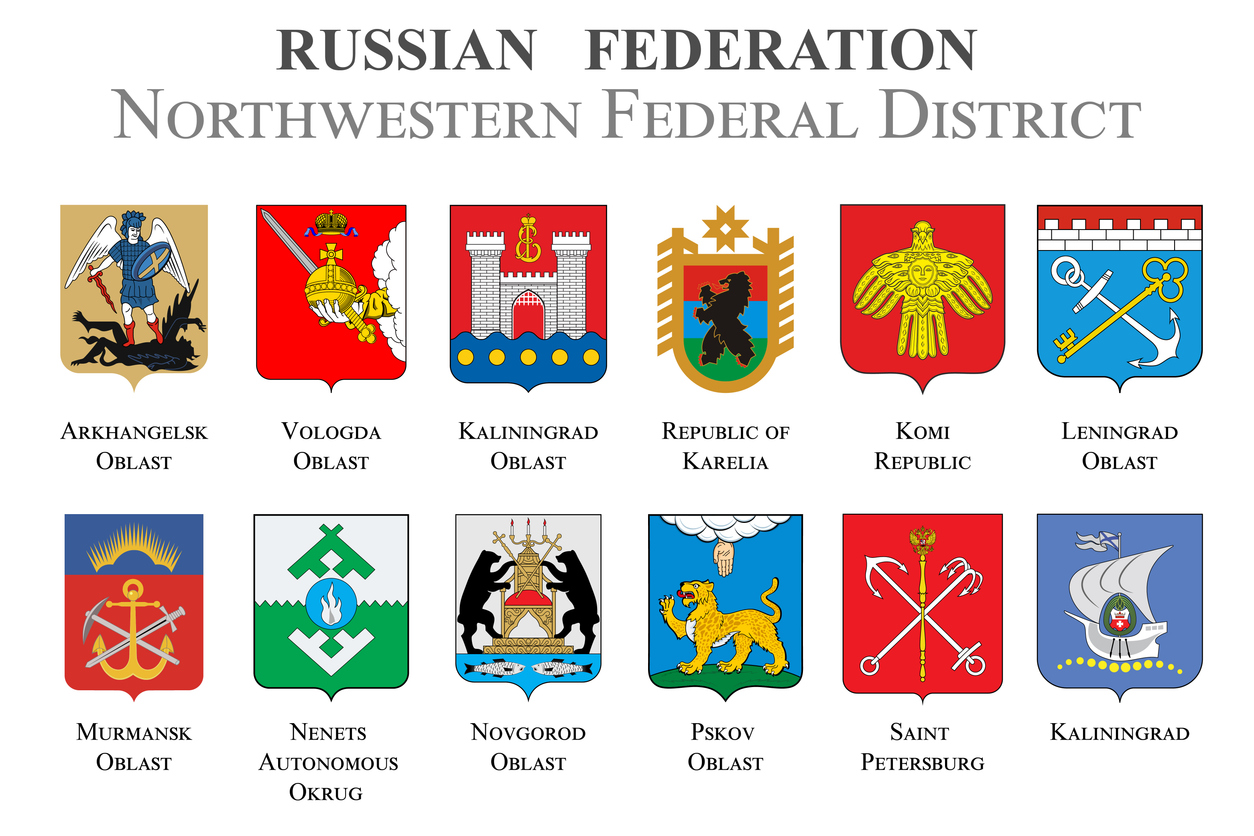
This district consists of seven oblasts — Arkhangelsk, Kaliningrad, Leningrad, Murmansk, Novgorod, Pskov, and Vologda; two republics — Karelia and Komi; the Nenets Autonomous Okrug, and the federal city of St. Petersburg.
This text aims to outline the current situation in the Northwestern Federal District across various dimensions — political, security-related, economic, financial, and social. The analysis is contextualized by both the ongoing war in Ukraine — to which virtually all spheres of public life in Russia have been subordinated — and the Kremlin’s regional policy, based on the strict control (and ever-tightening) control of the central authorities in Moscow over the federal subjects.
2. Political and security situation
The political situation in the subjects of the Northwestern Federal District generally reflects nationwide trends and the Kremlin’s regional agenda. Moscow continues its policy of super-centralization, aimed at tightening control over all levels of the so-called power vertical (Bartosiewicz, 2023). However, the full-scale invasion of Ukraine brought new responsibilities for regional authorities related to supporting the war effort, since it is the Kremlin’s overriding priority. This translates directly into the shape of the local political landscape.
Hostilities in Ukraine have extended to Russia’s Northwestern regions. Ukrainian drones have attacked every subject there, except for the Nenets Autonomous Okrug (which has the smallest population of all Russian regions) and Kaliningrad Oblast (where alerts were nevertheless issued in May and September 2026). Leningrad Oblast, which surrounds St. Petersburg, bore the brunt of the strikes. UAVs targeted, among other sites, Russia’s largest Baltic port at Ust-Luga, shipyards in Vyborg, and fuel and energy facilities, eg. Kirishinefteorgsintez oil rafinery. Governor Alexander Drozdenko stated that the oblast had become a “front-line region” (Moscow Times, 2026). To counteract the threat, the BARS-47 unit (Boyevoy armeyskiy rezerv strany; Combat Army Reserve) was created there.
The subjects of the Northwestern Federal District are the only Russian regions that share a land border with NATO member states, including Finland, which joined the alliance in 2024. Hence, these regions — traditionally characterized by a significant military presence, particularly the Kaliningrad and Murmansk oblasts and the Republic of Karelia — are witnessing another phase of militarization (7×7, 2026). This is manifested, among other things, in the establishment of new bases along the border with Finland (Mäkeläinen, 2026) or the exercises like the August “Sodruzhestvo 2026“.
Another manifestation is the closure of railway crossings on the borders with Estonia, Finland and Latvia in July 2026, or the introduction of temporary restrictions on the sections of the borders with Estonia and Finland in September. These decisions are made at the central level or by regional security structures, bypassing regional civilian authorities.
Militarization is also expressed in political narrative. Aleksej Besprozvannyh, the governor of Kaliningrad Oblast — an exclave bordering Poland and Lithuania — spoke of the need to be prepared for “provocations by Western states” (Muhametshina, 2026) echoing earlier remarks by Putin’s aide Nikolai Patrushev (Kommersant, 2025). Another aide — who also chairs the Russian Military Historical Society — Vladimir Medinsky, spoke of the need to address the issue of “Germanic symbolism” there (The Insider, 2026). In July 2026, Putin held a working meeting regarding the region within the framework of the Security Council of the Russian Federation. The oblast also established its own ministry of regional security and a mobilization reserve.
Authorities in regions bordering Finland also employ alarmist rhetoric. In October 2025, the formation of volunteer patrols to assist the border guard was announced in Karelia. In 2024, the republic’s Supreme Court ruled that actions taken by Finnish forces during World War II constituted “war crimes, crimes against humanity, and genocide against the Soviet people” (TASS, 2024). Meanwhile, the regional parliament renamed “Liberation Day of the Republic from Fascist Invaders” (celebrated on September 30) to “Liberation Day of Karelia from German-Fascist and Finnish Invaders.” Authorities in the Murmansk Oblast (it also borders Norway) in turn warned about the threat posed by “foreign sabotage and reconnaissance groups” (The Insider, 2026a).
The invasion of Ukraine, despite the militarization it brought about, has not fundamentally altered Putin’s system of regional control in which the heads of federal subjects are effectively reduced to the role of Kremlin field representatives — closely supervised yet simultaneously saddled with political and social responsibility for unpopular decisions made by the central authorities (Bartosiewicz, 2025). The Kremlin’s personnel policy in the Northwestern Federal District was thus similarly conservative to its policy across the country. Between 2022 and 2025, there were five changes of governors.
In 2023, Georgy Filimonov succeeded Oleg Kuvshinnikov (who became a senator in the Federation Council) in Vologda Oblast. In 2024, Anton Alikhanov left his post in the Kaliningrad Oblast to become the federal Minister of Industry and Trade; he was succeeded by Besprozvannyh, a deputy minister from the same federal ministry (who, like Alikhanov, is linked to the state corporation Rostec). That same year in the Komi Republic, Vladimir Uyba (who failed to secure a suitable result for Putin in the rigged 2024 presidential election; Prakh 2024) was replaced by Rostislav Goldstein, the governor of the Jewish Autonomous Oblast. A year later, Novgorod Oblast Governor Andrey Nikitin was appointed federal Deputy Minister of Transport (he subsequently became minister when his predecessor — former Kursk Oblast Governor Roman Starovoyt — was dismissed and committed suicide) and was succeeded by his then-first deputy, Alexander Dronov. Meanwhile, in the Nenets Autonomous Okrug, Yuri Bezdudny was replaced by Irina Gekht, the head of the government of the occupied Ukrainian Zaporizhzhia Oblast. Currently, all governors in the federal district are members of Putin’s ruling United Russia party, except for Besprozvannyh, who nevertheless governs as their nominee.
The figure of Filimonov, who sparks considerable controversy, is worth noting. The governor of the Vologda Oblast has, among other things, clashed with one of the richest men in Russia, Alexei Mordashov (Khorin, 2024) — owner of the Cherepovets-based steel giant Severstal — and introduced restrictions on alcohol sales that led to the emergence of a black market and “alcohol tourism” in neighboring regions (Motyzlevskaya, 2025). In the rigged 2026 State Duma elections, Filimonov failed to secure a desired result for United Russia (it garnered only 31% in the Vologda Oblast, compared to a national average of 58%). This, combined with his unpopularity in the region, renders his future uncertain (Novaya Gazeta Evropa, 2026).
In 2025, Putin’s plenipotentiary for the federal district also changed. The role went to Igor Rudenia, the governor of Tver Oblast, who has no ties to the Northwest. Given the interest shown in this position by the St. Petersburg “clans” close to Putin — specifically the Rotenberg and Kovalchuk brothers — Rudenia’s appointment is viewed as a compromise solution. At the same time, he is linked to Andrei Bokarev and Iskander Makhmudov, the owners of the railway rolling stock manufacturing giant Transmashholding (Pertsev, 2025).
As in other parts of Russia, veterans of the invasion of Ukraine in the Northwestern Federal District have not entered regional elites en masse, despite propaganda and some pressure from the Kremlin (Bartosiewicz, 2025a). This stems both from grassroots resistance within the bureaucracy and from the limited utility of veterans in terms of administrative or business work.
War veterans appointed to positions generally perform functions at the local level or hold roles devoid of significant authority, like Nikolai Sergienko — a professional military and decorated veteran — who became Deputy Minister of Construction for the Novgorod Oblast (Vedomosti, 2025). Veterans holding important positions generally belonged to the elite beforehand — such as Yelissan Shandalovich, chairman of the Karelian parliament. Some managed to leverage their participation in the invasion to advance their careers, like the former mayor of Vorkuta (Komi), Yaroslav Shaposhnikov; upon returning from the front, he resigned from his post to take up an unspecified position in Moscow (Vedomosti, 2025a) or pro-Kremlin journalist Kirill Dzhavlah, who became the Minister of Regional Security for the Vologda Oblast (Shorohov, 2025).
Nevertheless, authorities in all federal subjects are implementing regional personnel programs for selected veterans in line with Kremlin agenda (Komin, 2026), and some require major local enterprises to hire participants in the invasion according to established quotas — such as in the Leningrad, Murmansk, Novgorod, and Vologda oblasts, as well as in Karelia and St. Petersburg. The governor’s key performance indicators (which can be used to justify the promotion or dismissal of the regional head), updated by the Kremlin in November 2024, include veterans’ satisfaction with medical rehabilitation, professional retraining, and employment opportunities.
Kremlin-enforced local government reform is also proceeding, aimed at eliminating the lower tier and tightening gubernatorial control over municipal authorities (Bartosiewicz, 2025b). Within the Northwestern Federal District, only the Nenets Autonomous Okrug retains a two-tier system, yet pressure from Moscow casts doubt on its long-term survival. Resistance from lower levels of the power vertical is proving ineffective. For instance, the parliament of Komi — dominated by United Russia — rejected an initiative from the Communist Party of the Russian Federation to hold a referendum on local government reform there.
As in other regions of Russia, local and regional officials in the Northwestern Federal District are regularly detained by law enforcement. Corruption is officially the most common reason, though the allegations cannot be verified independently. Those detained included, among others, Denis Alekseyev — Deputy Governor of the Vologda Oblast; Anton Vinogradov — former Deputy Prime Minister of Komi; Konstantin Kuranov — the Transport Minister of the Novgorod Oblast, and Alexander Fyodorov — rector of the Kaliningrad-based Immanuel Kant Baltic Federal University.
Repression of varying severity also targets opposition figures — including those active in “systemic” opposition parties like the Communist Party of the Russian Federation or A Just Russia — to prevent them from participating in elections (Vazhnyye Istorii, 2026). Local and regional deputies were also stripped of their seats under legislation concerning so-called foreign agents — such as Boris Vishnevsky (Yabloko) in St. Petersburg (Puchkova, 2024) or head of the communist faction in the Komi parliament Viktor Vorobyov (Prakh, 2024a). The last “foreign agent” deputy in all of Russia to be stripped of his mandate was a local councilor from the Pskov Oblast, Nikolai Kuzmin (7×7, 2024).
Meanwhile, United Russia holds more than half of the seats in each of the 11 regional parliaments in the Northwestern Federal District. Efforts to consolidate the ruling party’s position are continuing — for instance, in Komi, where the mixed electoral system for local legislative bodies was abolished and replaced by a majoritarian one (TASS, 2025).
In the context of the systematic destruction of political pluralism, it is worth noting that in 2026, Yabloko — Russia’s only registered non-systemic opposition party opposing the war — managed to register an electoral list for the Novgorod Oblast parliament and win one seat. It was not possible for Yabloko to achieve even such a modest result anywhere else, due to the numerous obstacles placed by the authorities (Domańska, 2026). A year earlier, a court ordered the compensation to the regional branch of Yabloko in the Pskov Oblast for the unlawful removal of its party lists from the 2023 local elections. However, the awarded amount was many times lower than the sum demanded by the party (7×7, 2026a).
Civil society organizations and independent media are also under constant pressure. For instance, in 2024, regional portal Komi Daily became the first media outlet in Russia to be designated a terrorist organization by the authorities (Meduza, 2025).
Authorities in the northwestern regions — much like their counterparts across Russia — are also employing broader repressive measures, such as cutting off mobile internet access (citing security concerns), as seen e.g. in the Arkhangelsk Oblast or St. Petersburg.
3. Economic and financial situation
Although the full-scale invasion of Ukraine did not bring about significant changes in the Kremlin’s regional policy, the federal subjects have acutely felt its economic and financial consequences (Bartosiewicz 2026).
The indirect effects of the invasion — economic sanctions, the exodus of Western companies, disrupted supply chains, the reorientation of exports, fluctuations in the ruble-dollar exchange rate, a decline in investment, and technological regression — have led to macroeconomic stagnation in Russia (in 2025, official GDP growth stood at just 1%) and are impacting the economic health of individual regions.
Federal subjects with economies focused on sanctioned sectors — such as metallurgy (employing 700,000 workers across Russia) or coal mining (150,000) — find themselves in a difficult situation. Also affected are regions specializing in oil and natural gas extraction, forestry and related industries, or transport and the export of goods to the West. For instance, Kaliningrad Oblast is facing difficulties due to Lithuania’s restrictions on the transit of goods to and from the region across its territory (Glukhova, 2026). Meanwhile, in Murmansk Oblast, the implementation of an LNG transshipment terminal project is being delayed because of US sanctions.
The crisis in various sectors resulted in a decline in corporate income tax (CIT; nalog na pribil) revenues for regional budgets, falling from RUB 5.8 trillion in 2024 to RUB 5.3 trillion (approx. US$ 63 billion) in 2025. The hike in the CIT rate from 20% to 25% that same year yielded no benefits for the regions, as the additional revenue went to the federal budget. The increase may even have had negative consequences for individual subjects, as some enterprises implemented tax optimization measures.
Although the decline in regional CIT revenues was accompanied by a rise in personal income tax (PIT; nalog na dohody fizicheskih lic) receipts (from RUB 8 trillion to 9 trillion), inter-budgetary transfers from the federal centre remained unchanged in relative terms (15% of revenue), while regional expenditures grew significantly faster (+8.9%) than revenues (+4.1%). When adjusted for inflation (5.6%), the latter decreased. Consequently, in 2025, the financial crisis hit the budgets of federal subjects with full force.
The combined regional budget deficit in 2025 reached a record RUB 1.5 trillion (approx. 5.5% of total expenditure; US$ 20 billion), far exceeding the federal government’s previous forecast of around RUB 300 billion (regions ended 2024 with such a deficit).
In the Northwestern Federal District, the largest deficits for 2025 were recorded by the Vologda Oblast (specializing in metallurgy and mining) — 23% of expenditures; Komi (oil and gas extraction, metallurgy, timber industry) — 20%; Arkhangelsk Oblast (shipbuilding, timber industry, mining) — 19%; and Murmansk Oblast (metallurgy, transport) — 16.5%. It is worth noting that the Vologda Oblast’s budget deficit was the largest in all of Russia.
At the same time, the budget deficit of the Nenets Autonomous Okrug and the Leningrad and Novgorod oblasts did not exceed 10% of expenditures, while the deficit of St. Petersburg (with its high concentration of corporate income taxpayers), Karelia, and the Pskov Oblast did not exceed 5%. The Kaliningrad Oblast — which possesses both a developed automotive industry (a sector currently under sanctions and in a deep, structural crisis) and a defence industry (which clearly drives regional economies) — recorded a budget surplus.
In addition to a record deficit, Russia’s federal subjects also recorded record debt in 2025, reaching a combined total of RUB 3.5 trillion (US$ 42 billion). This was largely due to a nearly threefold increase over the course of the year in the share of commercial loans — which are significantly more expensive than the budget loans that form the core of regional debt.
In the Northwestern Federal District, the largest percentage increases in debt between January 1, 2025, and January 1, 2026, were recorded in Murmansk Oblast (+78%; debt reached RUB 75 billion), Komi (+56%; 39 billion), Arkhangelsk Oblast (+28.6%; 111.5 billion), and Novgorod Oblast (+22%; 23.7 billion). Significantly slower growth rates were observed in Leningrad (+5%; 12 billion) and Vologda (+1.5%; 19 billion) oblasts.
Regional challenges stem not only from the growth of expensive commercial debt — a consequence of limited assistance from central authorities in the form of new budget loans — but also from the difficulty of securing such financing to cover deficits. For instance, in 2026, the Arkhangelsk Oblast was unable to find banks willing to lend it RUB 13 billion (Severnye novosti, 2026). Instead of granting further loans, Moscow for its part appears to favour the cancellation of regional debt (conditional on the freed-up funds being allocated to infrastructure projects and investments, though in practice they serve to finance obligations linked to the invasion of Ukraine).
On the other hand, between January 1, 2025, and January 1, 2026, Kaliningrad Oblast reduced its debt by 24% (to RUB 18 billion), the Pskov Oblast by 12% (17 billion), and the Nenets Autonomous Okrug by 8% (0.4 billion). St. Petersburg cut its debt by 2% (to RUB 71 billion), as did Karelia (20 billion).
The rapid rise in regional expenditures — the primary driver of the increase in the deficit and debt — stems at least in part from the involvement of federal subjects in the invasion of Ukraine. The Kremlin is increasingly burdening regions with tasks related to the co-financing of the war (Bartosiewicz, 2026a).
A primary obligation for regional authorities in this regard is the co-financing of one-off payments for volunteers signing contracts with the Ministry of Defence. In the Northwestern Federal District, the amount of the regional bonus ranges from RUB 400,000 (approx. US$ 5,000) — in Karelia, Komi, and the Murmansk, Novgorod, and Pskov oblasts — to RUB 3.5 million (approx. US$ 40,000) in St. Petersburg and Leningrad Oblast. In between, Arkhangelsk Oblast pays RUB 600,000; the Nenets Autonomous Okrug — 1.3 million; the Kaliningrad Oblast — 2.5 million; and the Vologda Oblast — 2.7 million.
Moreover, half of the Russian regions have introduced one-off payments for individuals — whether private citizens, military recruiters, local government employees, or others — who found people willing to enlist in the army (Savina, 2026). Among them are Arkhangelsk, Kaliningrad, Murmansk, and Pskov oblasts, where such a “middleman” can receive up to RUB 100,000.
Information regarding the real costs incurred by regional budgets in connection with the financing recruitment and other benefits for soldiers, veterans, and their families is scant. A significant portion of them may be deliberately concealed within budget items such as social policy, healthcare, etc. According to independent estimates, in 2024, federal subjects may have allocated nearly a quarter of their social spending to various payments for soldiers, veterans, and their families (Savina, 2024). This implies that in 2024–2025, regional budgets spent at least RUB 840 billion (US$ 10 billion) annually on war-related recruitment and social benefits (such as compensation) alone. Other calculations suggest that the regional spending for these purposes amounted to at least RUB one trillion (Kluge, 2026).
According to available official data and media reports, in 2025 St. Petersburg has allocated approximately RUB 30 billion (approx. US$ 360 million) to support invasion participants, veterans, and their families; Leningrad Oblast – 14 billion; Komi – 3.3 billion; Kaliningrad Oblast – 3 billion; Vologda Oblast – 2 billion; Karelia – 1.7 billion; Novgorod Oblast – 1.6 billion; Murmansk Oblast – 0.9 billion and the Nenets Autonomous Okrug – 0.4 billion.
No information has emerged regarding expenditures for this purpose by Arkhangelsk and Pskov oblasts. In case of the latter, in June 2024, the governor estimated his region’s spending on “combat operations in Ukraine and support for Russian military personnel” at RUB 1.1 billion — an amount representing more than one-third of the projected budget deficit for the year (Radio Svoboda, 2024).
What is more, federal subjects co-finance regional volunteer units fighting in Ukraine — such as the battalions “Ladoga” and “Onego” (Karelia), “Avrora”, “Kronstadt”, “Neva” and “Pavlovsk” (St. Petersburg) or artillery divizions (not to be confused with divisions) “Neva”, “Ladozsky” and “Leningradsky” (Leningrad Oblast).
Regions are also required to participate in the reconstruction of occupied Ukrainian territories, where they co-finance the restoration of schools, hospitals, road infrastructure, utility networks etc. Thus, in the so-called Donetsk People’s Republic, St. Petersburg took Mariupol under its “patronage”, the Leningrad Oblast — Yenakiieve, and the Vologda Oblast — Alchevsk. Komi oversees Rovenky in the so-called Luhansk People’s Republic. In the Kherson Oblast, the Kaliningrad Oblast acts as a patron for Oleshky, while the Pskov Oblast does so for Beryslav, Ivanivka, as well as for Henichesk (which is officially under the patronage of the Republic of Adygea). In the Zaporizhzhia Oblast, the Arkhangelsk Oblast sponsors Melitopol, the Murmansk Oblast — Prymorsk, and the Nenets Autonomous Okrug — Kamianka-Dniprovska, while the Novgorod Oblast and Karelia finance Vasylivka.
Due to the lack of transparency surrounding these “patronages,” it is difficult to estimate even their approximate costs. For instance, in 2023, the authorities of St. Petersburg allocated at least RUB 1.7 billion (US$ 20.4 million) for the reconstruction of Mariupol (The Insider, 2024). The Arkhangelsk Oblast officially planned to allocate over RUB 800 million to support Melitopol between 2023 and 2025, while the Kaliningrad Oblast planned RUB 1.5 billion for Kherson Oblast between 2026 and 2030.
The financial pressure on regional budgets associated with co-financing the war in Ukraine leaves the authorities of federal subjects with little room for manoeuvre. To balance their budgets, some regions have cut compensation payments to wounded soldiers and the families of those killed; however, the Kremlin’s prioritization of the invasion suggests these will likely be merely stopgap measures due to their politically sensitive nature.
Meanwhile, war-related costs are becoming an increasingly heavy burden. For instance, Leningrad Oblast needs an additional RUB 23.2 billion in 2026 to cover expenses; the largest share — 8.2 billion — consisted of payments to volunteers signing contracts with the Ministry of Defence.
The only solution becomes covering war expenses using funds allocated for other budget items — such as education, healthcare, infrastructure, housing etc. For example, in 2026, authorities in the Arkhangelsk Oblast decided to divert RUB 63 million from social spending to payments for war participants and their families (Nastoyaschee Vremya, 2026), while St. Petersburg planned to increase such payments at the expense of funding for schools and municipal infrastructure, among other things (Zubareva, 2026). That same year, Vologda Oblast, in turn, recorded the largest reduction in healthcare spending in all of Russia — by as much as 39% (RUB 6.5 billion) — driven in part by a 99% cut in funds allocated for salary increases for doctors and medical staff (Kuznetsov, Savina, 2026).
To add insult to injury, regional finances and economies must also contend with the periodic costs of hostilities — including the repair of damage caused by Ukrainian drone strikes, fuel shortages, and mobile internet outages. Another issue is the labour shortage, stemming from the demographic crisis, the exodus of specialists from Russia following 2022, and the migration of workers to the army or the defence industry, driven by higher wages.
Labour shortages also have political roots. In 2024, following the terrorist attack in Krasnogorsk near Moscow, regional authorities across Russia stepped up restrictions on the employment of migrants — particularly those from former Soviet republics in Central Asia. For instance, St. Petersburg banned the hiring of foreign nationals in sectors such as taxi services and delivery. These decisions were driven mainly by a desire to align with the Kremlin’s anti-migrant rhetoric. In the Vologda Oblast, governor Filimonov banned the employment of migrants in the construction sector — which could have been prompted by his conflict with Severstal, owned by Alexei Mordashov. In response, conglomerate warned that it might halt key investment projects in the region. Consequently, Filimonov was forced to quickly reverse his decision (Meduza, 2025a).
4. Social situation
The full-scale invasion of Ukraine ushered in an even harder line in the Kremlin’s domestic policy, resulting in intensified repression, censorship, and social surveillance. Coupled with the near-total elimination of civil society structures and the systematic dismantling of relative political pluralism that had previously existed at the lower levels of the power vertical, the potential for protest in Russia has diminished even further.
Nevertheless, Russian society — despite becoming increasingly atomized and politically passive — has retained the capacity for limited protest regarding issues that directly affect it, such as livelihood concerns, local environmental matters, and the like (Talanova, 2025). Such acts of resistance — small in scope and apolitical by nature — sometimes prove effective, especially when they attract the attention of higher authorities (to whose jurisdiction, including the Kremlin itself, the protests are usually addressed).
Cuts to regional budgets linked to the financing of the war create a risk of escalating social unrest of this kind in the near future. Reductions in “civilian” spending are further degrading the already deplorable state of Russian public services — such as healthcare, education, and postal services (Bartosiewicz, 2024) — as well as municipal infrastructure, housing, and waste management (Bartosiewicz, 2025c). The regions of the Northwestern Federal District are no exception here.
According to official data, municipal utility networks (heating, water supply and sewerage) are significantly worn out. While official data indicates that over 40% of their total length across Russia requires immediate replacement, the figure reaches as high as 80% in the Pskov Oblast, 70% in the Kaliningrad Oblast, around 60% in the Murmansk and Vologda oblasts and Karelia, around 50% in the Arkhangelsk, Leningrad, and Novgorod oblasts, around 40% in St. Petersburg, 18% in Komi, and merely a few percent in the Nenets Autonomous Okrug.
The poor condition of municipal utility networks is reflected in frequent service failures — particularly during the winter months — that often affect thousands of residents. For instance, in January 2026, the collapse of electricity pylons (the oldest of which had been commissioned in the 1960s) in Murmansk led to a blackout in the city and in nearby Severomorsk, the headquarters and main base of the Northern Fleet.
The poor condition of rapidly aging housing stock also presents a problem. According to incomplete data, the rate of wear and tear on multi-family residential buildings ranges from 30% to 40% in the Arkhangelsk, Kaliningrad, Leningrad, Pskov, and Vologda oblasts, as well as in Karelia and Komi. In St. Petersburg, the Murmansk and Novgorod oblasts, and Nenets Autonomous Okrug, this figure ranges from 20% to 30% (Esli bytʹ tochnym, 2026).
The question of the so-called emergency housing (the lowest technical condition classification, posing a direct risk to residents) is particularly severe in the northern regions, thus has a political significance, what Putin draws attention to during meetings with governors. Solving this problem in Arkhangelsk Oblast would cost approximately RUB 160 billion (approx. US$ 2 billion) — the equivalent of perhaps a few days of military operations in Ukraine (Novaya Gazeta Evropa, 2025).
Amid the deteriorating state of housing and municipal utility networks, the issue of utility tariffs is becoming increasingly important. Authorities face a dilemma here: they must raise charges while remaining mindful of the public unpopularity associated with rising costs (Glukhova, Morokhin, 2026).
Waste management in Russia is also systematically deficient — which is manifested, among others, by low levels of recycling or by landfills covering an area comparable to the Netherlands. According to estimates by the authorities themselves, by 2050 they may occupy 1% of the entire country’s territory if the problem of illegal landfills is not eliminated (NIA «Ekologija», 2023). Nevertheless, the construction of waste processing plants encounters serious problems, both due to costs, corruption schemes, and resistance from residents — e.g. in Arkhangelsk Oblast (Novaya Gazeta Evropa, 2025a).
Environmental issues could similarly fuel public discontent. Man-made disasters frequently occur in the regions of Russia’s Northwestern Federal District. For instance, a liquid ammonia leak took place in Ust-Luga (Leningrad Oblast) in July 2025, and an oil spill occurred in the Kola Bay (Murmansk Oblast) in September. However, large-scale protests are prevented by the authorities’ suppression of environmental organizations.
Furthermore, the poorly developed transport network is a source of dissatisfaction among residents. In 2025, residents of the village of Kharitonovo in Arkhangelsk Oblast announced a boycott of the gubernatorial election due to the cancellation of bus routes, which effectively cut them off from the city of Kotlas — where they relied on the hospital, bank, the railway station, and other services (7×7, 2025).
The problem of access to medical care is particularly alarming. In 2025, none of the regions within the Northwestern Federal District had an adequate number of medical specialists. St. Petersburg had approximately 12,400 unfilled physician vacancies. Kaliningrad Oblast had 1,500 unfilled vacancies; Arkhangelsk and Leningrad oblasts — 1,400 each; Vologda Oblast — 1,200. Komi and Murmansk Oblast each faced a shortage of over 700 doctors; Karelia — of 609; Pskov Oblast — over 500; and Novgorod Oblast — over 400. In contrast, the Nenets Autonomous Okrug had a shortage of only 15 (Arktik TV, 2025).
As a cost-cutting measure, regional authorities are “optimizing” healthcare spending — leading to the closure of clinics, outpatient facilities, and maternity units in smaller, remote localities — while some doctors are leaving on their own, unable to count on higher wages. For instance, in the village of Meliorativny in Karelia — home to 600 children — parents were forced to seek medical help in Petrozavodsk, 20 km away, after the only pediatrician resigned (Radio Svoboda, 2024a).
“Optimization” also affects kindergartens, schools, cultural institutions, post offices, etc. The ongoing local government reform (which also sparks public protests — albeit limited ones) — driven by the Kremlin’s policy of hyper-centralization — exacerbates the decline of smaller and remote localities.
There are currently 1,120 cities in Russia, 70% of which are small or medium-sized. In the near future, as many as 129 of them — home to nearly 3.5 million people — could effectively disappear. Over the last decade, their population has shrunk by more than 300,000 (Lezhepekova, 2025).
Another source of — albeit lesser — public discontent may be the regional authorities’ historical policy, which aligns with trends prevailing at the Kremlin. By early 2026, there were over 110 monuments to Joseph Stalin across 26 Russian regions, the majority of which were erected during Putin’s rule. Several such monuments were built in the Vologda Oblast with the backing of governor Filimonov, despite opposition from residents. He also planned to launch a youth organization called “Oprichniki” (a name alluding to the secret police of tsar Ivan IV — known as Ivan the Terrible).
Meanwhile, at memorial sites in Karelia, plaques and crosses commemorating the victims of Stalinist repressions — Russians, Poles, and Ukrainians alike — were disappearing, and activists and foreign diplomats faced obstacles in paying tribute to the victims of the Great Terror (Meduza, 2025b).
Public sentiment toward veterans of the invasion of Ukraine remains an uncertainty; this issue may well become a source of more organized collective frustration in the future. This group is simultaneously supported and favored by the authorities — receiving privileges and social benefits — yet also causes problems, particularly regarding violent crime (committed either before or after their wartime service). These two perspectives symbolically converged in 2023, in the village of Khabarikha in Komi, where a memorial plaque was unveiled honouring Vladimir Popov, a Wagner Group mercenary killed in Ukraine. He had been sent to the front from prison, where he was serving a sentence for rape (Verstka, 2024).
Finally, it is worth drawing attention to the poor situation of ethnic minorities. For instance, the Central Election Commission of Karelia — the only republic in the Russian Federation where the language of the titular ethnic group is not an official state language — consistently refuses to provide election ballots in the Karelian and Veps languages. Restrictions are also placed on the volume of content in publications issued in Karelian and Finnish (Radio Svoboda, 2024b). As of 2023, there were 32,400 Karelians in Russia (with 25,000 in Karelia itself); in 2010, this figure was nearly twice as high. The number of Karelians who speak the Karelian language stood at only 11,280.
Minorities in Russia are sometimes statistically overrepresented on the Ukrainian front, and war casualties among them — such as the Nenets (Radio Svoboda, 2024c) — are particularly severe given their small population size. However, the situation of ethnic minorities — including those in the Northwest — remains a rather marginal topic in both Russian discourse and society.
5. Conclusions
Amid the full-scale war in Ukraine, the current situation in the regions of the Northwestern Federal District generally reflects trends prevailing across Russia — in the political and security, economic and financial, and social spheres alike. This is likely due primarily to the state’s high degree of centralization, the result of a quarter-century of such policies pursued by Vladimir Putin’s regime.
However, local specificities do matter. In the case of the militarization and securitization of the northwestern regions, the geographical proximity of NATO states — viewed by the Kremlin as Russia’s “real” adversary in the war against Ukraine — plays a significant role. The measures being taken there indicate that the Kremlin is planning — or fears (or perhaps both) — some form of confrontation with the Alliance.
In the political realm, the Kremlin is continuing its nationwide drive toward centralization and the expansion of control over the lower levels of the so-called power vertical in the northwest, employing the same tools and methods. At the same time, however, “NATO-at-the-borders” factor serves as an additional instrument for presenting the public with a propagandistic vision of an external threat, thereby justifying domestic actions.
As in other parts of Russia, the regions of the Northwestern Federal District have experienced the negative economic and financial consequences of the full-scale invasion of Ukraine. These difficulties are likely to intensify, given the Kremlin’s prioritization of the war and the growing burdens placed on regional authorities in connection with its conduct.
The war, economic and financial conditions connected to it, and the Kremlin’s centralizing policies are exacerbating pre-existing social problems in Russia and may be contributing to the emergence of new ones. In the northwestern regions, these issues primarily concern living standards — specifically, the deteriorating state of public services and municipal infrastructure, and, to a lesser extent, environmental concerns.
Despite a growing number of problems at various levels, the political situation in the Northwestern Federal District appears far from boiling over, and the potential for social protest movements seems limited in terms of both scale and scope. However, given that the situation in northwestern Russia largely reflects processes originating in the Kremlin, conditions in the region may shift in tandem with unfolding events at the federal centre.
References
7×7 (2024), Последнего депутата-иноагента в России лишили полномочий, November 14, https://semnasem.org/news/2024/11/14/poslednego-deputata-inoagenta-v-rossii-lishili-polnomochij. Accessed October 4, 2026.
7×7 (2025), Жители поселка Архангельской области заявили о бойкоте будущих выборов губернатора из-за отмены автобусных рейсов, June 19, https://semnasem.org/news/2025/06/19/zhiteli-poselka-arhangelskoj-oblasti-zayavili-o-bojkote-budushih-vyborov-gubernatora-esli-chinovniki-ne-vosstanovyat-uprazdnennye-avtobusnye-rejsy. Accessed October 4, 2026.
7×7 (2026), Север под прицелом. Как милитаризация Мурманской области и Карелии может повлиять на жизнь в этих регионах, July 2, https://semnasem.org/articles/2026/07/02/sever-pod-pricelom. Accessed October 4, 2026.
7×7 (2026a), Компенсацию псковскому «Яблоку» за снятие с выборов в двух районах снизили в 18 раз, February 20, https://semnasem.org/news/2026/02/20/kompensaciyu-pskovskomu-yabloku-za-snyatie-s-vyborov-v-dvuh-rajonah-snizili-v-18-raz. Accessed October 4, 2026.
Arktik TV (2025), В регионах СЗФО сохраняется жёсткий дефицит врачей, September 10, https://xn—-7sbhwjb3brd.xn--p1ai/news/severo-zapadnyy-federalnyy-okrug-16/v-regionah-szfo-sohranyaetsya-zhestkiy-deficit-vrachey. Accessed October 4, 2026.
Bartosiewicz, M. (2023), A tactical pause. The Kremlin’s regional policy in the shadow of the war. Centre for Eastern Studies, October 10, https://www.osw.waw.pl/en/publikacje/osw-commentary/2023-10-06/a-tactical-pause-kremlins-regional-policy-shadow-war. Accessed October 4, 2026.
Bartosiewicz, M. (2024), The crisis affecting Russia’s public services: healthcare, education, and the postal service. Centre for Eastern Studies, June 27, https://www.osw.waw.pl/en/publikacje/osw-commentary/2024-06-27/crisis-affecting-russias-public-services-healthcare-education. Accessed October 4, 2026.
Bartosiewicz, M. (2025), Regional elites in wartime Russia. Centre for Eastern Studies, March 10, https://www.osw.waw.pl/en/publikacje/osw-commentary/2025-03-10/regional-elites-wartime-russia. Accessed October 4, 2026.
Bartosiewicz, M. (2025a), Veterans of the Invasion of Ukraine as the New Elite of Russia – Challenges and Prospects. Warsaw East European Review XV (1) p. 39-51, https://www.researchgate.net/publication/398954339_Veterans_of_the_Invasion_of_Ukraine_as_the_New_Elite_of_Russia_-_Challenges_and_Prospects. Accessed October 4, 2026.
Bartosiewicz, M. (2025b), Methodical elimination. Efforts to dismantle the local government system in Russia. Centre for Eastern Studies, September 24, https://www.osw.waw.pl/en/publikacje/osw-commentary/2025-09-24/methodical-elimination-efforts-to-dismantle-local-government. Accessed October 4, 2026.
Bartosiewicz, M. (2025c), The Russian public services crisis: the municipal infrastructure is in a critical condition. Centre for Eastern Studies, January 27, https://www.osw.waw.pl/en/publikacje/osw-commentary/2025-01-27/russian-public-services-crisis-municipal-infrastructure-a. Accessed October 4, 2026.
Bartosiewicz, M. (2026), Home Front: the impact of the war in Ukraine on the political and economic situation in Russia’s regions. Russia’s war against Ukraine: Russia’s future military development, National Defence University, Department of Warfare, Series 2: Research Reports No. 44, https://www.doria.fi/handle/10024/195520. Accessed October 4, 2026.
Bartosiewicz, M. (2026a), Testing the limits: Russia’s regional budgets in wartime. Centre for Eastern Studies, August 5, https://www.osw.waw.pl/en/publikacje/osw-commentary/2026-08-05/testing-limits-russias-regional-budgets-wartime. Accessed October 4, 2026.
Domańska, M. (2026), Kremlin handpicks new State Duma deputies in ‘special election operation’. Centre for Eastern Studies, September 25, https://www.osw.waw.pl/en/publikacje/osw-commentary/2026-09-25/kremlin-handpicks-new-state-duma-deputies-special-election. Accessed October 4, 2026.
Esli bytʹ tochnym (2026), Износ и аварийность многоквартирных домов, September 17, https://tochno.st/datasets/gisgkh. Accessed October 4, 2026.
Glukhova, N. (2026), Калининград доводят до изоляции?. Novaya Gazeta Evropa, October 3, https://novayagazeta.eu/articles/2026/10/03/kaliningrad-dovodiat-do-izoliatsii. Accessed October 4, 2026.
Glukhova, N., Morokhin, D. (2026), «Работать на одну коммуналку». Novaya Gazeta Evropa, April 8, https://novayagazeta.eu/articles/2026/04/03/rabotat-na-odnu-kommunalku. Accessed October 4, 2026.
The Insider (2024), Петербург в 2023 году потратил 1,7 млрд рублей на нужды фонда «Победа», через который восстанавливают оккупированный Мариуполь, May 29, https://theins.ru/news/271980. Accessed October 4, 2026.
The Insider (2026), «Почему коньяк „Старый Кёнигсберг“?» — Мединский потребовал пересмотреть «немецкие мотивы» в Калининградской области, April 16, https://theins.ru/news/291596. Accessed October 4, 2026.
The Insider (2026a), Власти Мурманской области предупредили жителей об угрозе диверсантов, а затем удалили сообщение, June 27, https://theins.ru/news/294176. Accessed October 4, 2026.
Khorin, G. (2024), Зачем губернатору поручили отомстить олигарху Мордашову. Ura.ru, November 1, https://ura.news/articles/1036290085. Accessed October 4, 2026.
Kluge, J. (2026), Russia’s consolidated budget deficit reached almost 4% of GDP in 2025. Russianomics, February 7, https://janiskluge.substack.com/p/russias-consolidated-budget-deficit. Accessed October 4, 2026.
Komin, M. (2026), Booted, then suited: Veterans and the making of Putin’s new proto-elite. European Council on Foreign Relations, September 10, https://ecfr.eu/publication/booted-then-suited-veterans-and-the-making-of-putins-new-proto-elite/#elected-veterans:-blurring-the-boundaries-of-veteran-status. Accessed October 4, 2026.
Kommersant (2024), Патрушев: Россия ответит на военную агрессию против Калининградской области, July 26, https://www.kommersant.ru/doc/7922737. Accessed October 4, 2026.
Kuznetsov, P., Savina, S. (2026), В 2026 году рекордное за время войны число регионов сократили расходы на здравоохранение. Vazhnyye Istorii, March 10, https://storage.googleapis.com/istories/stories/2026/03/10/v-2026-godu-rekordnoe-za-vremya-voini-chislo-regionov-sokratili-raskhodi-na-zdravookhranenie/index.html. Accessed October 4, 2026.
Lezhepekova, A. (2025), Почти 130 малых городов России оказались под угрозой исчезновения, RBK, August 5, https://www.rbc.ru/society/05/08/2025/68919f989a79477f02805326?utm_referrer=https%3A%2F%2Feuc-word-edit.officeapps.live.com%2F. Accessed October 4, 2026.
Mäkeläinen, M. (2026), Paikansimme Petroskoin uuden varuskunnan. Yle.fi, June 10, https://yle.fi/a/74-20229401. Accessed October 4, 2026.
Meduza (2025), Издание Komi Daily стало одним из первых независимых медиа, которые российские власти объявили «террористами» «Медуза» поговорила с его главой Ланой Пылаевой, February 12, https://meduza.io/feature/2025/02/12/izdanie-komi-daily-stalo-odnim-iz-pervyh-nezavisimyh-media-kotorye-rossiyskie-vlasti-ob-yavili-terroristami. Accessed October 4, 2026.
Meduza (2025a), Губернатор Вологодской области решил отменить запрет на работу мигрантов на стройках. Он ввел его неделю назад, March 5, https://meduza.io/news/2025/03/05/gubernator-vologodskoy-oblasti-reshil-otmenit-zapret-na-rabotu-migrantov-na-stroykah-on-vvel-ego-nedelyu-nazad. Accessed October 4, 2026.
Meduza (2025b), Члены «Русской общины» попытались сорвать чтение имен жертв сталинских репрессий в Сандармохе, August 5, https://meduza.io/news/2025/08/05/chleny-russkoy-obschiny-popytalis-sorvat-chtenie-imen-zhertv-stalinskih-repressiy-v-sandarmohe. Accessed October 4, 2026.
Moscow Times (2026), Ленинградский губернатор заявил, что область стала «прифронтовой», April 15, https://ru.themoscowtimes.com/2026/04/15/leningradskii-gubernator-zayavil-chto-oblast-stala-prifrontovoi-a192802. Accessed October 4, 2026.
Motyzlevskaya, P. (2025), Вологодские власти не согласны с репортажем «Ъ» о нелегальной продаже алкоголя. Kommersant, April 7, https://www.kommersant.ru/doc/7639695. Accessed October 4, 2026.
Muhametshina, E. (2026), Беспрозванных: Калининград должен быть готов к провокациям со стороны Запада. Vedomosti, July 19, https://www.vedomosti.ru/politics/articles/2026/07/19/1214826-kaliningrad-dolzhen-bit-gotov?from=copy_text. Accessed October 4, 2026.
Nastoyaschee Vremya (2026), В Архангельской области перенаправили 63 млн рублей с соцподдержки на выплаты участникам войны, September 30, https://www.currenttime.tv/a/v-arhangelskoy-oblasti-perenapravili-63-mln-rubley-s-sotspodderzhki-na-vyplaty-uchastnikam-voyny/33867346.html. Accessed October 4, 2026.
NIA «Ekologija» (2023), К 2050 году нелегальные свалки могут занять 1% площади России, November 10, https://nia.eco/2023/11/10/72705/. Accessed October 4, 2026.
Novaya Gazeta Evropa (2025), «Все наши дома стоят как несколько дней войны», April 11, https://novayagazeta.eu/articles/2025/04/11/vse-nashi-doma-stoiat-kak-neskolko-dnei-voiny. Accessed October 4, 2026.
Novaya Gazeta Evropa (2025a), «Я вдруг поняла, что птицы исчезли», November 5, https://novayagazeta.eu/articles/2025/11/05/ia-vdrug-poniala-chto-ptitsy-ischezli, Accessed October 4, 2026.
Novaya Gazeta Evropa (2026), Трудный ребенок, September 27, https://novayagazeta.eu/articles/2026/09/27/trudnyi-rebenok. Accessed October 4, 2026.
Pertsev, A. (2025), Soviet Mr. Putin. Riddle Russia, October 6, https://ridl.io/soviet-mr-putin/. Accessed October 4, 2026.
Prakh, A. (2024), Явка с последствиями. Kommersant, March 25, https://www.kommersant.ru/doc/6593228. Accessed October 4, 2026.
Prakh, A, (2024a), Госсовет Коми прекратил полномочия депутата-иноагента. Kommersant, October 24, https://www.kommersant.ru/doc/7250154. Accessed October 4, 2026.
Puchkova, P. (2024), Борис Вишневский досрочно уйдет из парламента Петербурга из-за статуса иноагента. Kommersant, October 28, https://www.kommersant.ru/doc/7265313. Accessed October 4, 2026.
Radio Svoboda (2024), На отправленные Псковской областью на войну деньги можно было реконструировать несколько школ, June 5, https://www.svoboda.org/a/pskov-dengi-na-voynu/32980227.html. Accessed October 4, 2026.
Radio Svoboda (2024a), В поселке в Карелии не осталось ни одного педиатра, June 17, https://www.svoboda.org/a/v-poselke-v-karelii-ne-ostalos-ni-odnogo-pediatra/32996329.html. Accessed October 4, 2026.
Radio Svoboda (2024b), В Карелии власти сократят число полос в газетах на национальных языках, June 28, https://www.svoboda.org/a/v-karelii-vlasti-sokratyat-chislo-polos-v-gazetah-na-natsionalnyh-yazykah/33012724.html. Accessed October 4, 2026.
Radio Svoboda (2024c), “Там друзья, режим и все просто”. Почему жители тундры едут на войну, March 19, https://www.svoboda.org/a/tam-druzya-rezhim-i-vse-prosto-pochemu-zhiteli-tundry-edut-na-voynu/32866379.html. Accessed October 4, 2026.
RBK (2026), В Петербурге секвестируют бюджетные расходы впервые за несколько лет, October 3, https://www.rbc.ru/spb_sz/03/10/2026/6aba7b3b9a79477dea7049c7?utm_referrer=https%3A%2F%2Feuc-word-edit.officeapps.live.com%2F. Accessed October 4, 2026.
Savina, S. (2024), Соцзащита военного времени. Vazhnyye Istorii, November 11, https://istories.media/stories/2024/11/11/sotszashchita-voennogo-vremeni/. Accessed October 4, 2026.
Savina, S. (2026), В 2026 году среднемесячные расходы на выплаты вербовщикам выросли более чем вдвое. Vazhnyye Istorii, May 15, https://istories.media/stories/2026/05/15/recruitment/. Accessed October 4, 2026.
Severnye novosti (2026), Архангельская область не нашла банки для 13 кредитов на 13 млрд рублей, October 1, https://newsnord.ru/arhangelskaya-oblast-ne-nashla-banki-dlya-13-kreditov-na-13-mlrd-rublej/. Accessed October 4, 2026.
Shorohov, R. (2024), Кирилл Джавлах возглавил министерство региональной безопасности. RBK, November 29, https://vo.rbc.ru/vo/29/11/2024/6749a93c9a79476b3148e6d0. Accessed October 4, 2026.
Talanova, D. (2025), ЖКХ вместо ФБК. Novaya Gazeta Evropa, June 16, https://novayagazeta.eu/articles/2025/06/16/zhkkh-vmesto-fbk. Accessed October 4, 2026.
TASS (2024), В Карелии признали преступления финских оккупантов геноцидом советского народа, August 1, https://tass.ru/proisshestviya/21504233. Accessed October 4, 2026.
TASS (2025), В Коми вернулись к выборам депутатов по мажоритарной избирательной системе, February 20, https://tass.ru/politika/23203007. Accessed October 4, 2026.
Vazhnyye Istorii (2026), В Петербурге задержали кандидата в заксобрание Ярослава Кострова, July 13, https://istories.media/news/2026/07/13/v-peterburge-zaderzhali-kandidata-v-zaksobranie-yaroslava-kostrova/. Accessed October 4, 2026.
Vedomosti (2025), Участник «Времени героев» стал замминистра строительства в Новгороде, February 4, https://www.vedomosti.ru/strana/northwestern/news/2025/02/04/1090038-uchastnik-vremeni. Accessed October 4, 2026.
Vedomosti (2025a), Мэр Воркуты ушел в отставку, February 14, https://www.vedomosti.ru/strana/northwestern/news/2025/02/14/1092318-mer-vorkuti. Accessed October 4, 2026.
Verstka (2024), В Коми установили мемориальную доску наёмнику ЧВК «Вагнер», который изнасиловал женщину с «легкой умственной отсталостью», July 5, https://verstka.media/novosti-svo-komi-pamiatnik-vagner-situacja-svo. Accessed October 4, 2026.
