
In this article, I briefly examine the interfaces between intelligence activities and foresight practices, as well as the research challenges that emerge between these research domains. It is first useful to reflect on the mutual interface between intelligence research and foresight research. The definition of these interfaces is often linked to methodological and theoretical questions, as well as to the reciprocity between the two research areas. Both research domains can be beneficial to one another: foresight research can draw upon intelligence studies, and intelligence studies can, in turn, benefit from foresight research. Ideally, this critical interaction may produce positive synergy. In poorly functioning scientific cooperation, however, such synergy can be absent or even negative. Hence, it would be valuable to consider how to strengthen the positive synergy between these two areas of research.
When reflecting on this challenge of synergy, we may, for instance, ask how various foresight methods (trend analysis, scenario analysis, weak signal analysis, wild card analysis, and multidisciplinary futures studies) could support intelligence work (e.g. threat assessment, risk evaluation, strategic signals related to comprehensive security, and preparedness). Conversely, we may consider how intelligence materials and information – whether classified or open-source – could contribute to foresight and futures research. This also raises interesting questions about the reciprocity of these scientific domains.
Can foresight research learn from traditional intelligence methodologies (such as data analyses of intelligence, information analysis, risk assessments, surveillance findings, and monitoring data and information)? Or might intelligence studies benefit from foresight methodologies (megatrend analyses, scenario analyses, weak signal detection, Delphi studies, horizontal scanning results, cross-impact analysis, etc.)? A particularly interesting unifying research field between foresight and intelligence concerns ethical, legal, and administrative issues – for example, how the oversight of intelligence activities should be organised in the future; how citizens’ fundamental citizen rights should be safeguarded; or how data usage and public foresight reports could be conducted according to high ethical standards. These are by no means easy research questions, and undoubtedly more research activities are needed.
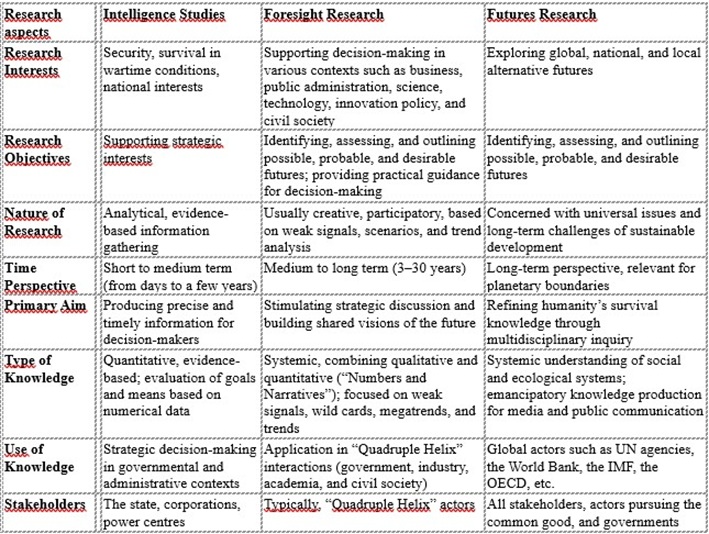
We may conclude that the interface between foresight, futures research, and intelligence is complex and multifaceted both theoretically and practically. Understanding this interface may help us see how futures knowledge and decision support can be integrated across different social contexts – such as strategic management, political decision-making, security policy, corporate competitive analysis, technology foresight, and systems analysis. This integrative task poses a significant challenge for each of these forward-looking research domains. Table below presents some of the key differences – and to some extent, similarities—between intelligence studies, foresight research, and futures research.
Table. Intelligence Studies, Foresight Research, and Futures Research
The interfaces can be approached through four dimensions: (1) the knowledge process dimension, (2) the purpose of knowledge use, (3) the organisational dimension, and (4) the institutional dimension. Foresight activities generate strategic, future-oriented understanding (e.g. megatrends, scenarios). Intelligence, on the other hand, continuously monitors the present situation and changes in the operational environment (e.g. strengthening signals, emerging risks, and critical uncertainties). The key distinction lies in the fact that intelligence validates and updates the assumptions of foresight, whereas foresight provides intelligence with long-term frameworks and direction for analysis.
Regarding the purpose of use, foresight supports strategic planning and innovation, while intelligence primarily supports operational decision-making and risk management. The common ground between the two is their shared objective: reducing uncertainty in decision-making across different time horizons. Foresight is typically conducted by research organisations, corporate strategy units, or political planning bodies, while intelligence is carried out by defence, security, and business intelligence organisations. Both rely on networked, confidential information exchange and shared analytical frameworks (such as risk-opportunity matrices).
A practical approach to managing these interfaces is to distinguish between Strategic Intelligence, Horizon Scanning, and Futures Intelligence.
- Strategic intelligence combines the long-term perspective of foresight with the analytical tools of intelligence, and is particularly suited for government and corporate executive decision-making.
- Horizon scanning functions as a joint tool for identifying weak signals and wild cards that may evolve into significant phenomena or trends.
- Futures intelligence merges foresight methodologies and intelligence processes, and is utilised, for example, in the strategic analyses of NATO, the BRICS countries, and the European Union.
In essence, foresight provides direction and creates opportunities, while intelligence research monitors, validates, and warns. Yet, this division of labour is not always so clear or simple in practice. Very complex interactions may emerge. For example, data and information leaks make interactions complicated and complex. The research interface involves continuous dialogue between the possible and the probable futures—a boundary that is itself often difficult to define in practice.
Jari Kaivo-oja
Research Director
Finland Futures Research Centre, Turku School of Economics, University of Turku
Finland
Docent (Adjunct Professor)
University of Helsinki
Finland
Docent (Adjunct Professor)
University of Lapland
Finland
Docent (Adjunct Professor)
University of Vaasa
Finland
Professor
Kazimieras Simonavičius University (KSU)
Vilnius, Lithuania
jari.kaivo-oja@utu.fi