
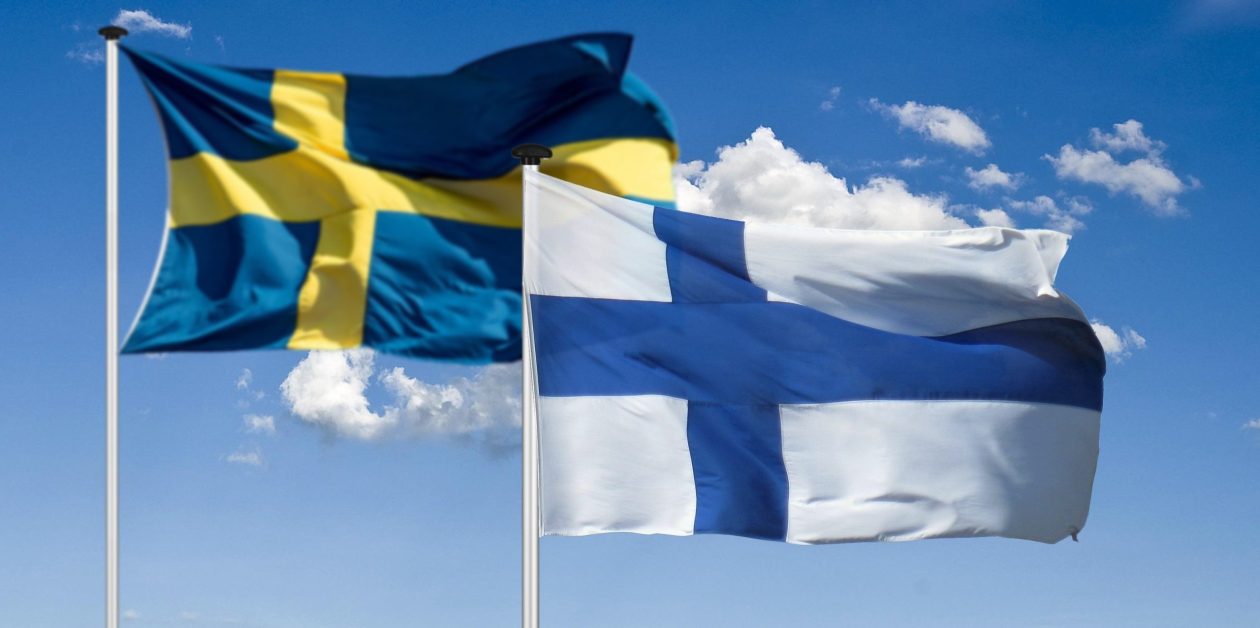
On June 28 2022 Sweden and Finland were invited to join NATO. During a symbolic ceremony at the NATO Madrid Summit, all the central actors gathered in front of the cameras, as if to replicate a “family photo” in mini format: representatives from Sweden, Finland and Turkey, as well as Secretary General Jens Stoltenberg. It was finally happening: Sweden and Finland would join the Atlantic Pact.
But how did Sweden get to this point? Over a few hectic months, a country strongly associated with neutrality had moved its policy from emphasizing continuity to altering the very foundations of its security. Further, what journey awaits in the future and what strategic consequences does a future NATO membership have?
The end of the cold war is often described as the starting point for a major shift in Sweden’s security policy. Sweden became Europeanized and internationalized, and this has been a gradual process regardless of the parties in government. The policy of neutrality was cultivated during the post-WWII hegemony of social democracy in a “double policy” of secret cooperation with NATO. The center-right government under Carl Bildt 1991-1994 started the reform process, and following the EU membership in 1995 policy was adjusted to military non-alignment, which reflected participation in the European supranational project. In 2009 Sweden declared a unilateral policy of solidarity with the EU and Nordic countries, a policy built on expectations of mutual help among the Nordic countries. However, the contemporary setting for a double policy is indeed different, and indeed the Russian escalation on 24 February doomed the existing policy.
Arguably, the most direct strategic effect in transatlantic affairs after the Russian full-scale invasion of Ukraine was the emergence of a new northern flank. Unlike the northern flank of the Cold War, Finland is now in the picture and Sweden has finally scrapped its double policy, and the two countries seems to march hand-in-hand in step with the trend of multinational defence cooperation. However, seen from a process perspective there are three notable differences between the NATO membership applications in Sweden and Finland: the NATO option, the public opinion and the turnaround. For Finland, the process towards NATO membership began already in 1995, with the EU membership and a declared “option” to join NATO. In essence, the basic mechanism behind the Swedish and Finnish applications seems very similar to the fairytale “The three little pigs”. The fifer pig (Sweden), lacking a strong defence and ambitions to join an alliance, is scared by the big bad wolf and engages in closer cooperation with the slightly more realist and capable fiddler pig (Finland). After February 24, following a quick assessment of the risks involved, the fiddler pig drags the fifer pig up to the practical pig (NATO), who has built a more solid house together with 29 other pigs.
On the national level, there are two main challenges for Sweden as member of NATO: to learn and to decide. Seen from one perspective, NATO is an international organization with a multitude of 154 committees with different working processes, as well as a huge staff structure, and the new members will have to learn it. It is within these structures that a large part of Swedish officers (ca. 150-250) will serve. Further, Sweden needs to learn the organizational dynamics of NATO. As the diplomatic negotiations with Ankara 2022-23 have shown, NATO is an arena where 31 different strategic agendas collide, and individual member states decide to play different roles and make different priorities (and interpretations) of the common commitments.
The European security system is in transformation. Institutions are either scrapped (Council of Europe), in angst about Russian membership (Arctic Council) or searching for new roles (EU and NATO). In a longer perspective, Sweden and Finland must deal with a military strategic situation on the new northern flank where Russia is both weakened by the war in Ukraine and whose position has dramatically deteriorated. The Finnish buffer is gone. The Gulf of Finland has become a choke point where the alliance may stop Russian shipping through the Baltic Sea. Russian air and naval bases on the Kola Peninsula will be particularly vulnerable. This presents both Sweden and Finland with the challenge of handling a situation as front state (Finland) and staging area (Sweden) in the alliance, which if nothing else reduces the scope for solo acting on the diplomatic level. The point is that the strategic issue Sweden must decide upon concerns which multinational baskets the country should put its military eggs in.
Magnus Christiansson
Dr., Assistant Professor
Swedish Defence University
Sweden
magnus.christiansson@fhs.se
Back to Table of Contents