
Smart Water for a Sustainable Wellbeing
Sustainable management of water resources is vital to ensure safe drinking water for present and future generations while protecting freshwater ecosystems. In Jurmala, Latvia, the municipal utility Jurmala Water demonstrates how integrated water abstraction, treatment, and treated wastewater discharge practices can achieve environmental protection and resource sustainability. Serving around 50,000 residents, the company manages the entire water cycle — from groundwater extraction to wastewater treatment and controlled discharge into the Lielupe River, which flows into the Gulf of Riga.
Water abstraction occurs from 20 artesian wells in Dzintari, Jaundubulti, Kauguri, and Kemeri, with depths from 145 to 255 meters. Jurmala Water employs a multi-stage treatment process to ensure high-quality drinking water. Aeration promotes iron oxidation, followed by filtration through quartz sand to remove iron and manganese. Nanofiltration membranes eliminate divalent ions and enhance water quality. Continuous monitoring using laboratory analyses and SCADA systems ensures compliance with WHO and EU drinking-water standards.
Equally important is wastewater management. Sewage from the serviced areas is treated at the Sloka wastewater treatment plant, where physical and biological processes remove pollutants before the effluent is released into the Lielupe River. This controlled discharge preserves aquatic ecosystems and protects the water source areas, effectively closing the loop of sustainable water management.
Innovation plays a central role in Jurmala Water’s operations. The company has introduced floating solar panels to supply renewable energy for wastewater treatment [1] and has launched nutrient-recovery projects [2] [3] [4] demonstrating the application of circular water management principles. These initiatives reduce environmental impact, improve efficiency, and provide replicable models for other municipalities.
Releasing clean water back into the environment is essential. Proper effluent treatment maintains river ecosystem health, supports aquifer recharge, and ensures long-term water availability. It prevents the accumulation of hazardous substances, safeguards public health, and fosters community trust in municipal services. Achieving these results requires robust operational practices, continuous monitoring, and skilled staff capable of maintaining complex treatment systems and responding effectively to disruptions.
Figure 1. Water management practices range
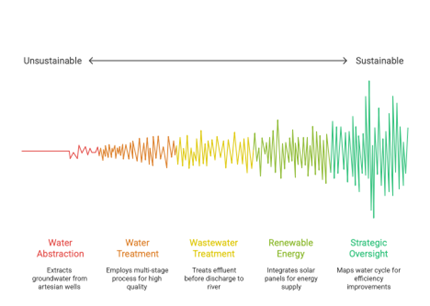
Jurmala Water shows sustainable water management is built on technological excellence, strategic oversight, and environmental responsibility (Figure 1). By mapping critical points in the water cycle — from groundwater abstraction to effluent discharge — the utility identifies opportunities to improve efficiency, mitigate risks, and strengthen sustainability. Every stage, from treatment optimization to resource recovery, protects water resources for future generations.
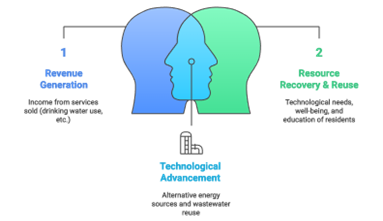
Although Jurmala Water’s revenues depend primarily on services sold, such as drinking-water supply, the company actively explores resource recovery and reuse for technological benefits, public well-being, and education. Developing alternative energy sources and reusing treated wastewater allows residents and visitors to benefit from sustainable practices — for example, by irrigating green spaces and, in the future, cleaning streets. The company views sustainability as a business objective and a balance between economic viability, environmental protection, and community education (Figure 2).
Figure 2. Jurmala Water’s sustainability vision
This case highlights the importance of municipal utilities as stewards of the water cycle. Jurmala Water successfully combines operational efficiency with environmental care through integrated management, innovation, and adherence to international standards. Continuous improvement and proactive strategies ensure that clean water remains available for its community while setting an example of sustainable urban water management for towns and cities worldwide.
Jurmala Water exemplifies how municipalities can transform water services into a sustainable, resilient, and responsible system through high-quality treatment, responsible effluent discharge, and forward-looking innovation. Protecting rivers and aquifers is not just a regulatory duty but a lasting commitment to ecological stewardship and societal well-being.
Note: The language of this text was reviewed and improved using Grammarly AI tools.
[1] https://derex.lv/news/derex-built-the-first-floating-solar-station-in-baltic-region [2] https://johnnurmisensaatio.fi/en/our-work/projects/the-pure-project/ [3] https://www.iwama.eu/tags/jurmala [4] https://interreg-baltic.eu/project/renutriwater/
Kristina Kokina
Dr.Sc.Ing.
Head of Water Treatment Technologies Department
Jurmala Water
Jurmala
Latvia
Associate Professor and Senior Researcher
Riga Technical University
Riga
Latvia
kristina.kokina@jurmalasudens.lv; kristina.kokina_1@rtu.lv
Jānis Zviedris
M.Sc.Ing.
Head of Wastewater Treatment Department
Jurmala Water
Jurmala
Latvia
Lead Expert
Riga Technical University
Riga
Latvia
janis.zviedris@jurmalasudens.lv; janis.zviedris_1@rtu.lv
Back to Table of Contents