
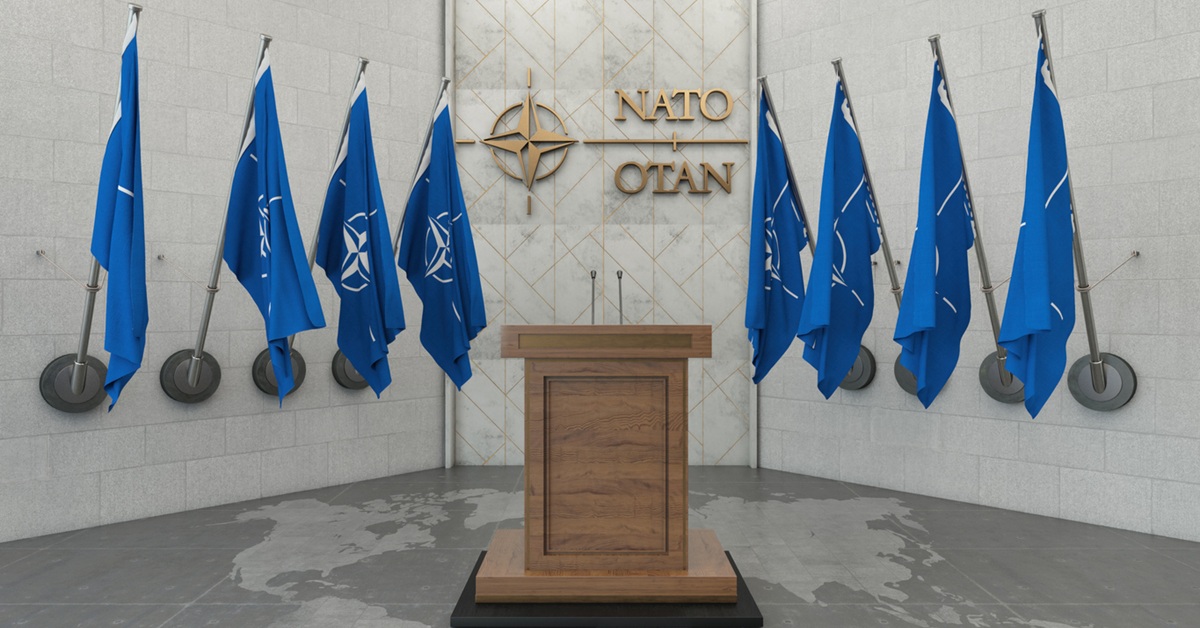
In 2024, NATO entered its seventy-fifth year as an organization committed to safeguarding transatlantic security, freedom, and democracy. Yet, the 2024 NATO Summit in Washington, D.C., will be far more than just a celebratory event. In 2024, NATO will have to prove it has successfully embarked on the biggest adaptation since the end of the Cold War. The Central and Eastern Europe (CEE) will play a crucial role in this process, as NATO’s political and military centre of gravity has been shifting towards the Eastern Flank.
There are three main objectives for CEE in the context of the upcoming 2024 NATO Summit. First, bringing Ukraine closer to NATO. In fact, Ukraine’s membership in the Alliance is the cheapest and most credible deterrence option against Russia. As James Goldgeier notes, “without NATO membership for Ukraine, the Russian threat against the country will continue, as will the need for the West to respond to Moscow’s aggression. The only way to take care of that threat over the long term is to bring Ukraine into NATO and deter a future Russian invasion.” Moreover, CEE Allies should promote practical long-term military projects with Ukraine. These projects should enhance sustainability of NATO’s support to Ukraine, boost Ukraine’s interoperability with NATO and offer the Alliance unique insights into Ukraine’s methods of fighting Russia. In this context, CEE Allies should lead the process of both enhancing NATO’s coordination role with regards to military support to Ukraine as well as establishing a NATO-Ukraine Joint Analysis, Training, and Education Centre (JATEC) in Poland. In fact, JATEC will become the first ever NATO-Ukraine military structure, with a goal of applying lessons that the Ukrainian military is learning in operations against Russian forces to NATO defence plans and training.
Second, continue to enhance NATO’s deterrence and defence posture, including by increasing defence spending and procuring new military equipment. Indeed, it requires years of sustained effort to rebuild forces that in many instances had become quite hollow. The substantial increases underway allow CEE Allies to pursue three equally important objectives: to rebuild forces at the right level of readiness and military effectiveness; to address capability shortfalls in domains that had been neglected and focus on rebuilding industrial capacity; and to better prepare for the future by developing the next generation of equipment and enablers as well as ensuring that NATO stays competitive in new domains of operations such as space or cyberspace.
Third, help NATO to be ready for a long-term strategic competition with Russia and China. To achieve this goal, CEE Allies should continue to invest in national and collective resilience, which are an essential basis for credible deterrence and defence and the effective fulfilment of the Alliance’s core tasks. CEE Allies should lead by example by developing national resilience goals and implementation plans, which will help to identify and mitigate strategic vulnerabilities and dependencies, including with respect to critical infrastructure, supply chains and energy systems. A lack of appropriate urgency in bolstering collective resilience in Europe will imperil the Alliance’s ability to effectively address the looming threats. At the same time, CEE Allies should actively engage in the works of the civil-military Defence Innovation Accelerator for the North Atlantic (DIANA) and the NATO Innovation Fund (NIF) to boost their technological edge. DIANA will work directly with top entrepreneurs, from early-stage start-ups to more mature companies, to solve critical problems in defence and security through deep technologies. NIF is a EUR 1 billion venture capital fund which will provide strategic investments in start-ups developing dual-use technologies. NIF will have three strategic objectives: seek out cutting-edge technological solutions that solve the Alliance’s defence and security challenges; bolster deep-tech innovation ecosystems across the Alliance; and support the commercial success of its deep-tech start-up portfolio. The recent decisions to establish the NIF Regional Office in Warsaw as well as to launch the Krakow DIANA Accelerator confirm that CEE Allies have an important role to play in NATO’s technological efforts. In fact, both DIANA and NIF can have a transformative effect on the CEE civil-military technological ecosystem as they provide the right framework to prepare for technological strategic competition. In this broader resilience-technology context, the CEE Allies should lead the discussion on economic deterrence in NATO. Indeed, it would be appropriate for NATO to develop its own economic deterrence agenda to be agreed as part of the 2024 NATO Summit deliverables.
The author writes in a personal capacity.
Dominik P. Jankowski
Deputy Permanent Representative
Permanent Delegation of the Republic of Poland to NATO
Brussels, Belgium