
Dr Greg Mills runs the Platform for African Democrats, is a strategic advisor to several African leaders, holds fellowships at the University of Navarra and the Royal United Services Institute, and is member of the Creative Team at the Chalke History Festival. He served as the Director of Studies and National Director of the South African Institute of International Affairs (SAIIA) from 1994-2005, and then for 20 years as the founding director of the Johannesburg-based Brenthurst Foundation.
Born in Cape Town, he served four deployments to the International Security Force in Afghanistan as the advisor to the commander, was a member of the Danish Africa Commission and the African Development Bank’s High-Level Panel on Fragile States, has directed numerous reform projects with more than two dozen African heads of government, and has conducted field- and policy-work in combat zones from Tigray to Ukraine. He is a regular contributor to international journals and newspapers and the author of numerous books including the best-selling Why Africa Is Poor, Rich State, Poor State, The Art of War and Peace and The Essence of Success, all with Penguin Random House. He has rowed and raced cars internationally, achieving podium positions in several 24-Hour races, and is a South African national.
Abstract
Africa is not immune to Russian attempts to manipulate public opinion. This has come to the fore in recent revelations about Russian media manipulation in the run-up to the May 2024 election in South Africa, particularly targeted against the Democratic Alliance, the official opposition. The DA had taken a strong stance against Russia’s war in Ukraine, which included a visit by its party leader to Kyiv in April 2022. The stands apart from South Africa’s official government policy of neutrality, which in effect, has meant tacit support for Moscow, and been interpreted as such.
Given its history of racial division, South Africa offers relatively easy pickings in Russia’s political warfare in Africa, where sowing division and discord is the aim, and where character assassination by fake news is part of the means. Across Africa, there is now clear evidence that foreign influence campaigns, especially those linked to Russia, are actively attempting to shape public opinion through disinformation networks, proxy media outlets, and coordinated online messaging. These campaigns are not random. They are carefully strategic. They are deliberate. And their ultimate target is public trust in democracy itself.
It is not surprising, therefore, given the BRICS interests and South Africa’s relative sophistication, along with legacy ANC links, proven levels of government corruption, and its relatively open media environment, that much Russian action focuses on South Africa. Unlike much of the rest of Africa, South Africa does not offer Russia a real opportunity through military support or financial and economic assistance.
Countering fake news is difficult. Debunking after the fact doesn’t work; the rumour is already on the mill. Pre-bunking is very difficult since one cannot predict the future, at least with any accuracy. But there are tools that permit one to detect Russian state‑media content laundering, which are capable of flagging duplicate content and amplification across the web to warn audiences before propaganda gains wider reach.
One of the problems in dealing with this form of interference is that, given that they work through existing political power structures, it’s hard to do more than call them out unless they do something egregious.
For its part, the DA – and other liberal-minded African oppositions – will have to monitor these campaigns, recognise them before they take root, and react in real time. Collaboration on this threat to democracy between oppositions across sub-Saharan Africa could not only create a measure of solidarity but also enable economies of scale. Oppositions clearly cannot rely on state ‘protection’, not least since the professional capabilities of African intelligence agencies are limited, and their political interests lie elsewhere. There is the unknown factor of the degree to which Russian intelligence has penetrated and compromised key personnel in those agencies.
African opposition parties including the Democratic Alliance in South Africa will need to ‘go it alone’ in both protecting itself against Russian penetration and disinformation, as well as identifying and countering the amorphous and international spiderwebs of the Russian agencies.
Key words: South Africa, Russia, hybrid war, political warfare, media, influence operation, Democratic Alliance, African National Congress, ANC, DA GNU, MK Party, Economic Freedom Fighters, EFF, GRU, FSB, KGB, BRICS, Vladimir Putin, Government of National Unity, John Steenhuisen, Nelson Mandela, Thabo Mbeki, Cyril Ramaphosa, Jacob Zuma, South African 2024 election, Advanced Persistent Threat (APT), Advanced Persistent Manipulator (APM)
1. Introduction
‘The ideal subject of totalitarian rule is not the convinced Nazi or the convinced Communist, but people for whom the distinction between fact and fiction (i.e., the reality of experience) and the distinction between true and false (i.e., the standards of thought) no longer exist.’
– Hannah Arendt, The Origins of Totalitarianism
‘If spying is mostly writing, a good deal of the remainder is waiting.’
– John McClosky, The Seventh Floor
Over the New Year holiday at the start of 2023, the Secretary-General of South Africa’s then ruling African National Congress (ANC) Fikile Mbalula was snapped wearing a white suit criss-crossed with rail-tracks and sleepers. With corruption investigations into the Republic’s Public Rail Agency, Prasa, ongoing, it was no surprise that the picture of the politician was soon dubbed ‘The Devil wears Prasa’.
Three years later the clownish ANC politician found himself at the centre of another storm. This time he was alleged to have sought assistance from a Russian agent for the 2026 Local Government Elections, while thanking Moscow for its support in the May 2024 event.
The Russian agent, code name 9477, and his translator met with Mbalula in the lounge of an upmarket Johannesburg hotel. ‘I briefly reported on the results of the 2024 mission,’ reported the agent. He does on to detail how Mbalula thanked the Russians for their assistance before the elections in May 2024 and asked the mission to continue to help the party, particularly in the run-up to the 2026 local government elections. Agent 9477 describes Mbalula’s request for ‘support for the shooting of a film to coincide with the party’s anniversary … and $300,000 to finance the organisation of the party congress.’
The Russians were reportedly behind a number of other ‘interferences’ against the opposition Democratic Alliance (DA) in the run-up to the 2024 election, including the fabrication of a letter signed in the name of Helen Zille, the chairman of the party, alleging a scheme to remove the ANC from power once a coalition had been formed. There were other, earlier deceptions, including a bill for a reservation for at a Singaporean hotel for Zille and her younger chief of staff Tim Harris, the intention to frame them as lovers.
Following the 2024 election the DA and the ANC were the two main parties to join a Government of National Unity (GNU) after ANC support fell to 40%. Despite being partners in the GNU, the DA and the ANC remain political rivals, and have taken very different positions on foreign policy, a domain still under the control of the ANC.
Fake news is one of the tactics in what is termed ‘hybrid war’, actions just below the threshold of inter-state violence, but nonetheless designed to achieve the same ends: chaos, capitulation and capture.
More exactly, this is a form of political warfare in which the Russian Federation is prominent but not alone in causing mischief in international relations.
South Africa offers relatively easy pickings in this war in which sowing division and discord is the aim, and where character assassination by fake news is part of the means.
A recently leaked dossier of Russian documents to The Continent and published by several outlets, including Forbidden Secrets, details the control that Russia’s Foreign Intelligence Service, or SVR, Sluzhba Vneshney Razvedki, the successor to the KGB’s First Chief Directorate, has assumed over Wagner influence operations and networks in Latin America and Africa.
Both regions have renewed global importance, given the race to secure critical minerals. Between them, they hold between 60-70% of global copper reserves and more than 60% of lithium, both key to the green energy and data revolutions. Chile and Peru already produce about half of the global copper supply. Chile, the world’s leading exporter of critical minerals, also ranks second in global lithium production with 30% of production.
Sub-Saharan Africa is home to approximately 30% of the world’s proven critical mineral reserves. The Democratic Republic of Congo accounts for nearly three-quarters of global cobalt production and about half of global reserves. South Africa holds nearly 80% of the total global PGM reserves. SA, Gabon and Ghana collectively produce over 60% of all manganese. Mali, Zimbabwe and the DRC all possess significant lithium reserves.
It’s not only the race for critical minerals that has had an impact, however. The fight for support for Russia’s war in Ukraine has widened the audience for its narrative. As a consequence of its diplomatic and economic isolation, Moscow has aggressively pursued an information operation worldwide, aimed at winning allies and dividing opponents. The DA’s opposition to Russia’s war and to Moscow’s longstanding relationship with the ANC has led to an increase in Russian involvement in South African domestic politics.
The Institute for Security Studies (ISS), utilising software from Murmur Intelligence, has analysed the vast scale of the influence campaign around South Africa’s May 2024 national election. The analysis drew on more than 1.2 million social media documents and field interviews with influencers.
Among its central findings was the identification of the so-called ‘Dumb Alliance’ influence campaign: a coordinated network of predominantly paid social media influencer accounts that systematically targeted the DA using a cluster of 11 anti-DA hashtags (#dumballiance, #notwhiteenough, #rescuedumballiance, #stopdaracism, #byebyeda, #danotayoba, #dontstealourvotes, #stoptheda, #doomsdayforda, #boycottelections). ISS identified a network of influencer accounts that generated nearly 80,000 posts linked to these hashtags.
ISS also identified at least 375 accounts that amplified links to the dedicated anti-DA website, dumballiance.com, and a core cluster of 24-26 accounts that had amplified at least seven unique anti-DA hashtags. During field interviews, one influencer told ISS researchers that a Russian client had contacted him via direct message on X and paid him between R40 and R50 per interaction to amplify pre-supplied content targeting the DA.
The core narratives pumped up by this disinformation campaign were racial polarisation, including framing the DA as the ‘white party’ and using hashtags such as #notwhiteenough and #stopdaracism; undermining the electoral process and results by implying the DA was rigging the 2024 election and the widespread use of #dontstealourvotes; and opposing the GNU and the DA’s role within it after the election.
Both the EFF and MK parties were identified as the most prominent voices on social media, ‘with each benefiting from the activities of supporters of their ideology and campaigns as well as paid influencers. Many of the MKP’s online narratives were defined by their attempts to undermine the integrity of the election results by pushing the conspiracy theory that the results were stolen. The MKP Community generated almost 25% in the total sample of users, followed by the EFF supporters’ community, which generated 20%. ‘This high level of content generation is indicative of either particularly passionate community members or inauthentic amplification,’ according to ISS.
In February 2026, the ‘All Eyes on Wagner’ project released an analysis of leaked Russian intelligence material that shed new light on the anti-DA activity observed during the May 2024 election. The SVR reportedly identified South Africa as a priority environment for social media mis/disinformation campaigns.
According to the documents, South Africa was to be targeted by uniting ‘allies of the progressive factions to expand its membership’ by launching ‘a counter-campaign against the DA party’; by conducting ‘anti-Ukrainian and anti-UAZA [Ukrainian-South Africa Association] campaigns’; and through promoting ‘South African alignment with BRICS’.
Within these documents are details of a plan to discredit the DA and its leader, John Steenhuisen, with the distribution of racist mugs as part of his birthday celebrations in 2025. No doubt Steenhuisen would have made himself a more visible target by visiting Ukraine in April-May 2022, shortly after the Russian invasion, to express common cause with Kyiv and support for upholding international law and sovereign norms. This included launching a May 2023 court action compelling South Africa to arrest Vladimir Putin if he attended the local BRICS summit, and against the planned appearance of Russian Tupolev Tu-160 ‘Blackjack’ bombers at a South African airshow in October 2024.
The DA’s opposition to the government’s foreign policy stance on Russia would only have further intensified Moscow’s efforts against the DA and legacy support for the ANC and other ‘revolutionary’ parties
Well before the election, the continent-wide scale of the Russian disinformation problem was documented by the Washington-based Africa Centre for Strategic Studies (ACSS) in its March 2024 report ‘Mapping a Surge of Disinformation in Africa’. In this, Russia was identified as the single largest sponsor of disinformation campaigns in sub-Saharan Africa, responsible for approximately 40% of all such known operations across more than 22 African countries.
South Africa was identified in the ACSS reporting as a country where Russian-linked influence networks were active, which noted that Russian-linked influencers had previously driven the #IStandWithPutin and #IStandWithRussia campaigns in the country, amplified in part by figures close to former president Jacob Zuma.
A separate study by the Centre for Analytics and Behavioural Change with Murmur identified three vectors of Russian influence in South Africa and linked the MK Party to Russian influence networks. The study noted, ‘Accounts like @embassyofrussia and @mfa_russia appear to tag accounts like @IOL [the Independent Newspaper Group], perhaps to draw their attention to particular posts. The choice of who these pro-Russian accounts tag regularly raises questions.’
In June 2024, the proprietor of the Independent Newspaper Group, Iqbal Survé, was awarded a medal for co-operation by Russian foreign minister Sergey Lavrov in Cape Town. It was apparently long overdue.
2. New Methods, Old Goals
The pattern of election interference is not unusual in global elections. Cyber warfare has become a major feature of campaigns.
Such cyber activities have to be divided between Advanced Persistent Threat (APT), essentially against malware and hacking to carry out financial crimes or to launch strategic destabilising actions. An APT does not comprise a ‘smash-and-grab’ one-time hack. Rather, it’s a long-term, sophisticated campaign in which an intruder gains access to a network, potentially staying there for an extended period, using tools that standard antivirus software can’t catch. APTs can involve state-sponsored groups endeavouring to steal secrets or, to take another example, to turn off (or on) infrastructure software. Russian-linked operations often pair intrusions with influence releases (‘hack and leak’) and coordinated personal political attacks.
The other, even more insidious form of cyber threat is known as the Advanced Persistent Manipulator (APM). This is the cognitive/information equivalent of an APT.
APM refers to the strategic use of psychological techniques to influence a target’s perceptions, emotions, or behaviour, mostly without them realising it.
It’s easy to get lost in the ‘Alphabet Soup’ of cybersecurity and psychological operations. While APT and APM may sound similar, they operate in completely different realms—one targets your hard drive, and the other targets your head. The goal is for the target to believe the conclusion they reached was their own original thought, rather than a narrative planted by an outside actor.
APTs have become far more sophisticated – and powerful – with the introduction of AI, which is exponentially increasing the volume of messaging. Already, it is estimated that Russian sources are generating two million information messages per day across a large number of languages. ‘By 2028,’ says Alto, a leading Spanish cyber and counter-intelligence capability, half of APT state actors will be AI.’ Alto already sifts more than 700 billion information signals annually.
‘Big Data’ and algorithms work out what makes you angry, scared, or compliant, harvest this digital dust, and then feeding you specific content to trigger those feelings.
Amplifying public messaging is the stock in trade of Russian attempts, which includes the likes of ‘Toy Soldiers’ – usually retired Western military colonels promoting a counter-narrative favourable to Russian interests. For this payment comes in a variety of forms, but notably through large-scale purchases of their writings, which satisfy their egos as much as their pockets. Another form is through so-called ‘Pink Slime’ journalism, where news outlets, often fake partisan operations, publish manufactured news reports to suit a particular point of view from sites of titles that are little more than shells for advocacy. The ZambiaNews.net or SANews.net sites are given as two examples.
The ready availability of sources of dissemination and information, such as the Russian state-controlled RT and Sputnik make this process easier.
Already by the end of 2024, fake news sites outnumbered real newspaper sites in the US, some 1,265 to the 1,213 daily newspapers. The effects are startling. Even before AI gained the traction it now enjoys, in May 2024, the Alliance for Security Democracy (ASD) published a report documenting some 400 domains that had published identical or nearly identical copies of articles originally featured on RT.com, Russia’s most influential, English-language propaganda outlet. ASD notes that the most observed domain was the bignewsnetwork.com, a website affiliated with a content distribution network of the same name, which operated more than 500 other websites that present themselves as local, regional, or national news outlets. It had surfaced as a primary dissemination point for both Russian and Chinese state media content.
Russia exploitation of these developments in the US has surfaced in the ‘Doppelganger’ case. Established by Russian firms (Social Design Agency and Structura National Technology) in May 2022, the campaign was directed at undermining support for Ukraine, weakening Western alliances, and disrupting elections in Europe and the US. The campaign cloned the websites of legitimate news organisations (including Der Spiegel, Le Monde, Fox News, and The Washington Post) to publish pro-Russian, anti-Ukrainian, or divisive content. The use of so-called ‘Recent Reliable News’ (RRN) would mimic the layout and branding of established media outlets, differing only slightly in the URL, and used bulk-created accounts on platforms like X and Facebook to spread this content. It also used AI to generate articles, images, and videos, including some featuring celebrities with false quotes.
The US Department of Justice (DOJ) disrupted this network in September 2024 by seizing 32 internet domains and sanctioning individuals involved, including employees of RT. However, it seems that Doppelganger continues to operate despite this disruption.
The increased use of Russian assets to spread disinformation in a domestic political context suggests there may be substance to rumours of Russian funding for the MK Party in South Africa. If true, this might also help explain why MK activists were recruited to fight in Ukraine. There is also evidence that influencers are being used to peddle anti-DA messaging, especially in the City of Cape Town.
Across Africa, there is now clear evidence that foreign influence campaigns, especially those linked to Russia, are actively attempting to shape public opinion through disinformation networks, proxy media outlets, and coordinated online messaging. These campaigns are not random. They are carefully strategic. They are deliberate. And their ultimate target is public trust in democracy itself.
None of this is new.
Today the digital/cognitive domain can also act as a hinge between the physical and the cyber domains. Cyber is has an obvious connection but the physical aspect involves the co-ordination of social unrest, sabotage, and radicalisation, all within the scope of the weaponisation of information operations by Russia. The waving of the Russian flags in African protests across the Sahel region and in Nigeria from 2024, and the recruitment (and payment) of disaffected youths to mount arson attacks in the UK the same year against allegedly Ukraine-linked sites, are cases in point. Ken McCallum, the head of MI5, Britain’s domestic intelligence service, warned that Russia is on a ‘mission to generate mayhem on British and European streets,’ while his then counterpart at MI6, the British foreign intelligence agency, said bluntly that ‘Russian intelligence services have gone a bit feral.’ Or as Gabrielius Landsbergis, Lithuania’s former foreign minister, put it: ‘During the Cold War, you had to cultivate an agent, then the agent would cultivate a network. Now you offer €50, €100, and you have a bunch of people that join in and do stuff for you… This is the way it works in the 21st century.’
The Soviets were masters of AGITPROP, Agitation and Propaganda, the central thesis of which was repetition of messages, no matter how fake and fact-free. Vladimir Vladimirovich Putin, as a former KGB agent and head of its successor, the FSB (Federal’naya sluzhba bezopasnosti), knows these techniques well, as do those schooled in this system by the former liberation movements.
It’s a lesson learnt from others – on which the ‘Big Lie’ idea of political propaganda is based. ‘The masses have limited understanding, scant wisdom and a weak memory. Thus, to have a major impact, political propaganda must focus on a small number of points and convey them through slogans. That will ensure that even the slowest member in the audience will understand the message.’
So wrote Adolf Hitler in Mein Kampf. Hitler was reflecting on the propaganda techniques used during the First World War. He concluded that German propaganda was sophisticated but ineffective, while the British variant was comparatively simplistic and effective. The political rewards would be in focusing on emotion over intellect.
The Russians have employed this technique well in Ukraine in utilising several lines of argument, none of which are necessarily true, but nonetheless have wider strategic goals: that Russian victory is a matter of time, of the constant threat of a wider war, that Ukraine is a non-country run by Nazis, and that Putin can do what he likes immune from domestic criticism or challenge. This narrative is used not only to maintain his perception of power domestically, but to widen the strategic fissure created by Donald Trump with America’s European NATO partners. The way in which Putin has been able to win a measure of diplomatic support among the majority of the world is both a measure of the success of such techniques and the regard in which the West is held globally.
This narrative is designed to create a virtual reality for Putin despite his economy suffering under the strain of the war and extraordinary personnel and materiel costs for limited gains. Russia has lost 1.3 million soldiers dead or seriously wounded since its ‘special military operation’ started four years ago in February 2022, and it has added less than 1.3% of Ukrainian territory since then to the 20% it had already taken in 2014.
3. The Next Matryoshka
Russia has long wielded intelligence as its most powerful domestic and foreign policy weapon, with disinformation at the heart and soul of its activities. Since the 1960s, Soviet intelligence had found its forte ‘in planting fake rumours in the media to discredit Western leaders, in assassinating political opponents, and in supporting front organisations that would foment wars in the Third World and undermine and sow discord in the West.’ The Communist Party of the Soviet Union itself possessed a sprawling international network of bank accounts, buildings and foreign firms. ‘Through these bank accounts and other connected firms, the strategic operations of the Communist Party abroad – and those of allied political parties – had been funded.’ The most secret operations had been run out of Room 516, housing the International Department’s special section for ‘party technology’. Headed by Vladimir Osintsev, it ran ‘Communist Party influence campaigns to sow discord in countries where the existence of the Party was illegal, such as El Salvador, Turkey, South Africa and Chile.’ 1 Valentin Falin, who headed the International Department of the CPSU, allegedly ordered the destruction of the International Department’s files following the August 1991 coup, after which he left government service under a cloud of corruption.
The methods of making money off the books were straightforward during Soviet times. A series of trusted firms would import raw materials at local (Soviet) prices, and sell them on at a massive profit, which would never return to the Soviet Union. This system was managed by the KGB, which, upon the ascension of its former chief, Yury Andropov, to the Soviet leadership in 1982, began preparing for the inevitable market transition. After 1991, the bankruptcy of the post-Soviet Russian state forced the knock-down privatisation of key assets, including in banking, mining, and oil and gas. The tycoons who inherited these assets, including the likes of Boris Berezovsky and Mikhal Khodorkovsky, were able to ‘turn around the Soviet legacy of falling production, deep debts and neglect’ by the end of the 1990s.
But in the process, some of the new oligarchs forgot to whom they owed their debt of ownership: Putin and his KGB cronies. This set the stage for a counter-economic coup in which the assets the new elite had received cheaply were snatched away and placed in the hands of Vladimir Vladimirovich’s trusted circle. For Putin, power accesses money, and money is power.
In Putin’s People, journalist Catherine Belton tells the story of how Vladimir Putin and his entourage of KGB men seized power in Russia and built a new league of oligarchs through a ruthless seizure of private companies, in the process blurring the lines between organised crime and political power. By siphoning billions and shutting down their opponents, they used the power granted by their riches to extend influence in the West through methods tried and tested in the Cold War. ‘Putin and the KGB men who ran the economy through a network of loyal allies now monopolised power, and had introduced a new system in which state positions were used as vehicles for self-enrichment,’ she writes. ‘It was a far cry from the anti-capitalist, anti-bourgeois principles of the Soviet state they had once served.’
The ‘deep-state’ of KGB types, which ‘emerged to monopolise power’ in a joint venture with Russian organised crime, aimed to reassert the country’s global position and prestige. Employing old smuggling contacts and practices developed during the Cold War, they were able to turn the billions of dollars now in their hands to undermine and corrupt festering Western democracies. The KGB playbook of the Cold War era, when the Soviet Union deployed ‘active measures’ to sow division and discord in the West, which included the funding of political parties, was ‘fully reactivated’, the difference this time being a deeper well of cash in a form of ‘hybrid KGB capitalism’. Belton notes that ‘For the Putin regime, wealth was less about the well-being of Russia’s citizens than about the projection of power, about reasserting the country’s position on the world stage.’
Putin and his men created what is known in Russian criminal parlance as an obschak, a slush fund for a criminal gang to hand out riches to a network of allies, ‘where the lines between what was to be used for strategic operations and what was for personal use were always conveniently blurred.’ This became, writes Belton, ‘the basis for the kleptocracy of the Putin regime, and later its influence operations too – and it was based on the clandestine networks and payment systems of the KGB.’
In this sense, what Putin managed after his return from his Dresden posting and installation as the Deputy Mayor of St Petersburg was a version of cadre deployment, his cadre being drawn from his old KGB colleagues.
*
Following its involvement in the August coup, the KGB was succeeded by the FSB, known in English as the Federal Security Service, and the SVR. While the FSB focuses on protecting Russian borders and maintaining the country’s and its neighbourhood’s stability, the SVR’s focus is on countries outside Russia, where its primary role is espionage and intelligence collection.
FSB and SVR operations are separate from those of the GRU (Main Directorate of the General Staff, Glavnoje upravlenije General’nogo shtaba Vooruzhonnykh sil Rossiyskoy Federatsii), Russia’s primary foreign military intelligence agency. The GRU is known for conducting espionage, sabotage, cyberattacks, and special operations (Spetsnaz) worldwide, including the 2018 Salisbury nerve agent attack, and various cyber campaigns.
Like a matryoshka doll, the stacking wooden figurine of decreasing size placed inside one another, the SVR is a leaner version of its KGB forefather but, in some respects, meaner.
The SVR was officially established in December 1991 following the dismantling of the KGB due to the involvement of its head in the failed Soviet coup in August that year. The SVR continued largely as before under new management, initially under Yevgeny Primakov, an intelligence apparatchik who had worked for years in the Middle East under the cover of a Pravda correspondent, establishing close ties with Saddam Hussein, among others. Primakov went on to serve as the Minister of Foreign Affairs in 1996 and Prime Minister of Russia two years later.
Increasingly the SVR was drawn into cyber operations through its unit APT29, also known tellingly as ‘Cosy Bear’, responsible for state-sponsored attacks including Operation Ghost which compromised high-value targets, including victims within the Ministry of Foreign Affairs in Europe and Washington; the 2016 Democratic National Committee hack which stole over 19,000 emails; the 2019 SolarWinds attack which inserted a virus via an update into the US government’s Homeland Security along with AT&T, Microsoft, Cisco and Deloitte; and the counter-intelligence hack on Microsoft in 2024. SVR headquarters at Yasenevo, in Moscow’s southern suburbs, has more than doubled in size since the mid-2000s, a state-of-the-art facility known as les (the ‘forest’) or kontora (‘office’).
Some SVR activities remain ‘traditional’, such as its ‘Illegals programme’ to insert sleeper agents in American and other communities, assassinations abroad including of the former acting Chechen president Zelimkhan Yandarbiyev in Qatar and the poisoning of the defected former FSB officer Alexander Litvinenko in the UK in 2006, and co-operation with foreign intelligence services notably China, Iran and Saddam’s Iraq. Influence operations include targeting individuals with blackmail by assembling damaging kompromat (literally, ‘compromising material’), and recruiting through payments, as has recently occurred in the UK with the Reform Party. 2
And the SVR has significantly upped its disinformation campaign, initially aimed at promoting a positive image of Russia and inciting anti-American sentiment.
The GRU has several units, such as 29155, 26165, and 74455, with known cyber capabilities. Of these, Units 26165 and 74455 ‘represent an advanced, comprehensive cyber capability which Russia deploys for the achievement of military and foreign policy objectives’ specifically targeting Ukraine and its European partners and NATO allies. Unit 26165 had a reported role in conducting online reconnaissance on civilian shelters in Mariupol and Kharkiv, which resulted in the shelling and killing of sheltering non-combatants. Other reported activities include destructive cyberattacks, such as 2022’s Operations Viasat and Whispergate, as well as Unit 26165’s cyber espionage campaign targeting foreign assistance to Ukraine.
The UK has sanctioned three GRU officers — Victor Lukovenko, Artyom Kureyev, and Anna Zamareyeva — for their roles in the interference agency African Initiative. ‘These sanctions highlight the hybridity of Russian operations and their expansion beyond Europe’ reads a UK Foreign and Commonwealth Policy Paper of December 2025.
Launched in September 2023, the GRU’s African Initiative has a growing online presence. In the eight months from its launch in April 2025, its website published over 18,000 articles in French, Arabic, Spanish, Russian and English. The initiative ‘employs Russian intelligence officers, and receives funding from Russia for influence operations in the region,’ developing content designed to undermine Ukraine’s Armed Forces, including through a press tour to the occupied city of Mariupol for a delegation of bloggers and journalists. Tours of African parliamentarians and politicians, including by the ANC Youth League to observe the Russian ‘referendum’ in occupied Donetsk and Crimea in 2022, to Russian-occupied areas of Ukraine are part and parcel of this approach.
The GRU has used Ukraine as a testing ground for the development of a range of cyber capabilities, integrated into its military doctrine, since 2014. As the UK FCO report concludes: [Russia’s destabilising activities are not commensurate with its role as a permanent member of the United Nations Security Council (UNSC). They also run contrary to the UN norms of responsible state behaviour in cyberspace, which Russia claims to uphold.’
Niels Groeneveld’s Moscow Playbook, for example, demonstrates how Russian intelligence agencies are not just espionage tools but the architects of the Kremlin’s domestic and foreign policies. He reveals how the centralisation of the FSB, GRU, and SVR under Putin has seen the intelligence community come to dominate governance and suppress dissent while shaping global geopolitics in seamlessly integrating espionage, military strategy, and statecraft. He writes that ‘the SVR has gained notoriety for its use of disinformation campaigns as a tool of influence. These operations exploit social media and traditional news outlets to disseminate misleading or false narratives that align with Russian interests. Such tactics aim to destabilise adversarial governments, sway public opinion, and create divisions within societies. By leveraging these methods, the SVR seeks to reshape the information landscape, fostering an environment conducive to Russian geopolitical aspirations while undermining the credibility of opposing narratives.’
This approach is founded on what is termed the siloviki (literally, ‘strongman’) philosophy of state-first loyalty, where the interests of the state are prioritised over individual rights or freedoms. A siloviki is a person with a security service background, one responsible for the exercise of coercive state power. This mindset manifests in various ways, not least in the prioritisation of military and security solutions to geopolitical challenges, where diplomacy is viewed as secondary. The siloviki are intolerant of dissent, thereby allowing the state to consolidate power and maintain control over politics, the media, and civil society, ensuring compliance through a combination of a culture of fear and patronage.
1 See Catherine Belton, Putin’s People: Putin’s People: How the KGB Took Back Russia and Then Took On the West. London: William Collins, 2021.
2 Former Reform UK Wales leader Nathan Gill was sentenced to 10.5 years in prison in November 2025 for accepting approximately £40,000 in bribes from a pro-Kremlin agent to promote Russian interests. Gill, then a MEP, gave pro-Russian speeches and interviews between 2018 and 2019. David Coburn has also been named in a series of WhatsApp messages between an alleged ‘pawn’ in the SVR and Gill. Coburn was also Scotland’s UK Independence Party leader while Gill led the party in Wales and they served as MEPs together for five years. Coburn quit UKIP in 2018 allegedly over the party’s anti-Islamic policies, leaving UKIP the same week it’s former leader Nigel Farage.
4. The Legacy Intersection
The ANC enjoys deep historical ties to Russia and the Soviet Union from the Cold War and liberation struggle days, when the Soviet Union was a material backer and political supporter of the ANC and other liberation movements.
The Soviet Union treated the ANC as a key anti-colonial and anti-apartheid partner, giving it diplomatic recognition, political backing in international forums (including the UN and members of the Non-Aligned Movement), and public solidarity as part of the Cold War competition with the West. This support helped legitimise and elevate the ANC globally and to place pressure on the apartheid regime.
The USSR and some Eastern Bloc states provided regular financial aid to the ANC and allied organisations. Funds were used for exile administration, political work, welfare for exiles, and sustaining ANC structures in host countries. The scale varied over time and was supplemented by contributions from other sympathetic states and diaspora fundraising. Around half of ANC funding was supplied from Scandinavia.
The Soviets and Moscow’s allied states supplied weapons, explosives, military training, and technical assistance to MK cadres. Training took place in the USSR, East Germany, Cuba, and friendly African states (Angola, Mozambique, Tanzania, Algeria and, latterly, Uganda), covering guerrilla tactics, explosives, sabotage, and conventional military skills. Arms shipments and logistics support were routed through sympathetic governments and liberation fronts.
Security co-operation and intelligence sharing took place at varying levels. Soviet and Eastern Bloc intelligence services monitored South African and Western activities, provided counter-intelligence advice to ANC and allied South African Communist Party (SACP) members in exile, and helped establish safe transit and training networks across Africa. Cadres received intelligence training from both the USSR and the GDR, covering counter-intelligence, communications, tradecraft and analysis, delivered in Eastern Bloc centres and in allied African/Cuban locations.
The ANC’s alliance with the SACP created ideological and organisational links to Moscow and other communist parties. The Soviets promoted Marxist‑Leninist analysis and offered political education to cadres, though ANC strategy remained shaped by local conditions and a broad nationalist coalition rather than strict Soviet direction.
After the USSR’s collapse in 1991, Russian support waned, but the earlier Soviet role remained a significant factor in the ANC’s ability to survive and negotiate the end of apartheid.
When the ANC was elected to power in South Africa, the two countries had already re-established diplomatic relations (South Africa was the first African country to recognise the post-Soviet Russian Federation and establish diplomatic ties in 1992). After 1994, the phase of Russian-South African relations until 2019 was in two parts: the Thabo Mbeki period (including Mbeki’s time as deputy to Mandela) and that of Jacob Zuma.
Mbeki, even while still Deputy to Nelson Mandela, pursued a pan-African foreign policy that, in many respects, echoes what his later successor, Cyril Ramaphosa, continues to follow. Having spent some time in Russia during exile, Mbeki advanced both pan-African and anti-imperialist positions and laid the groundwork for South Africa to join BRICS.
Not necessarily pro-Russia, Mbeki was strongly in the non-aligned camp, which has always historically been beneficial to Russia by ‘neutralising’ Western-led criticism and international opposition. The Mbeki period saw South Africa strengthening as a country ‘outside’ the Western camp, while at the same time remaining firmly engaged with the West, more so economically. This was the period in which South Africa’s position within BRICS, the G20, and the non-aligned segment of the UN was cemented.
The election of Jacob Zuma as South African president marked what could be described as the ‘honeymoon phase’ for Russia in terms of South African relations. Then, President Zuma represented a strengthening of relations with Russia and the opening of several initiatives to entrench Russia, the most impactful being the proposed award of a contract to Russia to build nuclear power plants in South Africa. Despite Zuma’s best efforts, however, this never materialised, as even given the nature of government during the Zuma state-capture years, the South African institutional system thwarted Zuma’s Russian ambitions.
During Zuma’s tenure, poor leadership (or the Russians’ possession of kompromat) led to a waning of consistency and the rise of partisan pro-Russian positions. It has become a popular pastime amongst commentators and politicians to speculate that Jacob Zuma is and has long been a Russian intelligence asset, recruited and paid for many years. In this vein, South African accession to BRICS membership in December 2010 provided the context for rent-seeking and, in the case of the R1 trillion nuclear power option vigorously pursued with Russian President Vladimir Putin, a self-enriching potential deal of extraordinary proportions. A High Court ruling on 26 April 2017 halted the government’s ‘illegal and unconstitutional’ deal with Russia. This resulted in a collective national effort by civil society organisations and citizens, thereby sparing South Africans from the effects of the bankruptcy that would have ensued. Zuma reportedly agreed to the deal in 2014, just weeks after a trip to Russia for ‘life-saving’ treatment supposedly for poisoning.
Whether the FSB/SVR/GRU recruited Zuma and whether Zuma was/is a paid agent is moot. He has a long history of direct personal ties to Russia, and his political ideology and personality are oriented toward being ‘pro-Russian’. A person can be an asset without being paid or actively recruited. They might not even be aware of the fact that they are an asset. Thus, the debate over whether Zuma has been recruited is merely a debate about why he does and has done what he has; it does not seem to materially change his position and attitude toward Russia either way.
The election of Cyril Ramaphosa to the Presidency, in large part, marked a return to the policies and stance developed under Mbeki. Gone was the open push for closer ties with Russia that marked the Zuma years. But consistent with its previous position of global neutrality and its agenda of the South, South Africa did not reject Russia and refused to be drawn into Western camps. Pushed more strongly once again was BRICS-plus, engagement with pariah states like Iran, condemnation of Israeli policies (culminating in the South African case at the International Court of Justice) and a refusal to side with Western initiatives, including sanctions on Venezuela, Cuba, and Iran.
Consistent across the Mbeki-Zuma-Ramaphosa presidencies has been a refusal to downgrade Russian ties to please the West. At the official state-to-state and diplomatic level, Russia has consistently been treated as a friendly power. This helps explain the naval exercises and military visits after February 2022.
South Africa has not however stayed loyal to Mandela’s position that ‘human rights will be the light that guides our foreign affairs’, whether in Africa or farther afield. The lack of condemnation of Hamas’ 7 October massacres, the silence in condemning Tehran’s killing of unarmed protestors and its ‘neutral’ position on Russia’s invasion of Ukraine make a nonsense of South Africa’s human rights and negotiating credentials, as well as its citing of international law as a justification of its protests to the ICJ and UN.
South Africa’s refusal to vote against Russia in the UN after the 2022 invasion of Ukraine was a victory for both the ANC and Russia in that the DA-led Western Cape government came out in support of Ukraine. 3 By insisting on this policy of neutrality, the ANC government rejected the DA stance and in so doing, took the side of Russia. Ramaphosa and his inner circle would argue that they stayed neutral, but a large part of the ANC would happily accept the pro-Russia tag simply to ‘stick it’ to the DA, which at the time represented the immediate political enemy to the ANC.
For the Russians, neutrality essentially amounted to and was interpreted as open support.
3 Government buildings in Cape Town were lit up in Ukraine flag colours. The Cape Town mayor pledged support for Kyiv and requested that the South African government condemn Russia.
5. A Strategic or Opportunistic Approach?
Until now, and certainly compared to China, the post-Cold War Russian approach towards Africa has been somewhat ad hoc, short-term and lacking in material resources. That Russia was in this regard led initially, at least, by Wagner, tells something about Russia’s capacity as well as the interests driving Putin and his circles of trust and control.
China, by comparison, has a sophisticated long-term continental strategic outlook, folding its economic, diplomatic and military approaches into coordinated planning and execution, making maximum use of all arms of government and the state economy. The growing African expansionism of Gulf states and Turkey is following the Chinese pattern, albeit in earlier development and smaller scale.
The Trump administration has, since 2025, switched to what can be called a Chinese approach, engaging an aggressive push for control of strategic minerals, backing super-projects like the Angola-DRC Lobito corridor, and switching on a new ‘harder’ style of military engagement.
Russian activity in Africa is closely watched and assessed in the West. Even the Ukrainians have launched their own political-diplomatic initiative to counter Russia in Africa. The Africa Centre for Strategic Studies think-tank in Washington DC (funded by the US Department of Defence) is among those which tracks Russian and Chinese expansionism and strategy in Africa. Unsurprisingly, the activities of the Wagner group and its successor Afrika Corps has caught a lot of their attention. But so too has the Russian interventions to undermine democracy and swing elections to their favour. The abovementioned ACSS report of September 2021, notes:
While Russia’s engagement in Africa is frequently characterised as opportunistic, Moscow has clear governance objectives guiding its actions. Vladimir Putin has said the liberal international order has become obsolete and has advocated for a multipolar world where democracy is but one of several viable governance systems. Putin’s post-liberal international order envisages more limited space for an active civil society and human rights protections. It entails moving away from a rules-based international system to one defined by transactional relationships between leaders. As such, Putin’s vision is less a new international order as a return to a 19th-century laissez-faire model unencumbered by international standards for political or human rights.
The ACSS report goes on to note the focus of Russian action:
Russia’s attempt to influence Africa’s governance environment takes various forms. All revolve around some type of elite-level co-option. Paradoxically, elite co-option is used as an asymmetric tool by Moscow, well-matched to the relatively modest resources Russia brings to its Africa engagements. It doesn’t demand long-term investments and relationship-building across multiple sectors of shared interests, as do traditional bilateral relations. It certainly doesn’t involve broad-based popular engagement. Rather, it simply requires the capacity to influence pliable individual leaders at the top of a hierarchical power structure … As in other parts of the world, Russia is also active in election meddling in Africa. This typically involves surreptitious messaging supportive of a preferred candidate coupled with unfavourable representations of opposition candidates, dissemination of flattering, if dubious, polling figures to the media, and the unqualified and timely endorsement of election results by a pseudo-election monitoring organisation, such as the Association for Free Research and International Cooperation (AFRIC). Disinformation has been another mainstay of Russian engagement in Africa—and efforts to undermine democratic processes. In addition to the campaigns supporting specific candidates, Russia has mounted a broader messaging effort disparaging democracy.
Several ACSS studies and reports over the past five years demonstrate a strong pattern of disinformation and influence across the continent. The Russian operates continent-wide and dovetails with its global efforts, though the monitored disinformation campaigns show South Africa as a prime target of Russian influence within this wider effort. If one sets aside the campaigns that coincide with countries where the Wagner group puts its boots on the ground, South Africa is clearly the area of highest activity, and Russia is the main player.
This is clearly illustrated by the ACSS graphic, below, of March 2024:
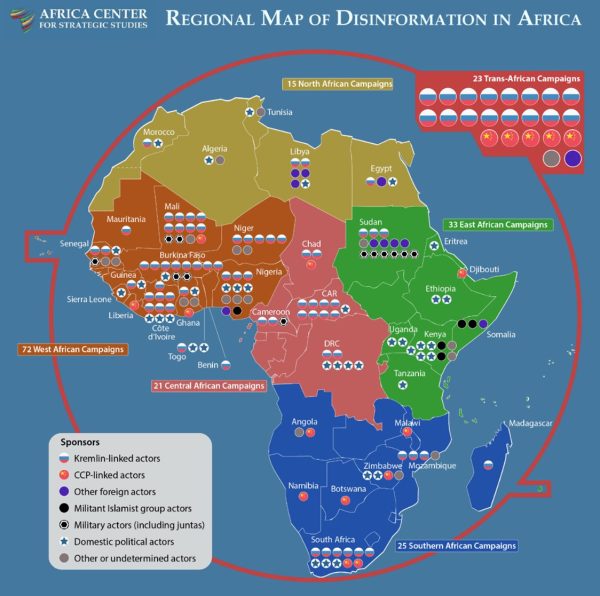
It is worth noting that the study reflects that China has a similar strong focus on South Africa in terms of disinformation and that Beijing, too, mounts ‘trans-Africa’ campaigns.
But Russia remains the single largest sponsor of Africa-wide disinformation campaigns.
ACSS describes the focus of the Russian South Africa message thus: ‘Russia has been the primary disinformation actor in South Africa. In addition to pushing narratives intended to polarise communities, fan distrust, and bolster the African National Congress, Russia has used influential South Africans to promote pro-Russian narratives within South Africa and abroad.’
The great weakness in the Russian position, massively exacerbated since the start of the all-out phase of its war in Ukraine in 2022, is that Russia simply lacks the economic might and resources that its competitors are deploying as part of their African expansionist strategies. America, Turkey, China and the Gulf states comparatively have no such weakness.
It is not surprising, therefore, given the BRICS interests and South Africa’s relative sophistication, along with legacy ANC links, proven levels of government corruption, and its relatively open media environment, that much Russian action focuses on South Africa. Unlike much of the rest of Africa, South Africa does not offer Russia a real opportunity through military support or financial and economic assistance.
In a country like the Central African Republic or Burkina Faso, for instance, Russia could, with limited materiel and financial assistance, immediately capture the attention and goodwill of the government and people as well as shore up the leader’s hold on power. South Africa has no insurgency or military emergency, and its military is, inasmuch as it is functional, oriented to NATO-standard technology. There is no existential threat to an ANC government (so far) that Russia might plug. Economically, despite attempts to gain significant footholds via the nuclear power sector, and more recently the Mossel Bay PetroSA GTL refinery, Russia has neither the means nor apparently the will to ‘pay upfront’, and hence such initiatives have been stillborn. The long-running Ukraine war and international sanctions have further eroded Russia’s capabilities, if not its adventurism in search of allies.
Even so, remarkably, the ANC has managed to elevate China and Russia above the foreign policy interests of the United States, which has over 600 corporations represented and invested in South Africa, employing over 220,000 South Africans.
The beauty of Russian interference is that they win either way. If they capture the elite of a country they can syphon resources and entrench themselves (CAR). If on the other hand they fail to ensure the life of the host they are parasitic of (such as in Mali) they also win: a crumbled failed state is a problem for its neighbours and for Europe, via migration, terrorism, and general destabilisation. Collapse is thus weaponised, not least since Europe needs to invest a lot more resources to keep it together than Russia needs to rip it apart.
That much is true of South Africa as well. Russia wins if it can support the ANC to run a successful South Africa, with weight and influence in Africa and beyond. But it also wins if South Africa collapses, pulling down Zimbabwe, Mozambique and others, and pulling south the line that divides Africa as a migration watershed. This drives more Africans towards Europe, where Russia simultaneously runs campaigns to stoke up anti-migration sentiments, and finances populist right-wing parties that feed on those sentiments.
Russia only ‘loses’ in the event of a successful South Africa run by an elite it hasn’t captured, that is, a DA-led government. It is Moscow’s African nightmare, and one they will invest a lot to avoid.
Without the necessary financial wherewithal and with its military prestige severely dented, Russia’s strategic advantages lie in diplomacy, political goodwill, and its overt and covert influence programmes.
6. Conclusion: Facing the Threat
In every generation, democracy faces new threats. Russia’s war in Ukraine is the first in Europe since 1945, a fully-fledged conventional war with millions of casualties in a war that has endured longer than the Soviet involvement in the Second World War. The Gaza conflict, sparked by the 7 October attacks on Israel, illustrates the prosaic fault-lines that still exist, putting conflict resolution and mediation efforts on the back foot. The actions against Iran led by the US and Israel only heighten these differences and yet, paradoxically, reinforce the importance of democracy and the integrity of the fourth estate.
Disinformation is not merely about lies. It is about eroding the shared reality that democracy depends on. When voters cannot distinguish fact from fiction, inevitably trust in free and fair elections declines, institutions and political parties are delegitimised, public debate becomes polarising and divisive, and rational decision-making is replaced by emotional reaction.
Such scenes correspond with the two decades of democratic regression globally. After the rapid increase in democracies following the end of the Cold War, the promise of a new, more stable world order seems a distant dream for many, including the more than 9 out of every ten Africans – amounting to 1.4 billion people — who live under various forms of authoritarianism elsewhere in the continent.
It follows that one of the most imminent dangers is not tanks on the streets or coups in parliament, but the quiet manipulation of truth on our screens. Disinformation, fake news, and coordinated social media campaigns have become a powerful tool of influence, risking the distortion of public opinion and undermining democracy.
The documents now in the news show us that South Africa is not immune.
The digital age has empowered individuals and democrats fighting against state-controls and censorship. But it has at least equally empowered authoritarians who seek to maintain these systems, who are less constrained by legal norms and social niceties.
While the methods of disinformation and division may not be new, the barriers to entry for influencers have never been so low and their aims so transparent. This should concern every South African voter who wants to vote on the issues facing the country, not someone else’s agenda.
If left unchecked, disinformation does something deeply corrosive: it replaces democratic choice with engineered perception.
A country like South Africa offers a particularly fertile environment for manipulation. High levels of digital engagement among the youth contrast with deep socio-economic frustrations and a vibrant but contested political legacy and landscape.
The greatest danger is not that voters are persuaded by a single lie, but that they become cynical about all truth. When citizens lose faith in facts, they lose faith in democracy itself.
Propaganda and disinformation do not aim to convince. They aim to exhaust.
Countering fake news is difficult. Debunking after the fact doesn’t work; the rumour is already on the mill. Pre-bunking is very difficult since one cannot predict the future, at least with any accuracy. But there are tools that permit one to detect Russian state‑media content laundering, which are capable of flagging duplicate content and amplification across the web to warn audiences before propaganda gains wider reach.
Deterrence, in the form of a forceful response against Russian assets in the country, could work in raising the cost of these campaigns beyond its usefulness. But the ANC is obviously not going to do that.
One of the problems in dealing with this form of interference is that, given that they work through existing political power structures, it’s hard to do more than call them out unless they do something egregious.
For its part, the DA – and other liberal-minded African oppositions – will have to monitor these campaigns, recognise them before they take root, and react in real time. Collaboration on this threat to democracy between oppositions across sub-Saharan Africa could not only create a measure of solidarity but also enable economies of scale.
Identifying and countering the spread and impact of Russian-type foreign influence and disinformation campaigns and projects would normally fall to the national intelligence and counter-intelligence agencies. This, however, generally only works in countries where such agencies have the necessary sophistication, funding, and independence from political interference to allow them to do so.
As one expert interviewed in the preparation of this report has put it:
The cyber posture in South Africa has historically been under-resourced, I think, and deprioritised, potentially increasing vulnerability to both cybercrime and state-linked operations. In other words, I think the argument is that South Africa is vulnerable to a sort of cyberattack. We have seen that Transnet had many attacks, as well as many other state-owned enterprises, and there is also evidence that some of these state-owned enterprises have actually had to pay a bribe eventually to get access to their own information and data. But usually, state security is involved in checking that stuff out. They are aware of it. But because South Africa’s state security is so destroyed, so dilapidated, so fragmented and perhaps even biased, the likeliness of them investigating absent … Parties like the DA, identified as enemies of Russia, need to have some serious cybersecurity programmes, if the GRU gets into their systems and feeds into the disinformation channels, it will be a fiasco.
For the DA, a compelling argument exists that it cannot rely on such state ‘protection’. There are grave questions about the professional capabilities of the South African agencies, in terms of technical ability, funding and personnel expertise. Added to that is the fact that South African agencies are heavily political and many in their leadership may not be inclined to act in defence of the DA (albeit that they should be acting in defence of democracy in general). And then there is the unknown factor of the degree to which Russian intelligence has penetrated and compromised key personnel in those agencies.
This means the DA would need to ‘go it alone’ in both protecting itself against Russian penetration and disinformation, as well as identifying and countering the amorphous and international spiderwebs of the Russian agencies.
Until now the DA’s role in the Government of National Unity has been driven by the belief that improvements in key areas of government – and in particular the six ministries that it heads – will change sufficiently the character of governance that the DA will benefit through the wider recognition of its role. While coalition politics may be the likely future in South Africa, with no party seemingly set on achieving a 50% threshold, this may not be enough to alter the ANC’s historic trajectory over the last three decades of rule: of increasingly blatant rent-seeking and a deterioration in basic services. Moreover, it is unlikely that the creation of centres of excellence in a few meritocratic ministries can turn the tide in a sea of entitlement. The DA and ANC remain at either ends of the political governance spectrum, and there are other more populist alternatives in the next election to the DA as a partner to the ANC, specifically Zuma’s MK Party and the Economic Freedom Fighters (EFF) of Julius Malema.
A cyber capability for opposition parties would have to create systems of early detection and intelligence on both malevolent actors and their narratives, understanding target audiences and managing a strategic online presence both systematically and through carefully-selected content. It also requires a heightened cyber-security capacity along with the cognitive aspect.
And this requires an active campaign to highlight the risk of interference, the importance of voter judgement, and the sanctity and integrity of key electoral institutions. Defending democracy has to become the responsibility of every citizen with a smartphone.
