

Police lawyer Markus Laine holds a Master of Laws degree from the University of Turku (2007). Laine serves as the head of legal affairs at the Southwestern Finland Police Department, where he is responsible for the police department’s legal sector. His extensive professional background includes experience in criminal investigation and criminal intelligence within the Southwestern Finland Police Department, the National Bureau of Investigation (NBI), and Finnish Customs. Laine specializes in the statutory powers of authorities during states of emergency and, in particular, the role of internal security authorities in countering threats within a shifting operating environment.
The views expressed in this article are solely those of the author and do not necessarily reflect the official policy or position of any government agency or authority.
Abstract
The internal security objectives of Prime Minister Petteri Orpo’s Government Programme center on strengthening crime prevention. According to the Government Programme, policing capabilities and the protection of internal security will be bolstered by enacting legislation that enables police criminal intelligence operations. Objectives concerning police information collection have also been incorporated into several government reports on security policy. The Ministry of the Interior has drafted a government proposal to Parliament for legislation governing criminal intelligence. This draft proposal strengthens the police’s capability to collect information before threats materialize into offenses, enabling the initiation of covert information collection prior to any concrete criminal suspicion if serious crime threatens the security of an individual or society.
In addition to internal security, the proposal has significant implications for ensuring Finland’s national security. Within the contemporary security environment, broad-spectrum influence operations conducted by foreign states can manifest in the form of criminal activity. For instance, sabotage targeting critical infrastructure is a characteristic national security threat that is countered through criminal procedure mechanisms. The proposed legislation would remedy authority-specific gaps in statutory information collection powers and, for its part, secure access to information in ambiguous situations threatening internal or national security.
1. Introduction
Intelligence refers to the acquisition of information from both public and non-public sources, aimed at mapping and increasing the understanding of the subject under investigation. Intelligence may target a narrowly defined intelligence question, or it can be more general in nature, focusing, for instance, on a phenomenon or the activities of a specific actor. Intelligence produces information that enables decision-makers and authorities to implement the measures required by a given threat. Information obtained through intelligence alone is often insufficient; therefore, the effectiveness of intelligence requires further processing of the data, such as analysis and the drawing of conclusions. The analytical products and conclusions generated on the basis of intelligence data serve as one of the foundations for decision-making by decision-makers, such as the state leadership.
Criminal intelligence refers to the acquisition of information regarding crime and criminal activity, and the analysis of the acquired data for the purpose of crime prevention. Intelligence produces information that enables intervention in, as well as preparation for, threats, risks, opportunities, and changes. The criminal intelligence activities of the police are linked to crime prevention, the generation of analyzed situational awareness regarding crime, and the collection of early-stage information to obtain a comprehensive overview of crime situations and threats. Legislation requires police operations to anticipate and prevent threats; thus, effective intervention and prevention naturally demand efficient methods of information acquisition, analyzed data, and situational awareness, on the basis of which police operations can be directed effectively and in an intelligence-led manner. Effective intelligence-led operations also have significant cost-reducing effects.
The reform of Finnish intelligence powers can be considered to have commenced in January 2013, when the Finnish Government issued a resolution on the Cyber Security Strategy, which was based on regulating the powers of the Finnish Defence Forces in signals intelligence. The legislative projects concerning the intelligence sector were recorded in Prime Minister Juha Sipilä’s Government Programme, leading the Ministry of the Interior and the Ministry of Defence to appoint working groups in 2015 to prepare legislative packages for civilian and military intelligence.The preparation regarding the oversight of intelligence laws and constitutional regulation was carried out by the Ministry of Justice. The model for the parliamentary oversight of intelligence was prepared by the Office of the Parliament. Despite the extensive scope of the reform, the legislative work related to the intelligence laws progressed quite rapidly, and the series of legislative amendments commenced in Parliament in 2018 with an amendment to the Constitution of Finland. The actual legislative packages concerning intelligence were subsequently processed such that the substantive legislation was unanimously approved by Parliament on 11 March 2019. The Acts on Civilian and Military Intelligence entered into force on 1 June 2019.
The Finnish military and civilian intelligence legislation recently marked its seventh anniversary. This legislation entered into force prior to the intense and rapid transformation of society’s security environment. The shift in the operating environment has been unprecedentedly swift, affecting not only external but also internal security. According to the Government Report on Internal Security, the objective of internal security policy is to ensure that Finland remains a society based on trust, where security and justice are realized under all circumstances.Profound and rapid changes in external security also reverberate through internal security. In a complex operating environment, it is worth noting that countering external security threats is often carried out in the first instance through the powers and resources of internal security actors. Examples of this include the damage to critical infrastructure in the Gulf of Finland, the countering of drones that have strayed into Finnish airspace, and instrumentalized migration. In all the aforementioned threats, which have a direct nexus to national security, the police and the Finnish Border Guard have served as the primary competent authorities.
Finland’s internal security authorities, particularly the police and the Finnish Border Guard, play a significant role in countering external threats that cannot be directly interpreted as military in nature. However, their significance should not be overlooked even in clearly military threats, where the police often serve as the first responder. While the police must not become a party to hostilities, they maintain a duty under all circumstances to ensure public order and security, as well as to protect the lives and health of citizens. With the rise of hybrid warfare, it is increasingly vital that authorities possess the capacity and prerequisites to operate in all types of situations, even those that are highly unpredictable.
The diversity of new threat vectors requires sufficient methods of information acquisition under all circumstances, not exclusively in situations that unambiguously fall within the domain of civilian or military intelligence. For instance, hybrid warfare can manifest in the form of serious or organized crime, in which case countering the threat falls primarily to the police. Various forms of information influence activities can express themselves as criminal conduct. Sabotage targeting critical infrastructure is often investigated within a criminal framework. Consequently, providing the police with threat-based criminal intelligence powers would enhance society’s capacity to counter serious threats directed at individuals or societal security—threats which, if realized, would manifest as serious criminality, or even as a threat to national security. State actors have already been observed utilizing organized crime as part of their hybrid warfare strategies. The scope of application for a Criminal Intelligence Act would, on a criminal basis, encompass operations such as various sabotage attacks against critical infrastructure or serious acts of violence, such as assassinations. Organized crime can also operate conspicuously with geopolitical motivations, as has been observed with Russian criminal groups. Threats to critical infrastructure are intrinsically linked to hybrid threats posed by foreign states, and from the perspective of the police, it is a matter of countering these threats through criminal investigation and prevention frameworks. According to the Government Report on Internal Security, the threat directed at critical infrastructure has become more pronounced.
One of the core objectives of Prime Minister Petteri Orpo’s Government Programme is the strengthening of crime prevention. According to the Government Programme, policing and the protection of internal security will be reinforced by introducing legislation that enables criminal intelligence activities by the police. In 2023, the Ministry of the Interior appointed a project to prepare legislation concerning the criminal intelligence operations of the police. In February 2026, the Ministry of the Interior dispatched a draft Government Proposal for legislation on police criminal intelligence for consultation. According to Finland’s National Security Strategy, Finland develops its intelligence capabilities and legislation to better respond to the increased demands and changes in the operating environment through accurate and timely intelligence data. This objective is significantly supported by the enactment of the police criminal intelligence legislation. The Finnish Border Guard is likewise preparing its own criminal intelligence legislation, and the draft Government Proposal regarding this legislation was sent out for consultation in May.
The figure below provides a summarized presentation of the scopes of application for civilian and military intelligence, as well as the proposed criminal intelligence of the police.
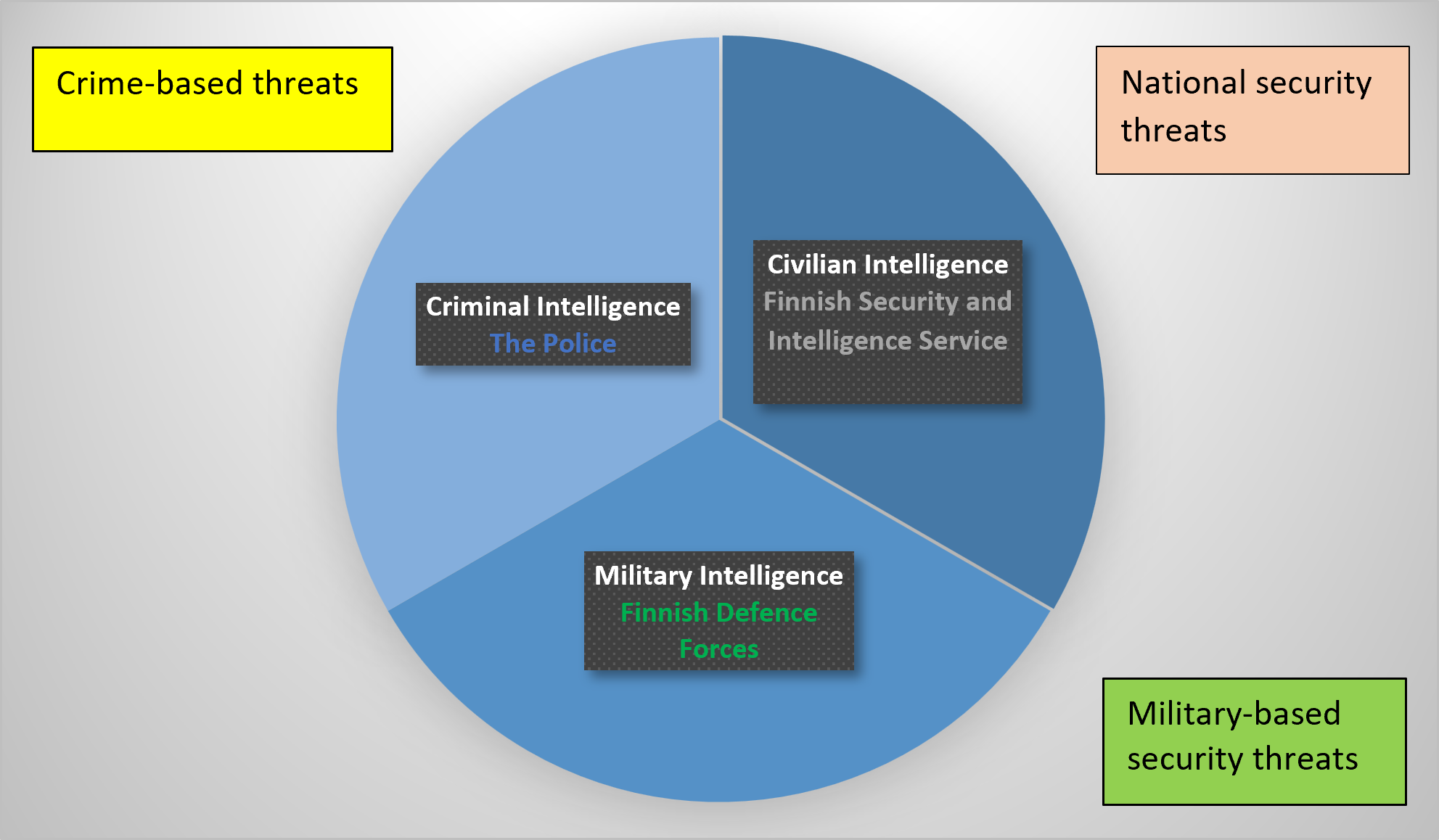
Figure 1: The Finnish Security and Intelligence Service and the Finnish Defence Forces operate as the designated intelligence authorities under the law. The criminal intelligence powers of the police would be strictly limited to threat-based intelligence targeting criminal activity.
2. Changes in the security environment
According to the National Police Board, a significant transformation in the operating environment of the police has occurred over recent decades regarding the most serious forms of criminality. This change has been driven, among other factors, by international developments, technological advancements, and digitalization. The severity of organized crime activities has escalated, operations have internationalized, and violent operational models have become more prevalent. Street gang criminality, particularly Swedish gang criminality and its associated “crime as a service” and “violence as a service” operational models, has infiltrated Finland in recent years. Extreme manifestations of violence have become more common, and serious acts of violence in educational institutions have occurred or been prepared at an accelerating pace in Finland.
The external security environment of Europe and Finland underwent a fundamental and abrupt transformation in 2022, as warfare returned to Europe with Russia’s military actions against Ukraine. This offensive was a continuation of Russian military actions in Crimea and Eastern Ukraine that had already commenced in 2014. According to the Government’s Defence Report published in 2024, the defensive operating environment is unstable and difficult to predict, and the security situation can deteriorate rapidly. The report states that changes in the security environment manifest particularly as broad-ranging hybrid influence activities. Finland is located on the eastern border of the military alliance NATO, occupying a geostrategically significant position between the Arctic region and the Baltic Sea.
The primary objective of Finland’s foreign and security policy is to safeguard Finland’s independence and territorial integrity, prevent Finland from becoming embroiled in a military conflict, and guarantee the security and well-being of the population. Consequent to the illegal war of aggression initiated by Russia, it has simultaneously shifted toward a more overt, long-term, and unpredictable confrontation with Western nations. From the perspective of internal security authorities, it is particularly noteworthy that Russia’s hostile hybrid operations, such as sabotage, have also targeted other parts of Europe. Russia’s high risk tolerance introduces broad-ranging instability across various dimensions of security, including national security. The methods employed in Russia’s hybrid operations are extensive, and the threshold for their deployment is lower than for actions that would trigger an actual military conflict. Hybrid operations are executed to undermine the target country’s cohesion, manipulate its decision-making and public opinion, and intensify polarization. Prolonged conflicts globally also fuel terrorism and extremism, creating new threats not only within Europe but also inside Finland. Hybrid influence activities directed at Finland by Russia have increased significantly. Terrorism can be considered one of the core threats to national security, and it can also be exploited within the hostile operations of state actors. According to the Finnish Security and Intelligence Service, the threat of terrorism in Finland stands at level three on a five-tier scale, which denotes an elevated threat. However, according to Security Intelligent Services assessment, the most likely threat of an attack is posed by radical Islamist or far-right actors, rather than state actors.
The Baltic Sea region can be considered an interest of paramount importance for Finland’s security. Conflicts and disruptions in the Baltic Sea would significantly impact Finland’s commercial maritime shipping and pose a concrete threat to Finland’s critical infrastructure. These, in turn, would have severe repercussions for the functioning and resilience of Finnish society as a whole. National security can be significantly jeopardized in operations targeting critical infrastructure or the security of supply, as well as during other disruptions affecting them. Furthermore, the geostrategically significant position of the demilitarized Åland Islands in the Baltic Sea is a noteworthy factor, particularly from the perspective that preparing for military escalation is restricted within the region.
According to the Government Report on Internal Security published in 2025, the most important objective of Finland’s internal security policy is to ensure that Finland remains a society based on trust, where security and justice are realized under all circumstances. The societal attributes protected under internal security include, among others, the prevention of crime, disruptions, accidents, and comparable events. According to the report, the internal security situation is currently considered stable; however, the fundamental and long-term transformation of the security environment, particularly due to Russia’s war of aggression, may undermine this stability. The report states that internal security authorities serve as a key first responder even in those external security threats that are non-military. From the perspective of increased broad-ranging hybrid influence, it is vital that authorities possess the capacity to operate in all types of situations, including those that are difficult to predict—this also requires internal security authorities to prepare for the possibility of military conflict and to identify its weak signals. Furthermore, the availability of operational capabilities in unforeseen situations is of vital importance.
According to the National Security Strategy published by the Government in 2026, increased threats to national security and the heightened international tension have led to national security being integrated more systematically into the work of ministries and authorities than before. The strategy states that in ensuring national security, the objective is to place particular emphasis on strategic tasks in situations where national self-determination, freedom of action, or the vital conditions of life for citizens are threatened. The core interests of national security are defined as the security and well-being of the nation, the continuity of the state, state sovereignty and territorial integrity, a democratic system of government and the rule of law, as well as societal stability.
According to the National Security Strategy, authorities counter criminality that jeopardizes the social order in a systematic and effective manner, utilizing a broad spectrum of measures. Authorities maintain a high state of operational readiness to respond to changes in the security situation. Transformations in the security environment necessitate measures to prepare for countering diverse and exceptional hybrid operations, such as actions targeting critical infrastructure. As part of this preparedness, the Government has transitioned to a continuous threat assessment model and enhanced the comprehensive coordination of security threats and information acquisition.
These changes also demand the development of statutory powers for authorities to ensure that the competent authority in each instance possesses clear, sufficient, and timely powers to respond swiftly to shifts in the operating environment. Particular attention has been directed toward preparedness related to hybrid operations in maritime areas. According to the strategy, the resilience of critical infrastructure must be enhanced, as state-sponsored hybrid influence, sabotage, and increased intelligence activities pose a threat to both the public and private sectors.
In summary, regarding the transformations in the security environment, emphasis must be placed on the rapid evolution and unpredictability of the security situation, the high expectations imposed on security authorities for immediate responses to novel types of threats, and the necessity of maintaining an adequate level of operational capability and statutory powers across different authorities. Throughout the various strategies, a clear emphasis on the concept of comprehensive security is discernible, alongside the realization that the diversity and unforeseen nature of threats demand that internal security actors also possess the preparedness to counter external security threats.
Evaluated against this backdrop, it is justified for authorities to possess partially overlapping statutory powers in functional areas that, depending on the situation, may fall under the responsibility of different authorities or be addressed through mutual cooperation. Particularly regarding hybrid operations, threats targeting critical infrastructure and the heightened obligation for inter-agency cooperation to prevent and counter them are underscored. In addition to the police, the Finnish Defence Forces and the Finnish Border Guard serve as the pivotal institutional actors in these tasks.
3. Intelligence Methods for Threat Detection
Information collection is an activity driven by the consumers of intelligence. Within the framework of Finland’s current intelligence legislation, the primary consumers of intelligence are—in addition to the state leadership—designated authorities, most notably the Finnish Defence Forces. Collection methods constitute one component of the broader intelligence cycle, and their purpose is to generate data for the intelligence process to support analysis and ultimate decision-making. Within the framework of this article, the primary purpose of intelligence is seen as acquiring foreknowledge of a threat that, if realized, would jeopardize Finland’s national security, such as sabotage targeting critical infrastructure.
The figure below illustrates the intelligence cycle, wherein information acquired through operational collection is analyzed and integrated into the decision-making process.
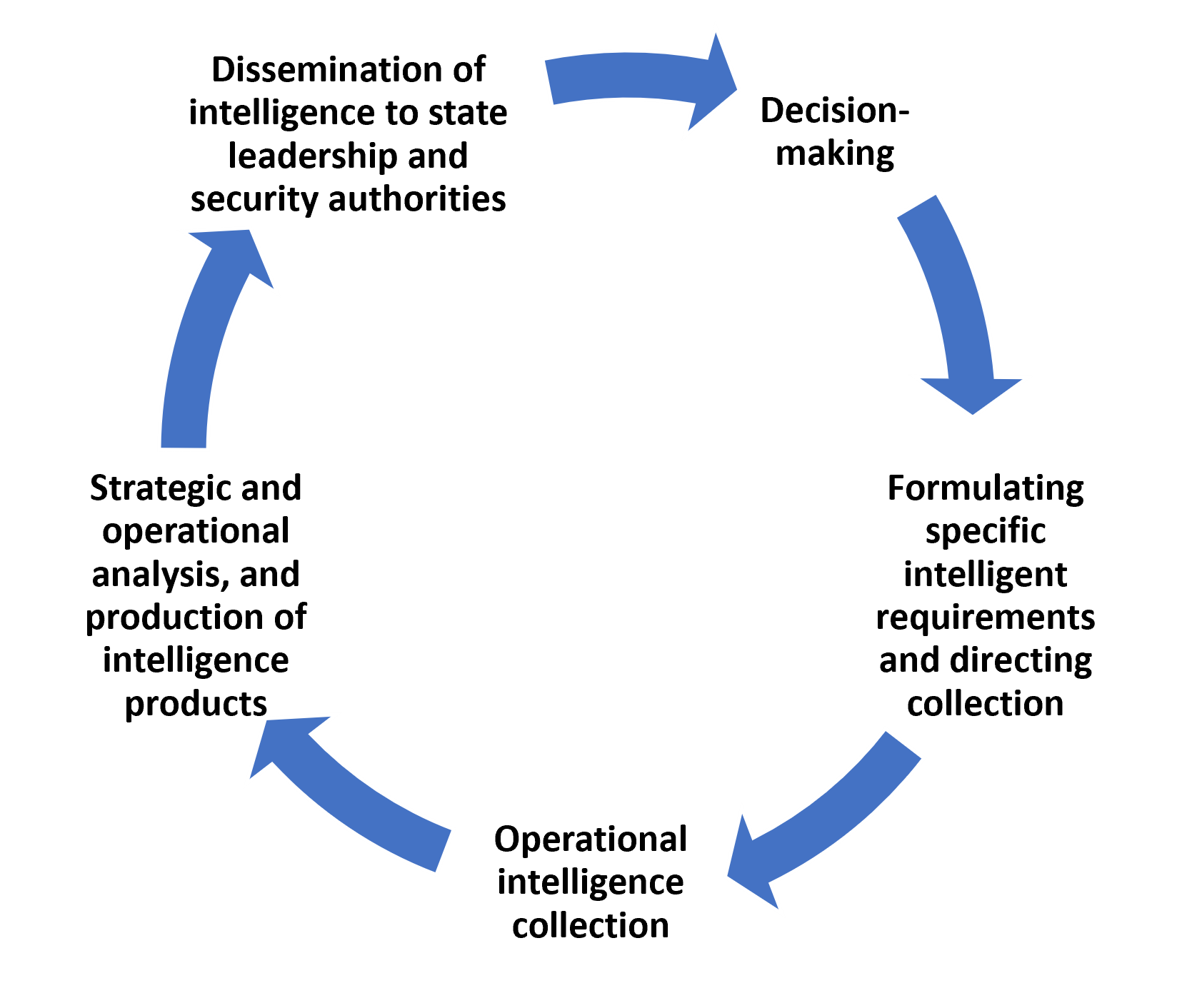
Figure 2: The intelligence cycle.
Operational intelligence collection can be implemented through various methods, and these methods often complement one another. In international research, intelligence collection disciplines are traditionally divided into the following five categories:
- Open-Source Intelligence (OSINT)
- Signals Intelligence (SIGINT)
- Human Intelligence (HUMINT)
- Geospatial Intelligence (GEOINT)
- Measurement and Signature Intelligence (MASINT)
However, when examining the conceptualization of intelligence disciplines in the light of Finnish national legislation, it is expedient to categorize the methods differently from the aforementioned international model1. Based on current legislation, intelligence methods can be divided into:
- Open-source intelligence
- Human intelligence
- Technical intelligence
- Signals intelligence
- Network intelligence / Telecommunications intelligence
- Geospatial intelligence
- Intelligence by means of reproduction / copying
Open-source intelligence refers to information collection that can, in principle, be conducted using data available to anyone. Open sources include, for example, social media channels and other information accessible online without the need for specialized technical measures.
Human intelligence encompasses methods based on surveillance or interpersonal interaction, such as physical surveillance, undercover operations, and confidential source operations (informant handling).
Technical intelligence refers to intelligence conducted using technical devices. These methods include, for example, technical interception (audio), technical viewing (video), and technical tracking, where a device is placed in a space or location from which observations can be made.
Signals intelligence entails, for example, radio signals intelligence or communications intelligence targeted at telecommunications networks or radio waves.
Telecommunications intelligence refers to various forms of data collection directed at a telecommunications terminal device or subscription, such as telecommunications interception (wiretapping) or telecommunications monitoring.
Geospatial intelligence involves, for example, imagery intelligence or geospatial analysis used to acquire information regarding the prevailing conditions in a specified location.
Intelligence by means of reproduction occurs when an authority copies documents or other subjects of information collection. This could involve, for example, copying a postal consignment before it is delivered to the recipient.
The aforementioned intelligence methods provide an overview of the mechanisms through which the Finnish Security and Intelligence Service and military intelligence can conduct information collection. It is pertinent to note that, in addition to these specific methods, there are numerous other means of acquiring necessary intelligence data. Most significant among these are information exchange with international partners and the retrieval of data from registers maintained by other authorities for different purposes. Furthermore, several intelligence methods are utilized that are not explicitly mentioned at a methodological level in official public documents and can be executed without explicit statutory authorization. Examples of such methods include hydrological and acoustic sensor surveillance.
The Criminal Intelligence Act currently under preparation for the police would be based on a considerably more restricted spectrum of methods than presented above. According to legislative drafting documents, criminal intelligence by the police could only be executed using the following specific methods of human intelligence, telecommunications intelligence, and technical intelligence:
- Systematic surveillance
- Covert information collection
- Technical viewing
- Technical tracking
- Acquisition of identification data of a telecommunications address or terminal device
- Undercover operations
- Simulated purchase
- Controlled delivery
- Directed confidential source operations
It is particularly noteworthy that criminal intelligence by the police would completely lack the competence to utilize, for instance, communications intelligence methods, which occupied center stage, at least in public discourse, during the drafting of the general intelligence legislation.
____________________
1 See further Lohse & al. 2019: Tiedustelumenetelmät. This more nuanced systematization aims to present the international classification of intelligence disciplines in a manner that reflects the specific additions within Finland’s spectrum of intelligence methods compared to the international division.
4. Targets of Intelligence and the Scope of Application for Methods
In legislation, nine distinct threat-based criteria have been defined as the targets of military intelligence activities, against which military intelligence may be directed, provided that the nature of the threats is military. These threats include, for example, intelligence activities targeted at Finland’s national defense, the organization of foreign military forces, the proliferation or manufacturing of weapons of mass destruction, activities threatening the security of an international crisis management operation, and actions that seriously jeopardize Finland’s national defense.
In legislation, 11 distinct threats to national security have been defined as the targets of civilian intelligence activities. These include, for example, terrorism, foreign intelligence activities (espionage), international organized crime threatening the social order, and activities threatening the democratic system of society. Consequently, these threats are predominantly non-military in nature.
Although the majority of the aforementioned targets of intelligence fall exclusively within the scope of application of either military or civilian intelligence, certain targets are of such a nature that they can be subjected to measures utilizing both military and civilian intelligence powers. Consequently, all 20 intelligence targets can be categorized as falling exclusively under either military or civilian intelligence, or within a zone of so-called shared competence. An example of a target of shared competence is activity threatening the security of an international crisis management operation, regarding which intelligence may be conducted by both the Finnish Security and Intelligence Service and the Finnish Defence Forces. The general rule, however, remains that military intelligence powers are employed solely to counter military threats, whereas civilian intelligence powers are directed against threats to national security—notwithstanding that threats to national security may also manifest in a military form.
In comparison to military and civilian intelligence, criminal intelligence by the police would legally occupy a largely distinct and separate field of operation, and its targets would be explicitly linked to the prevention and deterrence of crimes. In practice, this refers to preventing acts criminalized under the Criminal Code, but also to deterring nascent criminal phenomena and acts that threaten national security. The scope of application for criminal intelligence encompasses crimes that can simultaneously constitute threats to national security. Examples of these include sabotage targeting critical infrastructure or, conversely, criminal activities conducted by an organized crime group on behalf of a foreign state that concurrently threaten national security.
As delineated above, the intelligence mandates of various authorities partially overlap. This convergence reinforces the operational capabilities of authorities in ambiguous situations where multiple agencies share overlapping responsibilities for threat mitigation; furthermore, it ensures the timeliness of actions taken by the responsible authority in rapidly evolving scenarios. A certain degree of overlap among the different dimensions of intelligence operations is justified to prevent the emergence of blind spots detrimental to comprehensive security—whether in terms of institutional mandates or statutory powers. It remains paramount that ambiguities or potential deficiencies in statutory authority never manifest as barriers or impediments to effective counter-measures.
Even if an intelligence method has been deployed exclusively under the statutory authority of a specific agency, it is possible under designated circumstances to transfer the information obtained through that method to another authority. In accordance with the purpose limitation principle, civilian and military intelligence methods may only be utilized for civilian and military intelligence purposes—namely, for collecting information on activities that seriously threaten external and national security. However, legislation provides an exception that allows the transfer of information to a pre-trial investigation authority in specific, strictly defined situations. In practice, this means, for instance, sharing information obtained through civilian intelligence methods with the police if a serious crime has been uncovered via the intelligence method. The intelligence authority may transfer information on its own initiative if a sufficiently serious crime is revealed during an intelligence operation. Alternatively, the police may request information from the intelligence authority if the crime was already previously known. Regarding firewall regulation, it must be emphasized that it cannot be used to expand the statutory powers of the police; rather, it is intended solely for those narrowly defined situations where introducing the information into the criminal justice process is societally imperative. The police’s own Criminal Intelligence Act would not, per se, affect the application of the firewall provision, but it would in certain situations enable the police to deploy intelligence methods independently, whereby firewall regulations or information secrecy would not form a barrier to information transfer.
5. The Need for Intelligence Legislation in a Changing Operating Environment
According to a generally accepted definition, criminal intelligence aims to achieve:
- The prevention of the most serious crimes and other severe disruptions to internal security;
- Comprehensive general situational awareness regarding the operating environment and phenomena of crime prevention, serving as a foundation for strategic and operational analysis as well as decision-making; and
- Information to guide police operations and to ensure the expedient allocation of resources.
Within the operational framework of foreign state threats generated by the changing operating environment, the inter-agency cooperation among the Finnish Defence Forces, the police, and the Finnish Border Guard is particularly emphasized. An adequate national response can be established through the joint efforts of these and other pivotal stakeholders, wherein each authority participates in task execution in a role aligned with its respective statutory powers and institutional mandates.
The current statutory powers of the police regarding criminal intelligence are enacted in the Police Act, and they share a common feature: they can be applied exclusively through a person- and offense-specific approach. If the police do not possess knowledge of a specified crime or a designated suspect, the currently available spectrum of police information collection methods is, in principle, unavailable. In this context, it must be emphasized that these police information collection powers do not refer to the intelligence mandates of the Finnish Security and Intelligence Service, which entered into force in 2019. As delineated above, the objective of the civilian intelligence legislation utilized by Finnish Security and Intelligence Service is to protect Finnish society against severe threats targeting national security. Such threats include, for instance, espionage directed at Finland by foreign states, terrorism, the crippling of critical infrastructure, or the proliferation of weapons of mass destruction. However, if an imminent threat does not fall within the narrowly defined scope of civilian intelligence, and yet from the perspective of a pre-trial investigation, the threat is not sufficiently concrete or identifiable, significant barriers to information collection by authorities emerge.
As stated above, the police currently lack the statutory authority for the preemptive mitigation of threats using covert information collection methods, unless they possess a suspicion of a crime that is sufficiently specified and meets the elements of a criminal offense. The necessary elements to substantiate such a suspicion include, for instance, the location and time of the offense, the suspected individual, the specific criminal charge, and the potential victim or complainant.
Consequently, the most significant challenges in criminal intelligence relate to the fact that covert information collection measures cannot be deployed in cases where, for example, a specific group is suspected of committing serious crimes, but the police lack sufficiently detailed information regarding the type of crime, the modus operandi, or where and how the offense will be executed. From the perspective of a security authority, the situation is problematic if the police have reason to suspect that the group poses a significant threat to internal or national security, yet not a single member of the group is subject to a concrete criminal suspicion that would legally permit the initiation of measures—namely, information collection.
Within the framework of criminal intelligence, a threat refers to a potentially manifesting harmful event or course of development which, if realized, would satisfy the statutory elements of a crime. At a phenomenal level, this could mean, for instance, that authorities have indications of a criminal group—which has caused severe societal disruptions abroad—establishing a presence in Finland, and indications or weak signals of the criminal phenomena generated by this group are detected in Finland as well, yet at this stage without any concrete evidence of the preparation of a specific crime.
From the perspective of national security, it is pivotal to understand that the boundary between internal and external security has become increasingly blurred. Hostile actions by a foreign state are frequently preceded by various forms of sabotage, terrorism, assassinations, information operations, or the destabilization of the social order. Any of the aforementioned state-sponsored operations can be executed by criminal actors or disguised to appear as such. Although the primary purpose of the threat-based information collection within police criminal intelligence is to generate data to support decision-making and direct operations related to crime prevention and the situational awareness of criminality, it can also be seen as playing a critical role in the current security environment by safeguarding national security and countering detrimental actions directed against it. The partially overlapping statutory powers among criminal intelligence, civilian intelligence conducted by the Finnish Security and Intelligence Service, and military intelligence further reinforce deterrence against, for instance, terrorism as well as intelligence and sabotage activities targeting critical infrastructure.
Criminal intelligence by the police refers to the collection of information on serious criminality that poses a severe threat to the security of an individual or society, as well as the utilization of such information to mitigate the threat. According to the draft legislative proposal, the target of criminal intelligence is organized crime that severely threatens the security of individuals or society.
In addition, the target of criminal intelligence is serious criminality that severely threatens the security of an individual or society, and which:
- Constitutes a significant threat through its effects on the public economy, the functioning of the financial and insurance systems, or critical infrastructure;
- Threatens the life or health of a large number of people;
- Constitutes a large-scale threat to the environment through its effects;
- Threatens the fundamental functions of the rule of law; or
- Threatens public order and security on a large scale.
The methods of criminal intelligence by the police would encompass systematic surveillance, covert information collection, technical viewing, technical tracking, the acquisition of identification data of a telecommunications address or terminal device, undercover operations, simulated purchases, controlled deliveries, and directed confidential source operations.
The targets of police criminal intelligence would be strictly defined, and the spectrum of available methods considerably more restricted than in civilian and military intelligence. Consequently, the police would not have the authority, for instance, to conduct telecommunications interception on a threat-posing actor or to subject their residence to video surveillance. Nevertheless, this spectrum of methods would deliver significant operational capability to offense-based information collection—above all, by enabling early-stage intervention in hostile activities.
6. Critical Perspectives on the Draft of Criminal Intelligence Legislation
The draft government proposal for the Criminal Intelligence Act was circulated for a round of comments in the spring of 2026. A total of 44 statements were submitted regarding the draft. The substance of these comments was somewhat polarized; in particular, non-governmental organizations and interest groups approached the legislative proposal with caution or even criticism. The feedback highlights a general skepticism toward expanding police powers and the broader collection of citizens’ personal data through new mechanisms. Furthermore, the covert nature of these powers and the broad scope of application for the methods raised concerns among the respondents. Statements from legal professionals and judicial actors emphasized factors related to legislative drafting, the constitutional procedure for enacting laws, and the establishment of adequate, sufficiently comprehensive independent oversight.
Electronic Frontier Finland (Effi ry), an organization promoting the realization of fundamental rights and democracy in the digital world, states in its opinion that the proposal represents a step toward the arbitrary exercise of police power, thereby weakening Finland’s status as a constitutional state governed by the rule of law.
Representing the legal profession, the Finnish Bar Association points out in its statement that activities involving the collection of information outside actual pre-trial investigations have already occurred under the current Police Act. In the contemporary setting—where the collection, classification, storage, and use of police information outside the frameworks of civilian and military intelligence are not regulated by dedicated criminal intelligence legislation—there is a lack of full transparency regarding the precise methods deployed in intelligence-type operations and how decisions concerning these actions are formulated. Nevertheless, the Bar Association acknowledges that the draft proposal to enable threat-based information collection is comprehensible, and there are no grounds to dispute the depicted threats or the situational awareness as such. The pivotal question raised is whether adapting to these shifts requires an expansion of intelligence-type powers, or whether the issue could be solved more appropriately and effectively by enhancing inter-agency information exchange and cooperation without the necessity of enacting new statutory powers.
According to the statement by Amnesty International Finland, the incremental expansions of police authority enacted through isolated legislative proposals over recent years have obscured the broader trajectory and the cumulative effects of these changes. To clarify the scale and significance of this shift in statutory powers, the amendments, their impacts on fundamental and human rights, and the proportionality of these restrictions should be evaluated comprehensively. Amnesty maintains that the criteria for restricting fundamental rights must be scrutinized more rigorously during further drafting, as the proposed regulation is not sufficiently precise or narrowly tailored, and its proportionality has not been adequately guaranteed. The organization emphasizes that the proposed legislation constitutes a significant encroachment upon fundamental and human rights.
The Finnish Lawyers’ Association representing the Finnish legal community, considers that while the objectives related to developing crime prevention are understandable and partially justified, the draft proposal requires further preparation. During subsequent drafting, the legislative proposal must be refined, particularly regarding the targeting of criminal intelligence, the assessment of impacts on fundamental rights, and the arrangement of oversight and legal remedies. The Association underscores that countering serious crime and protecting fundamental and human rights are not mutually exclusive goals; rather, both are core characteristics of a democratic state under the rule of law.
The Finnish Council of Regulatory Impact Analysis issued its statement to the Ministry of the Interior regarding the legislative proposal for the Criminal Intelligence Act in June 2026. According to the statement, the proposal assesses the impacts of the criminal intelligence legislation reasonably well; however, the cumulative impacts of the numerous proposals concerning security and intelligence should undergo further evaluation. The Council noted that the draft bill itself explicitly highlights connections to multiple other security- and intelligence-related proposals currently under preparation or already being debated in Parliament. Consequently, either within the reviewed proposal or other interrelated draft bills, a comprehensive assessment must be conducted regarding these cumulative impacts—focusing, for instance, on the coordination of inter-agency tasks, institutional resources, and the realization of fundamental rights. The Council recommends that the draft government proposal be amended in accordance with its statement prior to the official submission of the government bill.
7. Conclusions
According to the Ministry of the Interior, the statutory powers provided by criminal intelligence legislation are pivotal, particularly in countering serious crime. These include, for instance, serious narcotics offenses and their associated phenomena, various forms of hybrid threats manifesting as criminality targeted at internal security, and threats that pose a severe danger to the life or health of a large number of people. As the operating environment shifts, the threats posed by criminality have become increasingly severe, multifaceted, and rapidly evolving; consequently, it is imperative to be able to counter them preemptively. This necessitates the initiation of information collection at a significantly earlier stage than currently permitted.
The enactment of the Criminal Intelligence Act for the police is therefore justified by the need to acquire the operational capability required to counter various threats. The current statutory powers and information collection methods of the police do not allow for sufficiently effective and early-stage threat mitigation. When information regarding threats is not obtained early enough, the measures to counter them also remain deficient. These deficiencies manifest not only in the prevention of individual offenses but, above all, in countering nascent criminal phenomena. Currently, the police lack the mechanisms and methods to identify and counter emerging trends. Information is critically needed, particularly for directing police operations and for strategic decision-making in crime prevention. An intelligence-led approach to crime prevention is also economically justified and inherently apt to reduce human suffering by enabling more effective preemptive mitigation of crimes.
The enactment of the Criminal Intelligence Act for the police is therefore justified by the need to acquire the operational capability required to counter various threats. The current statutory powers and information collection methods of the police do not allow for sufficiently effective and early-stage threat mitigation. When information regarding threats is not obtained early enough, the measures to counter them also remain deficient. These deficiencies manifest not only in the prevention of individual offenses but, above all, in countering nascent criminal phenomena. Currently, the police lack the mechanisms and methods to identify and counter emerging trends. Information is critically needed, particularly for directing police operations and for strategic decision-making in crime prevention. An intelligence-led approach to crime prevention is also economically justified and inherently apt to reduce human suffering by enabling more effective preemptive mitigation of crimes.
Although the proposed legislation is fundamentally based on countering criminal threats, it possesses concrete links to the safeguarding of national security. Threats to national security—both internal and external—frequently involve a nexus with criminal activity. A potential threat posed by a foreign state actor in the form of sabotage against critical infrastructure, or espionage targeting it, constitutes not only a national security threat but invariably a criminal offense as well. Consequently, it is often possible to prevent and investigate these threats through pre-trial proceedings.
Another pivotal issue is the partial overlap between the police’s criminal intelligence legislation and, most notably, civilian intelligence legislation. As the Intelligence Ombudsman points out in their statement on the draft government proposal, activities that seriously threaten national defense or national security—which fall under the purview of civilian and military intelligence—and the organized and serious crime targeted by police criminal intelligence would encompass partially overlapping subject matters. This convergence of targets could particularly manifest in activities involving threats from foreign state actors, as well as threats directed at the vital functions of society, the democratic state under the rule of law, and its fundamental rights system.
From the perspective of Finnish national security, the police’s threat-based criminal intelligence legislation would complement the statutory powers utilized to counter threats to national security. According to current assessments, the primary operational scope of the Act would not center on safeguarding national security per se; rather, it would provide authorities with the capability for information collection amidst the threats of a shifting operating environment. The information collection methods of criminal intelligence would not be as extensive as those in civilian and military intelligence; instead, they would consist of existing human and telecommunications intelligence methods already at the disposal of the police. However, the deployment of these methods would no longer be tied to a concrete criminal suspicion, but rather to a threat that could be suspected of evolving into criminal activity in the future. Although the scope of application for these information collection methods would be broader than at present, the targets of criminal intelligence legislation remain, to some extent, invariably linked—albeit indirectly—to the statutory elements of a crime. Consequently, it can be concluded that the scope of this information collection would be significantly more precisely defined than in civilian and military intelligence.
The shifting operating environment and novel threats necessitate a thorough review of the police’s statutory powers regarding information collection. Currently, the police lack sufficient authority to detect and identify all significant threats. This lack of instruments impedes not only the detection of these threats but also the effective direction of police operations. When evaluated in a European context, the resources of Finnish security authorities are modest; therefore, it is vital that these resources are operationally and appropriately allocated. Timely and relevant information plays a pivotal role in ensuring that resources are correctly targeted from the perspective of societal security. Preventing activities that jeopardize security is far more cost-effective than investigating a crime that has already occurred and enduring the resulting damages.
Better and more comprehensive information systematically generates more reasoned decisions and greater effectiveness. The objective of criminal intelligence is to prevent threats—posed by criminality that severely jeopardizes the security of individuals or society—from materializing into severe crimes.
Criminal intelligence does not establish a new mandate for the police, nor does it alter the existing division of duties between different authorities. Within the scope of police responsibilities, criminal intelligence remains inherently linked to crime prevention. The mandate of the Finnish Security and Intelligence Service continues to focus on countering threats to national security. The proposed legislation would complement the comprehensiveness of information collection across authorities, eliminate existing regulatory gaps, and contribute to the preemptive security paradigm outlined in society’s security strategy. To counter the most severe threats associated with criminality, the independent intelligence capability of the police would significantly enhance mitigation efforts. Crucially, the legal basis for information collection in civilian and military intelligence is not predicated on a crime or criminality.
The legislative proposal would shift the focus of police operations toward an even earlier and more abstract stage, which underscores the necessity of its legitimacy for the credibility of security authorities’ operations and comprehensive security. When covert information collection methods—which encroach deeply upon the realm protected by fundamental rights—are deployed at such an early stage, the oversight of these operations must be credible and comprehensive to guarantee the overall resilience of the democratic system.
The Finnish Government aims to submit the legislative amendments concerning the police’s criminal intelligence to Parliament during the current parliamentary term. However, the reform has faced resistance from opposition parties, and enacting the legislation also necessitates amending the Constitution of Finland. For this reason, the progress of the legislative project during this parliamentary term remains uncertain; at least some of the opposition parties have publicly announced that they will not support passing the bill under the urgent constitutional procedure for enacting legislation during the current session of Parliament.
References
Lohse, M., Meriniemi, M & Honkanen, K. Tiedustelumenetelmät. Helsinki 2019.
Lohse, M. & Viitanen, M. Johdatus tiedusteluun. Helsinki 2019.
Sisäministeriö: Luonnos hallituksen esityksestä poliisin rikostiedustelua koskevaksi lainsäädännöksi. 2026.
Ministry of the Interior (2023). Poliisin rikostiedustelulainsäädännön kehittämistarpeet
Ministry of Defence (2024). Valtioneuvoston puolustusselonteko
Finnish Security and Intelligence Service. Kansallisen turvallisuuden katsaus 2026.
Valtioneuvosto. Lainsäädännön arviointineuvoston lausunto VN/13861/2025-VNK-3. 2025
Valtioneuvosto. Sisäisen turvallisuuden selonteko 2025.
Valtioneuvosto. Kansallisen turvallisuuden strategia 2026 – 2035. 2026
Valtioneuvosto. Valtioneuvoston periaatepäätös järjestäytyneen rikollisuuden torjunnan strategiasta ja toimenpideohjelmasta vuosille 2025 – 2030. 2025.
Valtioneuvosto: Valtioneuvoston päätös huoltovarmuuden tavoitteista. 2025
MTV Uutiset (2026). Hallitus kiirehtii tiedusteluvaltuuksia laajentavaa lakimuutosta – SDP tyrmäsi https://www.mtvuutiset.fi/artikkeli/hallitus-kiirehtii-tiedusteluvaltuuksia-laajentavaa-lakimuutosta-sdp-tyrmasi/9328704

One Comment