
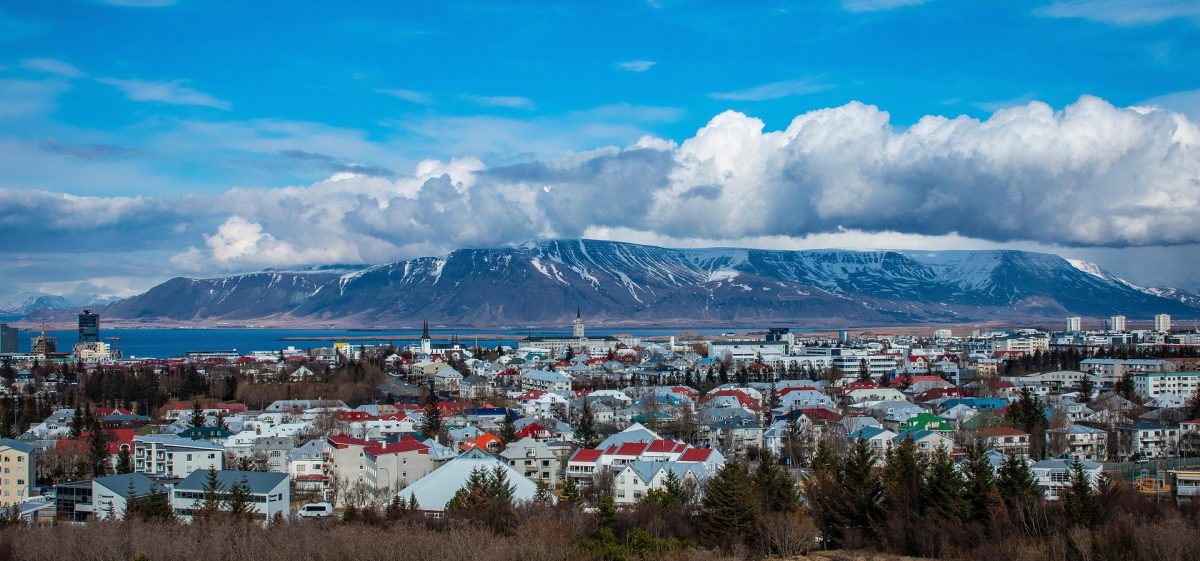
The local Finnish newspaper Turun Sanomat is our partner in the Baltic Sea Region Forum. As part of this cooperation, Turun Sanomat publishes articles written by experts participating in the Forum. The series begins with a piece by Professor Valur Ingimundarson of the University of Iceland, focusing on Iceland’s role in Arctic geopolitics.
From Ukraine to Greenland: Iceland and Arctic Geopolitics
Iceland is currently grappling with the geopolitical rupture stemming from the Trump Administration’s questioning of U.S. alignment with Europe, its accommodation of Russia, and its Arctic territorial designs on Greenland. The Icelandic response can be described in terms of “instrumental ambiguity”: it recognizes Iceland’s structural dependence on the United States, while realizing that Trump’s unilateral agenda may detrimentally affect its foreign policy interests. On the one hand, Iceland remains committed to the 1951 U.S.–Icelandic Defense Agreement and a continued rotational American military presence. On the other, it is forging closer links with European NATO states, Canada, and the EU through existing bilateral security agreements and prospective new ones, even if they do not involve defense guarantees. When, in early 2026, European NATO members—including France, Germany, Sweden, and Norway, took part in a highly symbolic military training mission in Greenland intended to signal support for the Danes and Greenlanders against U.S. threats— Iceland was involved in a civilian capacity. The decision reflected Iceland’s backing for Greenland’s right to self-determination and the territorial integrity of the Kingdom of Denmark. This tilt toward Europe has been further strengthened by a government proposal to hold a referendum in the fall on the resumption of Iceland’s EU accession talks, which were suspended in 2015.
What this suggests is that Iceland is seeking to hedge against the United States in case of disengagement or decoupling from Europe. It is not about shifting alignment but about reducing reliance on U.S. power. During the Cold War, Iceland was associated with North Atlantic and Arctic militarization as part of its integration into NATO and the global U.S. base network. Having temporarily lost its strategic value for the United States after the disintegration of the Soviet Union, Iceland subscribed fully to a narrative of post–Cold War cooperation. Whereas the North Atlantic was not written off as a potential conflict area, the Arctic was portrayed as a peaceful one. Yet this exceptionalist rhetoric, whereby the Arctic was outside the framework of great-power rivalries, was destabilized after Russia’s 2014 annexation of Crimea and was abandoned after its 2022 invasion of Ukraine. As a result, Iceland’s security policy once again became part of a Cold War–style Western balancing posture vis-à-vis Russia symbolized by the revival of the “GIUK Gap” (Greenland–Iceland–United Kingdom gap)—the strategic military chokepoint marking Russian military access from the Arctic to the Atlantic.
This policy has now been upended by the Trump Administration’s foreign and security policies. It also reflects an awareness that Western cohesion could be significantly undermined in the event of a U.S.–Russian rapprochement, which in the Arctic could revolve around joint ventures in natural resource exploitation or geopolitical attempts to carve up the region in a throwback to the nineteenth–century doctrine of spheres of influence. To be sure, the U.S.–Icelandic Defense Agreement has not been directly affected by the Trump Administration’s expansionist rhetoric. Yet when the designated U.S. ambassador to Iceland jested in Congress that Iceland could become the 52nd state of the United States, it prompted immediate political criticism. Nor did it sit well with Icelanders when President Trump mentioned Iceland four times in a speech reinforcing his desire to take over Greenland, even if he misspoke. Any move against Greenland would not only trigger a crisis in U.S.–Icelandic relations; it could also result in a major backlash against the presence of U.S. troops in Iceland.
As the Arctic and North Atlantic have increasingly merged into a single political and military theater, Iceland has sought to preserve its century-old unarmed identity while adjusting to renewed geopolitical contestation. When Iceland joined NATO in 1949, it did so on the condition that it would not establish its own armed forces but would make its territory available to Allied forces in wartime. Its strategy still rests on sustaining a U.S. defense link while deliberately widening security cooperation with European allies and Canada. This is not disengagement but recalibration: a recognition that the central determinant of Iceland’s security policy is currently the contested direction of American power and the fracture in U.S.–European relations.
Valur Ingimundarson
Professor
University of Iceland