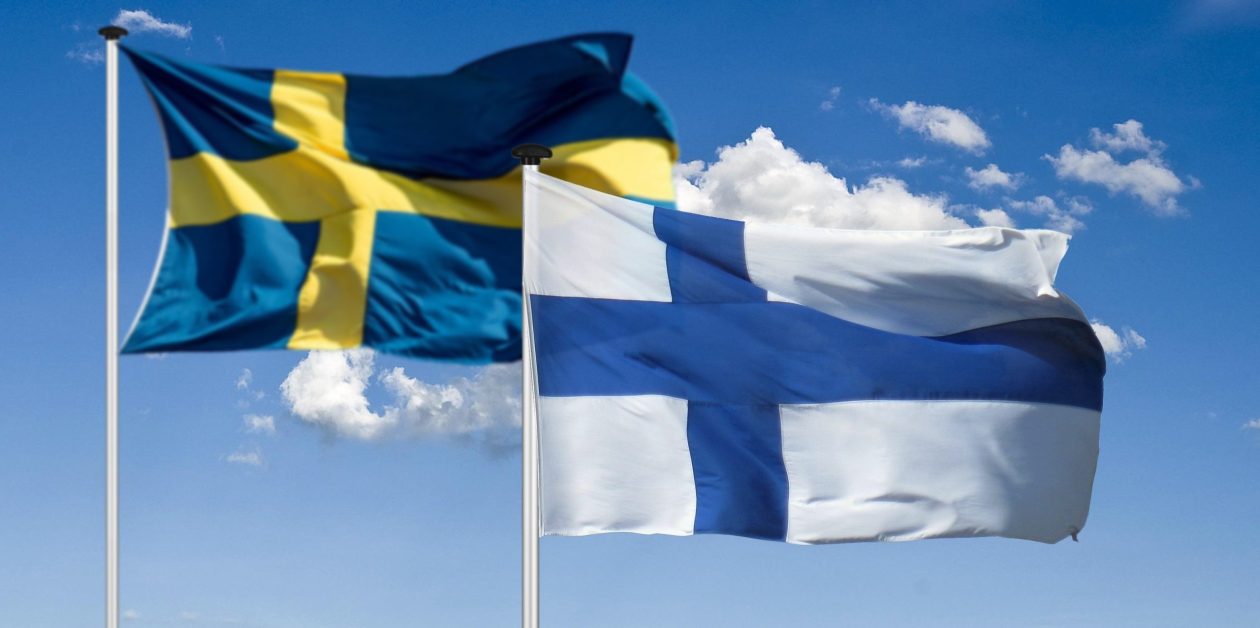
Russia’s full-scale invasion of Ukraine has brough Sweden and Finland closer together than ever before since the two countries separated in 1809. When Sweden hopefully soon joins Finland as a Nato member, the two countries will again be bound to each other by security guarantees.
Sweden and Finland do not only bring strong military capabilities to Nato. Their accession also adds two of the world’s most innovative and well-functioning economies to the Nato family – an important asset in its own right.
Openness to trade and investment is a key base for Sweden’s and Finland’s economic standing. A critical question is therefore: how should Finland and Sweden act in order to maintain their positions as competitive trade leaders in the EU and Nato as well as globally, given present geopolitical challenges and global economic uncertainties?
Evidence shows that openness to trade spur productivity, competitiveness and innovation. Thus, it is evident that Finland and Sweden have a strong joint interest in maintaining openness for international trade and a well-functioning EU single market, despite contemporary challenges.
Consequently, as EU members, Finland and Sweden should continue to cooperate to influence the EU common trade policy in a liberal direction.
This is presently a tall order, both for EU-internal and global reasons. Brexit has substantially weakened the pro-liberal trade camp in the EU. Globally, the United States has abdicated from trade leadership. It has securitized its trade relations due to rivalry with China and it is rejecting traditional free trade arrangements, as they are deemed to harm American workers. From this position, the US has rendered the dispute settlement function of the World Trade Organization (WTO) useless and dismissed agreements on new trade openings.
Nevertheless, Sweden and Finland have a strong interest in WTO and in making sure that the EU continues to be the prime guardian of the global trading system.
In addition, Sweden and Finland should continue to support EU negotiations for the completion of new free trade agreements with suitable partners. The recently finalized agreement with New Zealand might not cover large trade volumes, but it is a good model for additional agreements, such as the forthcoming one with Australia. Up-dated agreements with Chile and Mexico are under way. Hopefully, a deal can soon also be closed with Mercosur (Argentina, Brazil, Paraguay and Uruguay). If possible, agreements with India, Indonesia, Malaysia, the Philippines and Thailand would also be welcomed.
Under present geopolitical conditions, trade openness between reliable partners remain key. The National Board of Trade Sweden has therefore proposed closer trade links between the EU and the Pacific countries that are united in the Comprehensive and Progressive Trans-Pacific Partnership (CPTPP), including through use of relevant rules of origin.
The lack of an open Transatlantic market can be seen as the missing link in the present security architecture. It makes sense for Sweden and Finland to continue to back an EU-US free trade pact, despite the present lack of support in Washington. Meanwhile the two countries should promote facilitation of trade and investment through the EU-US Trade and Technology Council, the hopefully upcoming deal on strategic commodities and similar means.
As a new European Commission and European Parliament will begin their five years mandates in 2024, Sweden and Finland should do their utmost to influence the newcomers to maximize the gains from trade.
Fostering competitiveness was a key theme of Sweden’s EU presidency in the first half of 2023. It is also an EU priority for Finland, as stated by Prime Minister Petteri Orpo at the Turku Europe Forum. Sweden and Finland should seek to withstand the temptation to pursue single market policy through sector-by-sector approaches, as the present Commission is inclined. The Single Market is subject to increased fragmentation, which needs to be halted. The drive to reduce over-regulation should be supported, as should the Commission proposal for setting-up national “Single Market Offices” to address single market barriers.
In this context it also makes sense to look at the Nordic region which has the vison to become the most sustainable and integrated region in the world by 2030. Fulfillment of the vision would establish a Nordic role model for other EU regions to follow, since Nordic integration takes place in accordance with EU-legislation, under which Norway and Iceland partially form part as members of the European Economic Area (EEA).
In a report from 2022 the National Board of Trade Sweden proposes closer Nordic integration in the area of trade through mutual recognition of goods, closer cooperation in standardization, on free movement for services and between Nordic Solvit-centers. In addition, it is proposed that the Nordic countries improve cooperation on implementation of relevant EU directives in order to minimize discrepancies. To the extent proposals like these cannot be implemented by all five Nordic countries, Sweden and Finland could go ahead bilaterally and show a path forward for the others to follow.
Anders Ahnlid
Director General
National Board of Trade
Sweden
anders.ahnlid@kommerskollegium.se